Class 06 Science - Living Creatures
NCERT Biology Exercises for Class 06 Science - Living Creatures
Class 06 Science - Living Creatures: Exploring their Characteristics
Exercises
1. List the similarities and differences in life cycles of plants and animals.
Answer:
- Similarities:
- Both start from a "beginning" stage (seed in plants, egg or newborn in animals).
- Both undergo growth and development over time.
- Both reach a mature stage where they can reproduce to ensure the continuity of their kind.
- Both eventually age and die.
- Differences:
- Plants: Often go through a dormant stage as a seed. They produce flowers and fruits to reproduce.
- Animals: Often go through distinct larval stages (like mosquitoes and frogs) where the young look very different from adults.
2. Study the data and find out examples.
| S. no. | Does it grow? | Does it respire? | Example | Remarks |
|---|---|---|---|---|
| 1. | No | No | Pencil / Stone | Non-living objects do not grow or respire. |
| 2. | No | Yes | Not possible | Growth and respiration are both essential traits of life. |
| 3. | Yes | No | Crystal (e.g., Alum) | Crystals can "grow" in size, but they do not respire (not living). |
| 4. | Yes | Yes | Plant / Animal | Essential characteristics of all living beings. |
3. How can we use the knowledge of conditions required for seed germination for proper storage of grains and pulses?
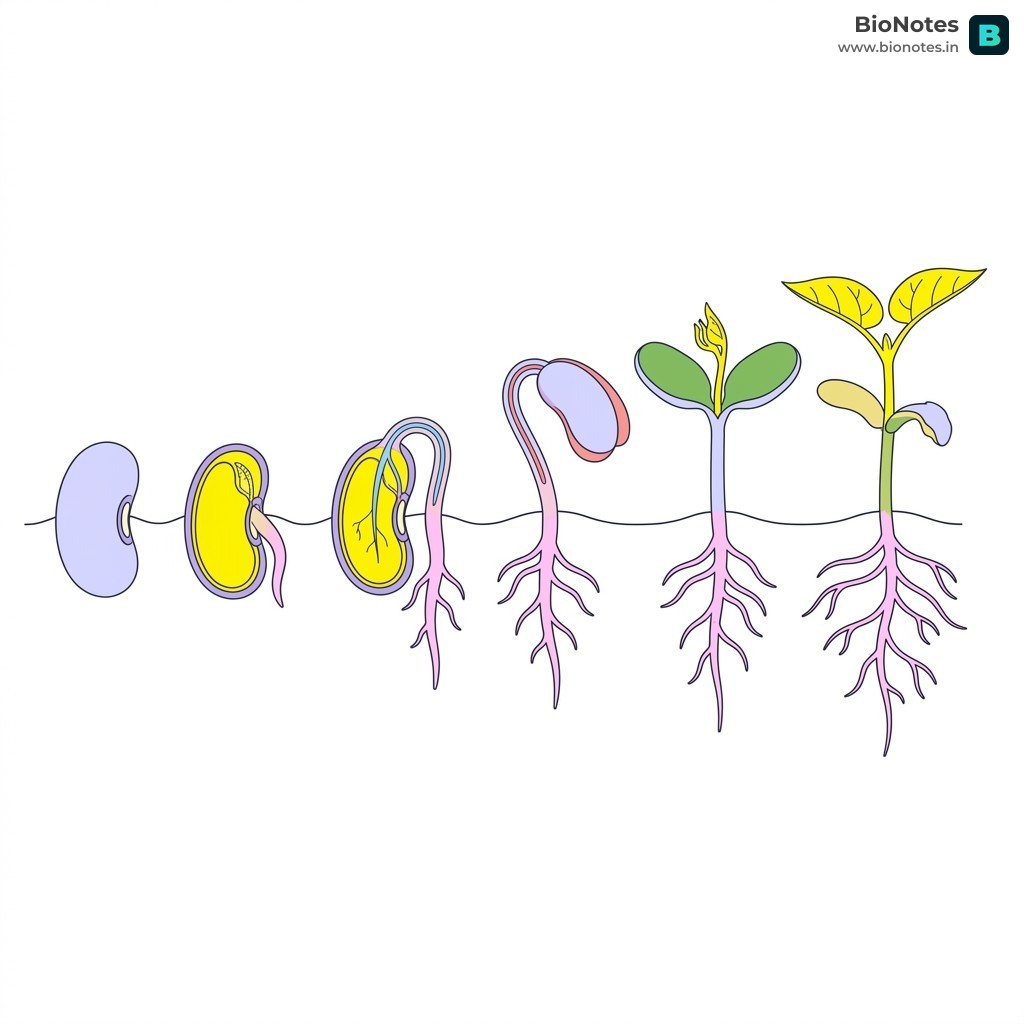
Answer: Seeds require water (moisture) and air to germinate. To prevent grains and pulses from germinating or rotting during storage, we must:
- Store them in a dry place to avoid moisture.
- Use air-tight containers to limit the supply of air.
- Keep them in cool conditions to slow down any biological activity.
4. You have learnt that a tail is present in a tadpole but it disappears as it grows into a frog. What is the advantage of having a tail in the tadpole stage?
Answer: Tadpoles live exclusively in water. The tail is an adaptation that helps them swim efficiently, much like a fish, to find food and escape predators. Once they develop legs and move to land as frogs, the tail is no longer needed and is absorbed.
5. Charan says a wooden log is non-living (no movement). Charu says it is living (obtained from trees). Give your arguments.
Answer:
- Argument: A wooden log is non-living, but it was once part of a living being.
- Reasoning: While the tree it came from was living (showing growth, respiration, etc.), the log itself no longer performs any life processes. It does not breathe, grow, respond to stimuli, or reproduce. Therefore, Charan is correct that it is now non-living, and Charu is correct about its origin, but being "made of wood" doesn't make the log currently alive.
6. What are the similarities and distinguishing features in the life cycles of a mosquito and a frog?
Answer:
- Similarities:
- Both lay eggs in or near water.
- Both go through a series of stages that look very different from the adult (Metamorphosis).
- Both have aquatic young stages (larva/pupa for mosquito, tadpole for frog).
- Distinguishing Features:
- Mosquito: 4 stages (Egg → Larva → Pupa → Adult).
- Frog: 4 main stages (Egg → Tadpole → Froglet → Adult). Tadpoles have tails and gills, while adult frogs have legs and lungs.
7. A plant pot is kept along the ground (horizontally). Draw what you expect to see after one week.
Answer:
- Observation: The shoot will bend and start growing upwards (towards sunlight/away from gravity). The root will bend and start growing downwards (towards gravity).
- Reason: This happens due to the plant's response to gravity (geotropism) and light (phototropism). Shoots are negatively geotropic, while roots are positively geotropic.
8. Tara and Vijay set up an experiment with a plant in a box with a small hole for light. What do they want to find out?
Answer: They want to find out if the direction of light affects the direction of plant growth. They will know they are correct if the shoot of the plant bends and grows towards the hole (the source of light).
/CBSE/NCERT/Exercises/Class_06_Science/Chapter_10_Living_Creatures.mdx