BioNotes
CBSE/NCERT/Notes/Class_07_Science

Life Processes in Animals

Note on Nutrition and Respiration in Animals (Chapter 9)

Life Processes in Animals

Key Concepts

Nutrition in Animals

Animals obtain energy from food containing complex components (carbohydrates, proteins, fats).

  • Digestion: The process of breaking down complex food components into simpler forms.
  • Human Digestive System:
    • Alimentary Canal: Mouth → Oesophagus → Stomach → Small Intestine → Large Intestine → Rectum → Anus.
    • Mouth: Mechanical digestion (chewing) and chemical digestion (saliva breaks starch into sugar).
    • Stomach: Churns food; secretes acid (kills bacteria) and digestive juices (breaks proteins). Mucus protects the stomach wall.
    • Small Intestine: ~6 metres long. Receives bile (from liver, neutralizes acid/digests fats) and pancreatic juice (from pancreas). Digested nutrients are absorbed by finger-like villi.
    • Large Intestine: ~1.5 metres long. Absorbs water and salts. Waste stored in rectum and expelled via anus (egestion).

Digestive Adaptations in Other Animals

  • Ruminants (e.g., Cows): Swallow grass partially chewed into the rumen. Food is later brought back to the mouth as cud for thorough chewing (rumination).
  • Birds: Have a gizzard where food is crushed with the help of swallowed grit (small stones).

Respiration in Animals

The process of breaking down nutrients (like glucose) to release energy.

  • Breathing vs. Respiration:
    • Breathing: Physical process of inhaling (O2 rich air) and exhaling (CO2 rich air).
    • Respiration: Chemical process inside cells: Glucose + Oxygen → Carbon dioxide + Water + Energy.
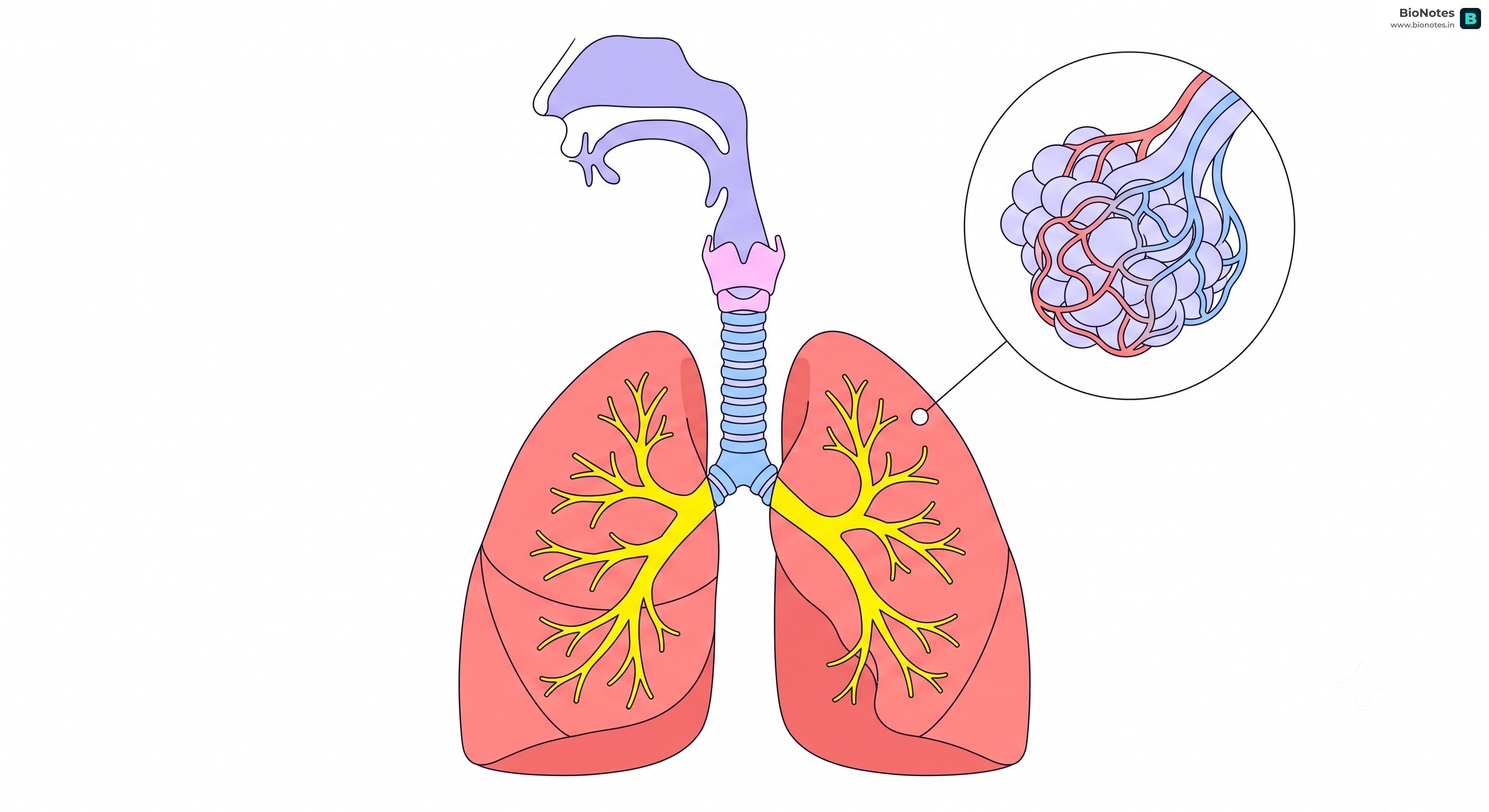
  • Human Respiratory System:
    • Pathway: Nostrils → Nasal passage (hair/mucus trap dust) → Windpipe (trachea) → Lungs → Alveoli (balloon-like sacs where gas exchange occurs).
  • Mechanism of Breathing:
    • Inhalation: Ribs move out, diaphragm moves down, increasing space; air enters.
    • Exhalation: Ribs move back, diaphragm moves up, decreasing space; air is forced out.

Breathing in Other Animals

  • Fish: Use gills to exchange gases dissolved in water.
  • Frogs: Use lungs on land; use moist skin in water.
  • Earthworms: Exchange gases through their moist skin.
  • Birds/Mammals: Use lungs.

Circulatory System

Includes the heart, blood, and blood vessels. Transports nutrients and oxygen to all body parts and removes waste.

  • Note on Smoking: Extremely harmful; damages lungs and causes respiratory illnesses. Affects others via passive smoking.
Location:/CBSE/NCERT/Notes/Class_07_Science/Chapter_09_Life_Processes_in_Animals.mdx

Created by Titas Mallick

Biology Teacher • M.Sc. Botany • B.Ed. • CTET Qualified • 10+ years teaching experience