BioNotes
CBSE/NCERT/Notes/Class_08_Science

Chapter 2: The Invisible Living World: Beyond Our Naked Eye - Notes

Detailed notes on NCERT Class 8 Science Chapter 2

Chapter 2: The Invisible Living World: Beyond Our Naked Eye

Key Concepts

Discovery of the Invisible World

For a long time, the microscopic world was hidden from human eyes. The invention of lenses and microscopes changed this.

  • Robert Hooke (1665): Using a primitive microscope, he observed thin slices of cork and saw small, empty compartments resembling a honeycomb. He called these "cells" (Latin for "little room").
  • Antonie van Leeuwenhoek (1660s): A Dutch scientist who crafted superior lenses. He was the first to see and describe living cells like bacteria and blood cells. He is known as the Father of Microbiology.

The Cell: The Basic Unit of Life

Every living organism is made of one or more cells.

  • Unicellular Organisms: Made of a single cell that performs all life functions (e.g., Bacteria, Amoeba, Paramecium, Yeast).
  • Multicellular Organisms: Made of many cells that coordinate with each other (e.g., Humans, Plants, Fungi like bread mould).
  • Levels of Organization: Cell → Tissue → Organ → Organ System → Organism
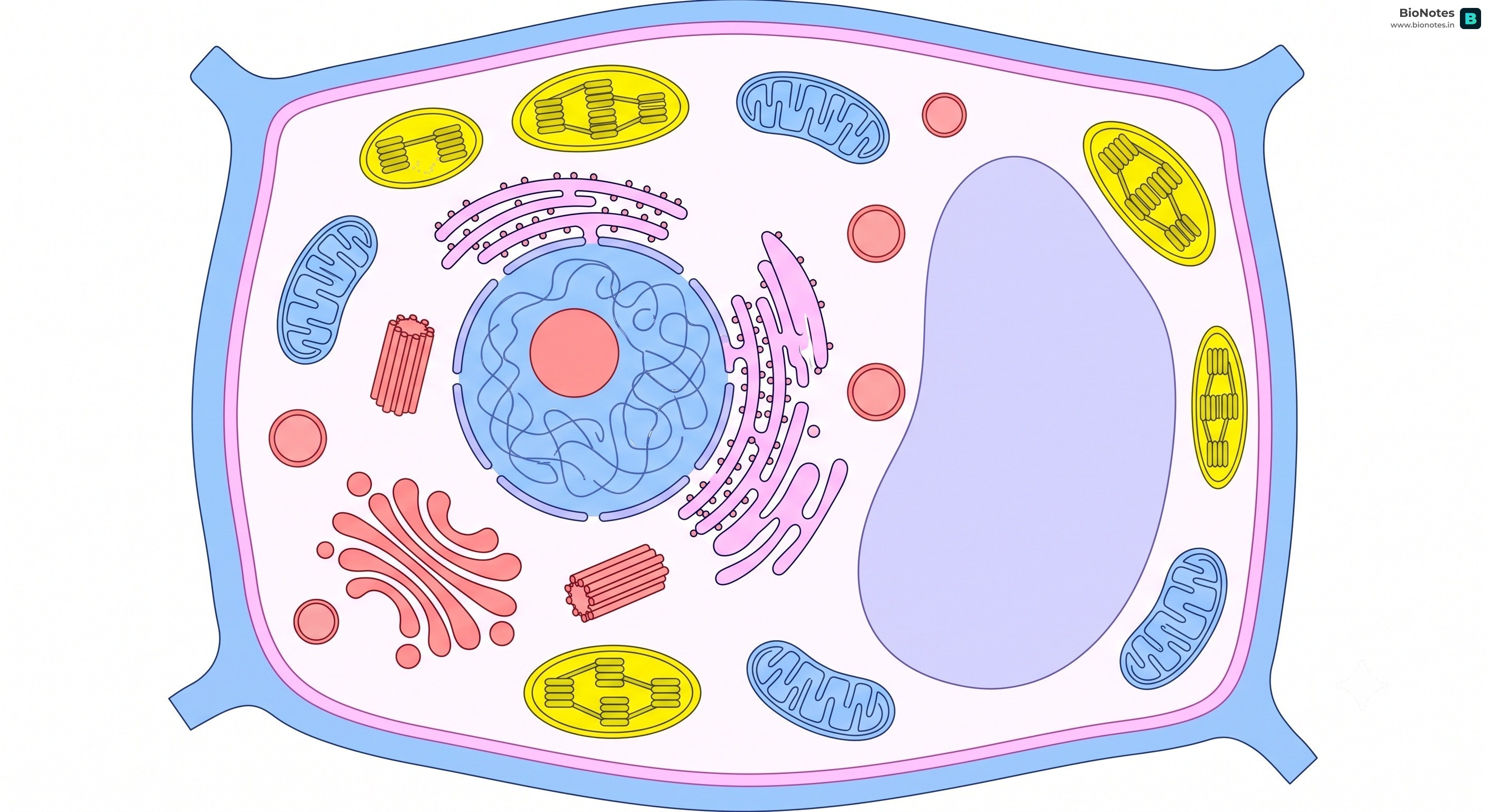
Cell Structure and Variation

Cells vary in shape and size depending on their function.

  1. Muscle Cells: Spindle-shaped and flexible to help in contraction and relaxation (movement).
  2. Nerve Cells (Neurons): Long and branched to carry messages across the body quickly.
  3. Cheek Cells: Polygon-shaped and flat to form a protective inner lining.
  4. Onion Peel Cells: Compact and rectangular for structural support.
  5. Ostrich Egg Yolk: The largest known single cell (130-170 mm).

Parts of a Cell

  • Cell Membrane: The thin outer layer that surrounds the cell.
  • Cytoplasm: The jelly-like substance inside the cell membrane where all cell activities occur.
  • Nucleus: The "control center" that regulates growth and cell activities.
  • Cell Wall: A rigid outer layer found only in plant, bacterial, and fungal cells. It provides strength and structure.
  • Nucleoid: In bacteria, there is no well-defined nucleus; instead, genetic material is in a region called the nucleoid.
  • Plastids (e.g., Chloroplasts): Found in plant cells; contain chlorophyll for photosynthesis.
  • Vacuole: A large empty-looking space in plant cells for storage and support. In animal cells, they are small or absent.

Microorganisms (Microbes)

Microbes are tiny organisms invisible to the naked eye. They are classified into:

  • Protozoa: e.g., Amoeba, Paramecium.
  • Algae: e.g., Spirogyra, Chlorella.
  • Fungi: e.g., Yeast, Bread mould, Mushrooms.
  • Bacteria: e.g., Lactobacillus, Rhizobium.
  • Viruses: Microscopic and acellular. They only reproduce inside the cells of a host organism.

Beneficial Role of Microbes

Microorganisms are essential for life on Earth and play several key roles:

  1. Cleaning the Environment: Fungi and bacteria act as decomposers, breaking down dead plants and animals into simpler nutrients (manure), thus recycling matter.
  2. In the Kitchen:
    • Yeast (Fungi): Respires and releases Carbon Dioxide ($CO_2$), making dough (for bread, idlis, cakes) fluffy and soft.
    • Lactobacillus (Bacteria): Converts milk sugar (lactose) into lactic acid to form curd.
  3. Nitrogen Fixation: Rhizobium bacteria in the root nodules of legumes (peas, beans) trap atmospheric nitrogen and convert it into nutrients for plants, enriching the soil naturally.
  4. Energy Production (Biogas): Bacteria decompose waste in an oxygen-free environment to produce biogas (mainly methane), used as fuel.
  5. Microalgae: Organisms like Spirulina (a "superfood") produce more than half of the Earth's oxygen and are used as nutrient-rich supplements.
  6. Oil Spill Cleanup: Scientists like Ananda Mohan Chakrabarty developed special bacteria to break down oil spills.
Location:/CBSE/NCERT/Notes/Class_08_Science/Chapter_02_The_Invisible_Living_World.mdx

Created by Titas Mallick

Biology Teacher • M.Sc. Botany • B.Ed. • CTET Qualified • 10+ years teaching experience