Class 5
Created by Titas Mallick
Biology Teacher • M.Sc. Botany • B.Ed. • CTET (CBSE) • CISCE Examiner
 BioNotes
Created by Titas Mallick
Biology Teacher • M.Sc. Botany • B.Ed. • CTET (CBSE) • CISCE Examiner
Online
Common Misconceptions
Watch Out! Insects and plants are best friends. Remember:
 www.bionotes.in
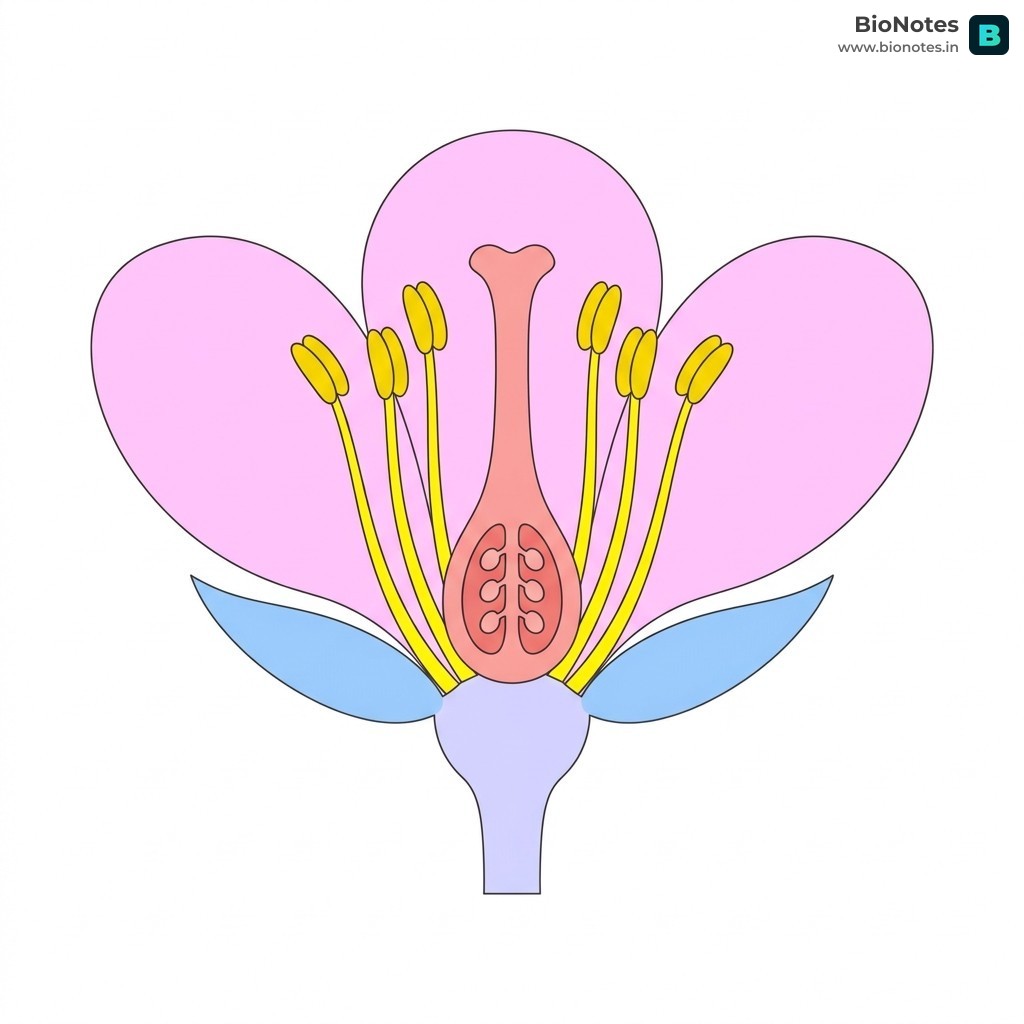
To understand pollination, it's important to know the main reproductive parts of a flower. A "complete" flower has four main parts: sepals, petals, stamens, and carpels (or pistil).
Vegetative Parts:
Reproductive Parts:
Pollination is the transfer of pollen from the male part (anther) to the female part (stigma) of a flower. This process is essential for fertilization and the subsequent production of seeds and fruits.
The key steps in the pollination process are:
Pollination can be broadly classified into two main types: self-pollination and cross-pollination.
Wait, is it Self or Cross? Biologically, Geitonogamy is cross-pollination because it uses a pollinator (like a bee), but genetically it is self-pollination because both flowers belong to the same parent plant!
Flowers can be classified based on the presence of male and female reproductive organs:
Bisexual Flowers (Hermaphroditic/Complete Flowers): These flowers possess both male reproductive parts (stamens) and female reproductive parts (carpels/pistil) within the same flower.
Unisexual Flowers (Incomplete Flowers): These flowers contain either stamens (male flower) or carpels (female flower), but not both.
Pollination is a fundamental ecological function vital for both human livelihoods and the health of terrestrial ecosystems.
For Food Production:
For Biodiversity:
NGSS-MS-LS1-4AQA-KS2-BiologyIB-PYP-Science