Class 09 Biology - Reproduction - Exercises
NCERT Biology Exercises for Class 09 Biology - Reproduction - Class_09_Science
Class 09 Biology - Reproduction - Exercises
Questions and Answers
1. A flower’s anthers are removed before it matures. Later, pollen from another plant of the same species is dusted onto its stigma and seeds are produced. Which process has been ensured here?
(i) Self-pollination (ii) Cross-pollination (iii) Fertilisation (iv) Tissue culture Answer: (ii) Cross-pollination. (The removal of anthers, called emasculation, prevents self-pollination, and the addition of external pollen ensures cross-pollination).
2. Arrange the following stages of sexual reproduction in plants in the correct order:
(i) Pollen germination on stigma (ii) Fertilisation (iii) Pollination (iv) Formation of zygote Answer: (iii) Pollination → (i) Pollen germination on stigma → (ii) Fertilisation → (iv) Formation of zygote.
3. Assertion (A): The zygote formed after fertilisation immediately attaches to the uterus wall.
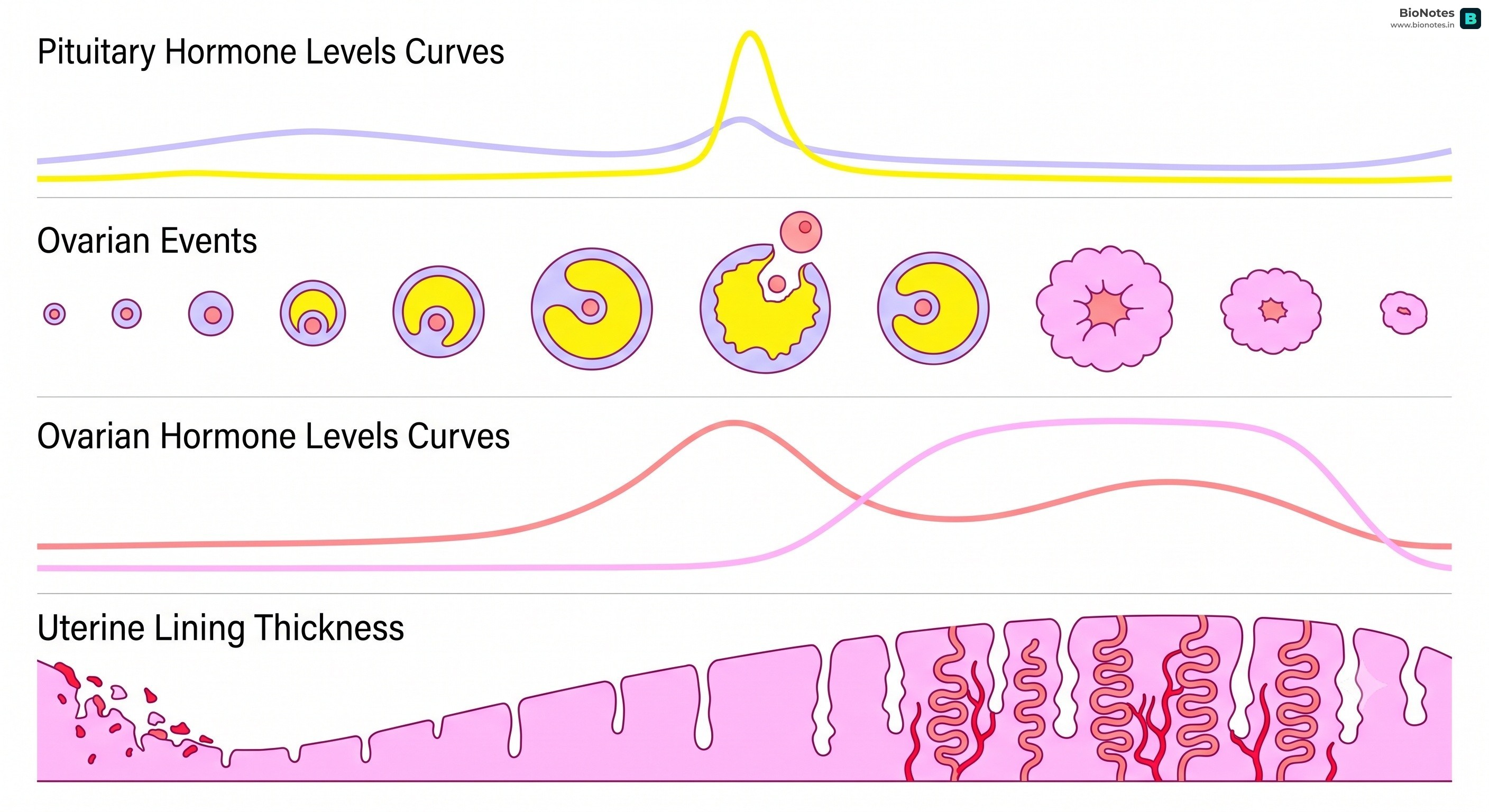
Reason (R): The uterus wall is always prepared to receive the zygote. Answer: (iii) (A) is true, but (R) is false. (The zygote attaches after several divisions, but the uterus wall is not always prepared; it only becomes thick and ready during a specific phase of the menstrual cycle following ovulation).
4. Why does asexual reproduction produce offspring that are genetically identical to the parent?
Answer: Asexual reproduction involves only one parent and does not involve the fusion of gametes. The offspring are produced through mitotic divisions, ensuring that the genetic material is copied exactly from the parent to the offspring without any mixing or recombination.
5. Explain why the menstrual cycle stops during pregnancy.
Answer: During pregnancy, the levels of hormones like progesterone remain high to maintain the thick uterine lining for the developing foetus. These high hormone levels inhibit the release of more eggs (ovulation) and prevent the shedding of the uterine lining (menstruation).
6. Why are flowers that bloom at night white or light in colour as compared to flowers that bloom during the day?
Answer: Night-blooming flowers do not need bright colors to attract pollinators as they are not visible in the dark. Instead, being white or light-colored makes them more visible in moonlight, and they often use strong fragrances to attract nocturnal pollinators like moths and bats.
7. Why do vegetatively propagated plants tend to be more vulnerable to diseases than sexually reproduced plants?
Answer: Vegetatively propagated plants are genetically identical clones of the parent. Because there is no genetic variation, if a particular disease or environmental stress affects one plant, it is likely to affect the entire population. Sexually reproduced plants have genetic variations that may provide some individuals with resistance.
8. If all flowers in a type of plant were only capable of self-pollination, how would it affect the genetic diversity over several generations?
Answer: Genetic diversity would significantly decrease because no new genetic material is being introduced from other plants. Over generations, this can lead to the accumulation of harmful recessive traits and a reduced ability for the species to adapt to changing environments.
9. A farmer wants to produce a large number of genetically identical plants quickly. Suggest suitable reproduction methods.
Answer: Tissue culture or cuttings are the most effective methods. Tissue culture allows for the mass production of thousands of identical plantlets from a small piece of tissue in a sterile laboratory environment. Cuttings are a simpler, faster way to propagate plants like sugarcane or rose while maintaining identical traits.
10. Pollen germination experiment:
(i) What hypotheses can be tested? Answer: "Pollen germination is most successful at a specific sugar concentration" or "High sugar concentrations inhibit pollen tube growth due to osmotic stress." (ii) What parameters should be kept the same? Answer: Temperature, type of pollen grains, age of the pollen, and the volume of the sugar solution on each slide.
11. Pollination types in:
- Tomato: Primarily self-pollination (stamens cover the stigma).
- Wheat: Wind-pollination or self-pollination (flowers often open after pollination).
- Papaya: Cross-pollination (since male and female flowers are often on separate trees).
12. Apple Orchard Experiment:
(i) Hypotheses? Answer: "Active beekeeping increases fruit yield in apple orchards" and "Natural pollinators are insufficient for maximum fruit set in changing climates." (ii) Parameters? Answer: Number of bee colonies (in Place B), variety of apple trees, and environmental conditions (temperature/rainfall). (iii) Analysis? Answer: Place B (with beekeeping) shows a higher percentage of fruit set and a lower percentage of fruit drop compared to Place A (natural pollinators). (iv) Inference? Answer: Beekeeping enhances pollination efficiency, leading to better fruit development and higher yields.
13. "Ovulation always happens on day 14." Critically examine.
Answer: This claim is incorrect.
- Cycle Variation: Menstrual cycles vary in length (21–35 days); ovulation typically occurs 14 days before the next period, not necessarily 14 days after the start of the last one.
- Hormonal/External Factors: Stress, illness, and hormonal imbalances can delay or accelerate the maturation of an egg, causing ovulation to happen earlier or later.
/CBSE/NCERT/Exercises/Class_09_Science/Chapter_11_Reproduction.mdxClass 09 Biology - Tissues in Action - Exercises
NCERT Biology Exercises for Class 09 Biology - Tissues in Action - Class_09_Science
Class 09 Biology - Patterns in Life: Diversity and Classification - Exercises
NCERT Biology Exercises for Class 09 Biology - Patterns in Life: Diversity and Classification - Class_09_Science