Living Creatures
Notes on Living Creatures for Class 6 Science
Living Creatures: Exploring their Characteristics
Key Concepts
Living vs. Non-Living
Objects in our surroundings can be classified as living or non-living. Living beings share a set of essential characteristics that distinguish them from non-living things.
Essential Characteristics of Living Beings
- Movement: All living beings show movement. While animals move from place to place (locomotion), plants show movement in parts, such as the opening of flowers or the trapping of insects by insectivorous plants like Drosera.
- Growth: Living beings increase in size over time. This is a permanent and irreversible process.
- Nutrition: Living beings need food for energy, growth, and the repair of body parts.
- Respiration: A process by which living beings obtain energy from food. It involves breathing (inhaling and exhaling air). Plants respire through tiny pores called stomata on their leaves.
- Excretion: The removal of waste products (like sweat, urine, or excess water in plants) from the body.
- Response to Stimuli: Living beings respond to changes in their environment (stimuli). Example: The Touch-me-not (Mimosa) plant folds its leaves when touched.
- Reproduction: The process of producing new individuals of one's own kind to ensure the continuity of life.
- Death: The final stage of life where all biological activities cease.
Seed Germination
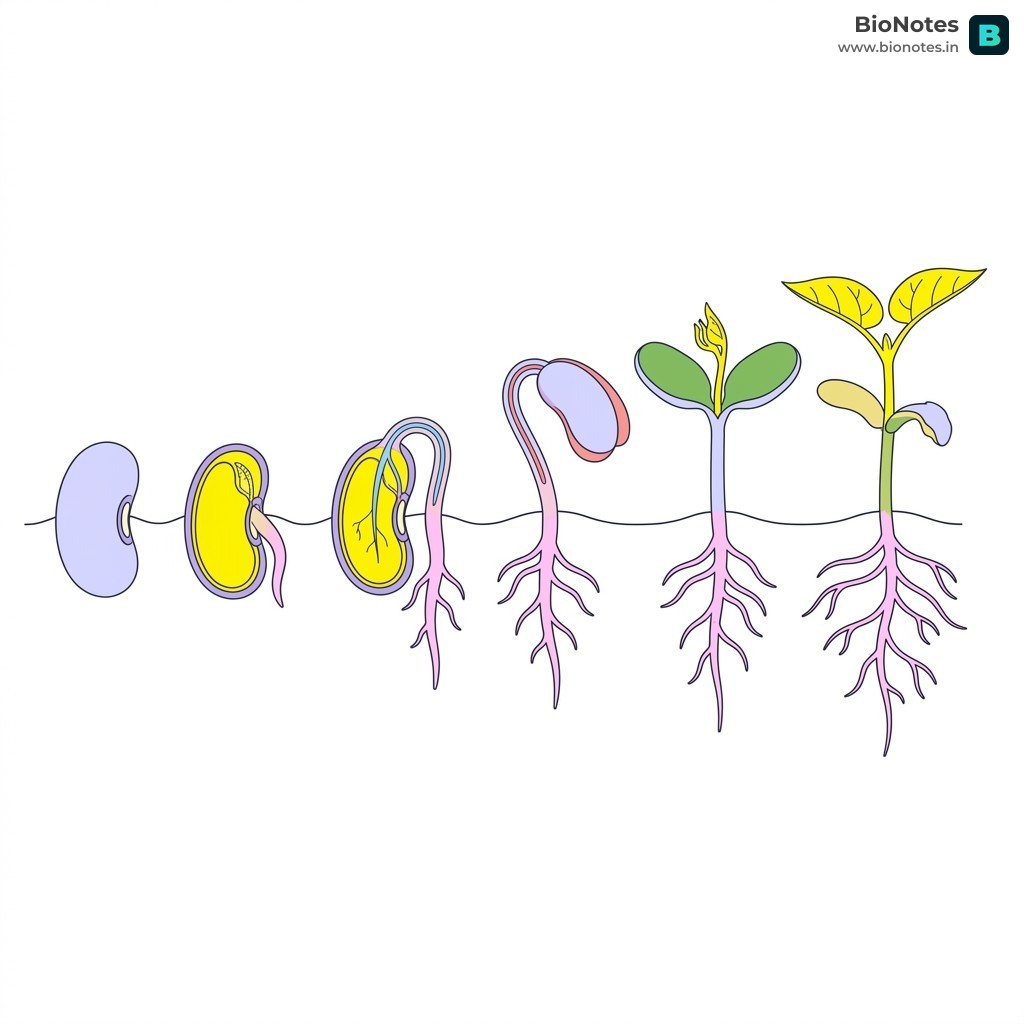
A seed is a living entity in a dormant state. Germination is the process where a seed turns into a young plant (sprout).
- Conditions Required:
- Water: Softens the seed coat and activates the embryo.
- Air: Provides oxygen for respiration in the spaces between soil particles.
- Soil: Provides space and support for roots.
- Light/Darkness: Most seeds do not require light for the initial stage of germination, but sunlight is essential for the growth of the seedling into a plant.
Growth and Movement in Plants
- Direction of Growth:
- Shoots: Generally grow upwards towards sunlight (Phototropism).
- Roots: Generally grow downwards into the soil towards gravity (Geotropism).
- Scientific Contribution: Jagadish Chandra Bose used an instrument called the crescograph to demonstrate that plants sense and respond to stimuli like light, heat, and electricity.
Life Cycle of a Plant
The journey from a seed to a mature plant that produces new seeds: Seed → Germination → Seedling (Leaves appear) → Mature Plant (Flowers appear) → Fruit/Seed Production → Death.
Life Cycle of Animals
Many animals undergo significant changes in body shape and structure during their development (Metamorphosis).
Life Cycle of a Mosquito
Mosquitoes pass through four distinct stages:
- Egg: Laid in or near stagnant water.
- Larva: A worm-like stage that lives in water and breathes air at the surface.
- Pupa: A non-feeding stage where the transformation into an adult occurs.
- Adult: The flying insect stage.
- Prevention: Spraying kerosene oil on stagnant water forms a layer that blocks air, killing larvae and pupae.
Life Cycle of a Frog
Frogs also have an aquatic young stage:
- Egg (Spawn): A jelly-like cluster of eggs.
- Embryo: Developed within the egg.
- Tadpole: Has a tail and gills for swimming and breathing in water.
- Froglet: Develops legs but still has a small tail; begins to spend time on land.
- Adult Frog: Lives both on land and in water; breathes through lungs and skin.
Activities
- Classify surrounding objects as living or non-living based on life characteristics.
- Experiment with seeds to identify the essential conditions for germination.
- Observe the direction of growth in a plant placed near a window or horizontally.
- Audit your surroundings for stagnant water and observe mosquito life stages.
/CBSE/NCERT/Notes/Class_06_Science/Chapter_10_Living_Creatures.mdx