Class 8
Created by Titas Mallick
Biology Teacher • M.Sc. Botany • B.Ed. • CTET (CBSE) • CISCE Examiner
 BioNotes
Created by Titas Mallick
Biology Teacher • M.Sc. Botany • B.Ed. • CTET (CBSE) • CISCE Examiner
Online
An ecosystem is a community of living organisms (biotic components) interacting with their non-living (abiotic) environment. These interactions form a system where energy and nutrients are transferred. The term "ecosystem" was first used by English botanist A.G. Tansley in 1935.
Common Misconceptions
Watch Out! Ecosystems are delicate balancing acts:
Did You Know? The Earth is a closed system for matter (meaning all the atoms we have now are the same ones we've had for billions of years) but an open system for energy, as we constantly receive new energy from the Sun.
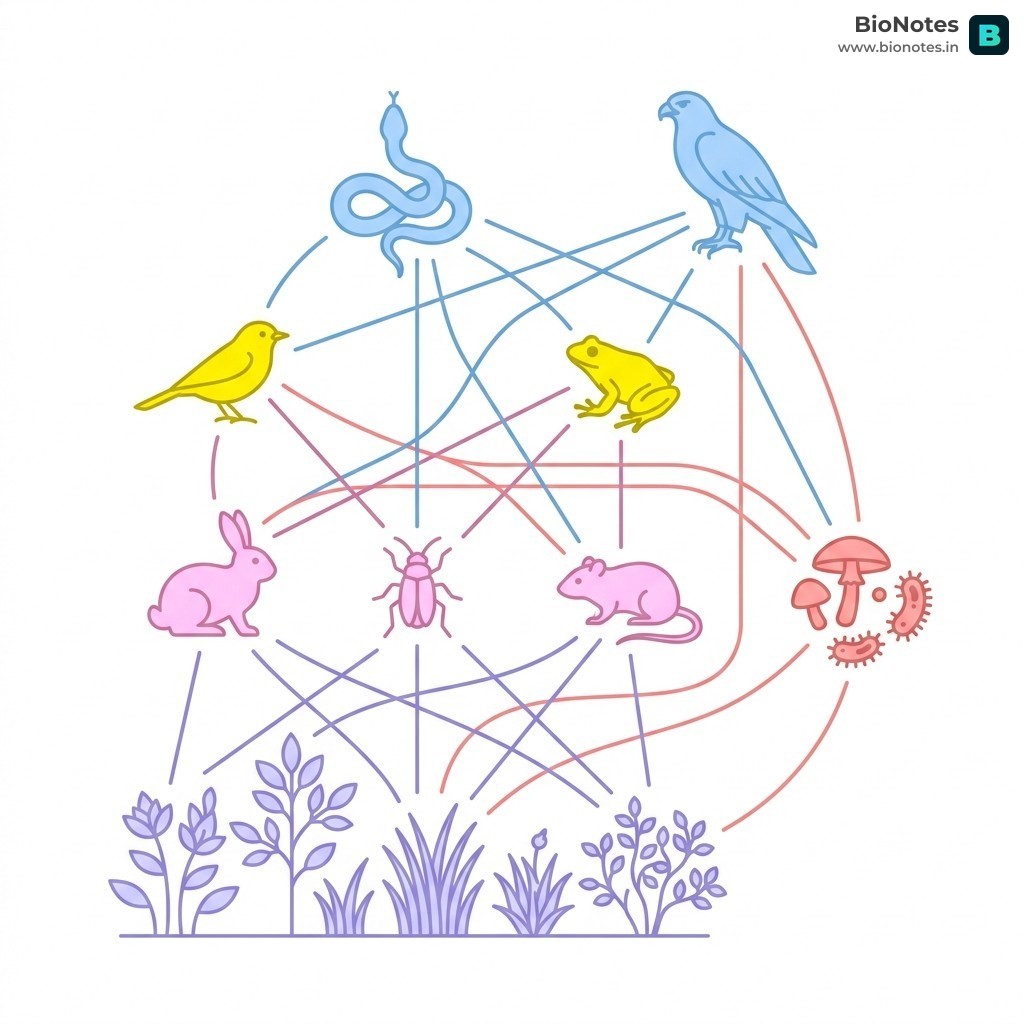
Biotic components are the living parts of an ecosystem, such as plants, animals, and microorganisms. They are categorized by how they get nutrition:
Nature's Recyclers Decomposers are essential for the health of an ecosystem because they return nutrients from dead organisms back to the soil, where they can be used again by producers.
 www.bionotes.in
Key Concept: The 10% Rule Only about 10% of the energy from one trophic level is passed on to the next. The remaining 90% is lost as heat during metabolic processes (like respiration) or used for the organism's growth.
Abiotic components are the non-living chemical and physical parts of an ecosystem.
Ecosystems are broadly categorized into two types:
NGSS-MS-LS2-3AQA-KS3-BiologyIB-MYP-Science