BioNotes
CBSE/NCERT/Notes/Class_09_Science

Introduction to Life

Note on Introduction to Life (The Building Block of Life)

Introduction to Life

Key Concepts

1. The Discovery and Nature of Cells

All living organisms are made up of cells, which represent the basic level at which life exists.

  • Unicellular organisms: Consist of a single cell (e.g., bacteria, yeast).
  • Multicellular organisms: Consist of millions of cells working together (e.g., plants, animals, humans).
  • Biological Organization: Cells → Tissues → Organs → Organ Systems → Organism.

2. Studying Cells: The Power of Microscopes

Since most cells are smaller than the limit of resolution of the human eye (0.1 mm), technological interventions are necessary.

  • Light Microscope: Uses visible light and glass lenses. Total magnification = Objective lens magnification × Eyepiece magnification.
  • Electron Microscope: Uses a beam of electrons to reveal fine details at the nanometre scale.
  • Resolution: The measure of clarity of an image.
  • Contrast: The difference in brightness between various parts of an object.

3. Prokaryotic vs. Eukaryotic Cells

Cells are classified based on their internal complexity:
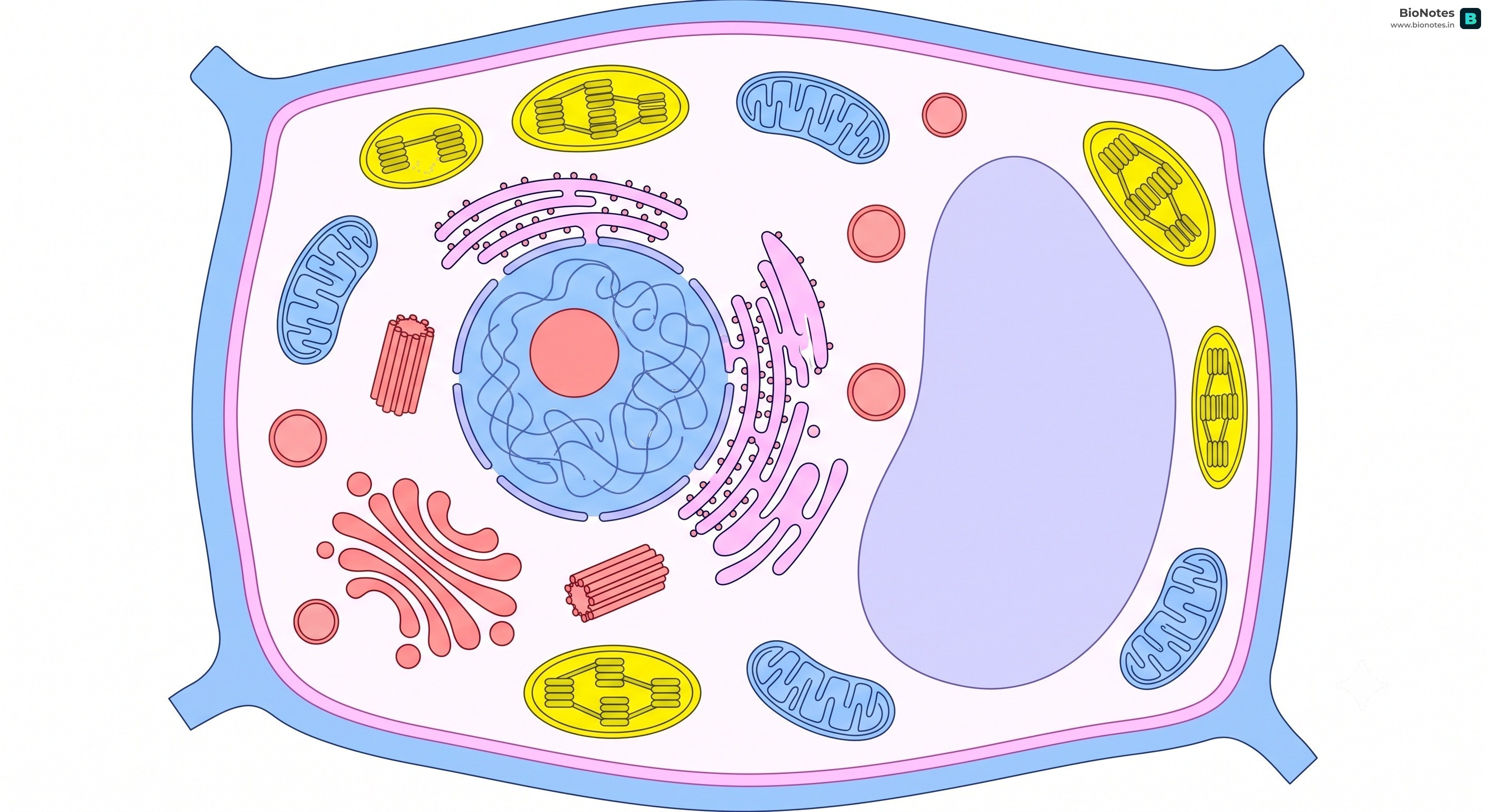
  • Prokaryotic Cells: Simple, smaller cells lacking a well-defined nucleus and membrane-bound organelles. Genetic material is located in the nucleoid.
  • Eukaryotic Cells: Complex, larger cells with a well-defined nucleus (surrounded by a nuclear membrane) and specialized membrane-bound organelles.

4. Essential Cell Structures

  • Cell Membrane (Plasma Membrane): A selectively permeable boundary that protects the cell and regulates the movement of substances.
  • Cell Wall: A rigid outer layer found in plants, fungi, and bacteria (made of cellulose in plants) that provides structural support and protection.
  • Cytoplasm: The semi-fluid substance filling the cell, where organelles are suspended and many chemical reactions occur.

5. Specialized Cell Organelles

  • Nucleus: The control centre containing genetic information (DNA) in the form of chromosomes/chromatin. It directs growth and reproduction.
  • Ribosomes: Small structures responsible for protein synthesis.
  • Endoplasmic Reticulum (ER):
    • Rough ER (RER): Has ribosomes; involved in protein synthesis and transport.
    • Smooth ER (SER): No ribosomes; involved in lipid and hormone synthesis.
  • Golgi Apparatus: Modifies, sorts, and packages proteins and lipids into vesicles for transport.
  • Lysosomes: The "clean-up system" containing enzymes to break down waste and damaged organelles.
  • Mitochondria: The "powerhouse of the cell," producing energy in the form of ATP through cellular respiration.
  • Plastids (Plant cells only):
    • Chloroplasts: Contain chlorophyll for photosynthesis.
    • Chromoplasts: Contain colored pigments for flowers and fruits.
    • Leucoplasts: Colorless plastids for storing starch, oils, or proteins.
  • Vacuoles: Large central vacuoles in plants provide rigidity and store water/waste; smaller temporary vacuoles exist in animal cells.

6. Cell Growth and Division

Cells divide to facilitate growth, repair damaged tissues, and reproduce.
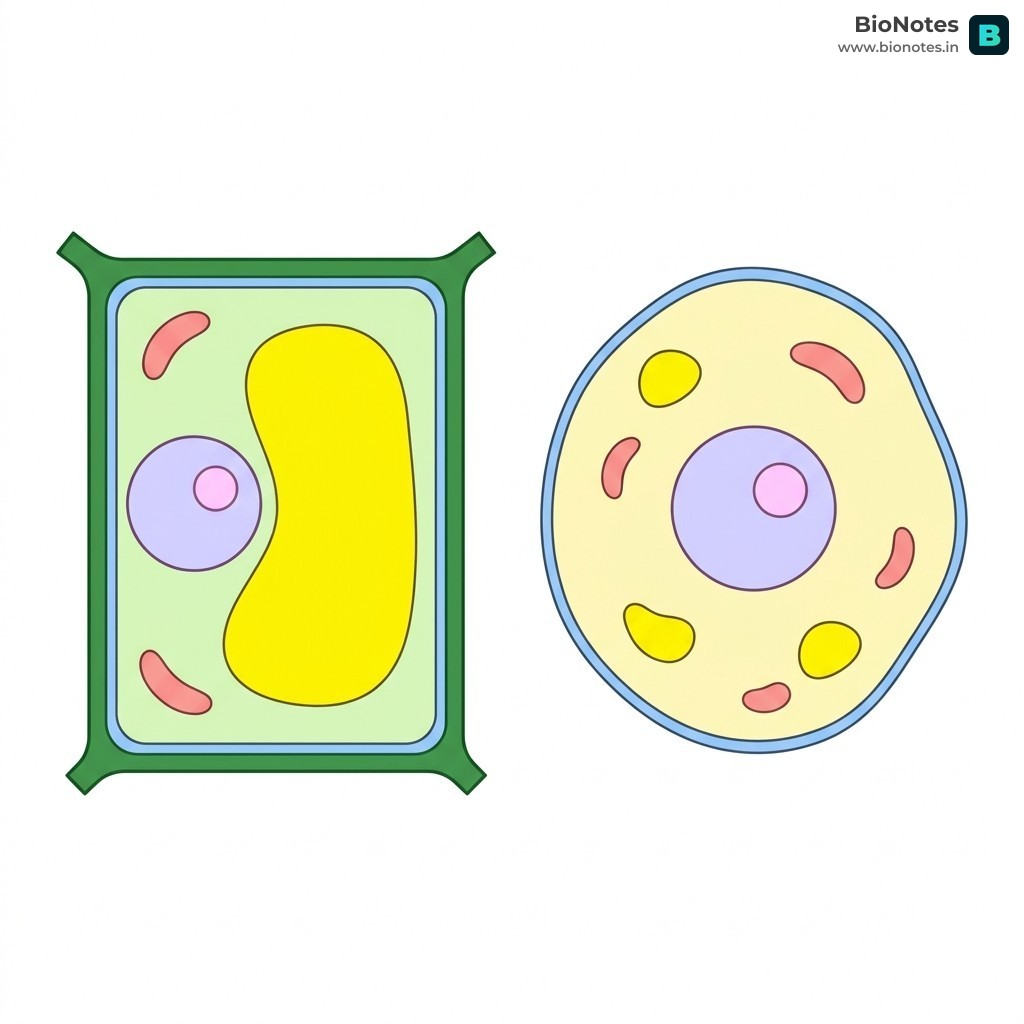
  • Mitosis: Produces two genetically identical daughter cells. Essential for growth and maintenance.
  • Meiosis: A two-step division producing four gametes (sperm/eggs) with half the chromosome number. Essential for sexual reproduction and genetic diversity.
  • Cell Cycle: A controlled and orderly process of cell growth and division in eukaryotes.

7. The Cell Theory

Formulated by Schleiden, Schwann, and Virchow, the theory states:

  1. All living organisms are made up of one or more cells.
  2. The cell is the basic unit of structure and function in living beings.
  3. All cells arise from pre-existing cells.

8. Maintaining Balance

  • Contact Inhibition: Normal animal cells stop dividing when they touch neighbors. Cancer cells lose this control.
  • Programmed Cell Death (PCD): A genetically regulated process of selective cell destruction necessary for normal development (e.g., forming fingers).
  • Totipotency: The ability of a single living plant cell to develop into a complete plant under favorable conditions.
Location:/CBSE/NCERT/Notes/Class_09_Science/Chapter_02_Introduction_to_Life.mdx

Created by Titas Mallick

Biology Teacher • M.Sc. Botany • B.Ed. • CTET Qualified • 10+ years teaching experience