Tissues in Action
Note on Tissues in Action
Tissues in Action
Key Concepts
1. Introduction to Tissues
A tissue is a group of similar cells that work together to perform a specific function. In multicellular organisms, tissues allow for the division of labour, which increases the body's efficiency.
- Hierarchy: Cells → Tissues → Organs → Organ Systems → Organism.
2. Plant Tissues
Plant tissues are broadly classified based on their ability to divide:
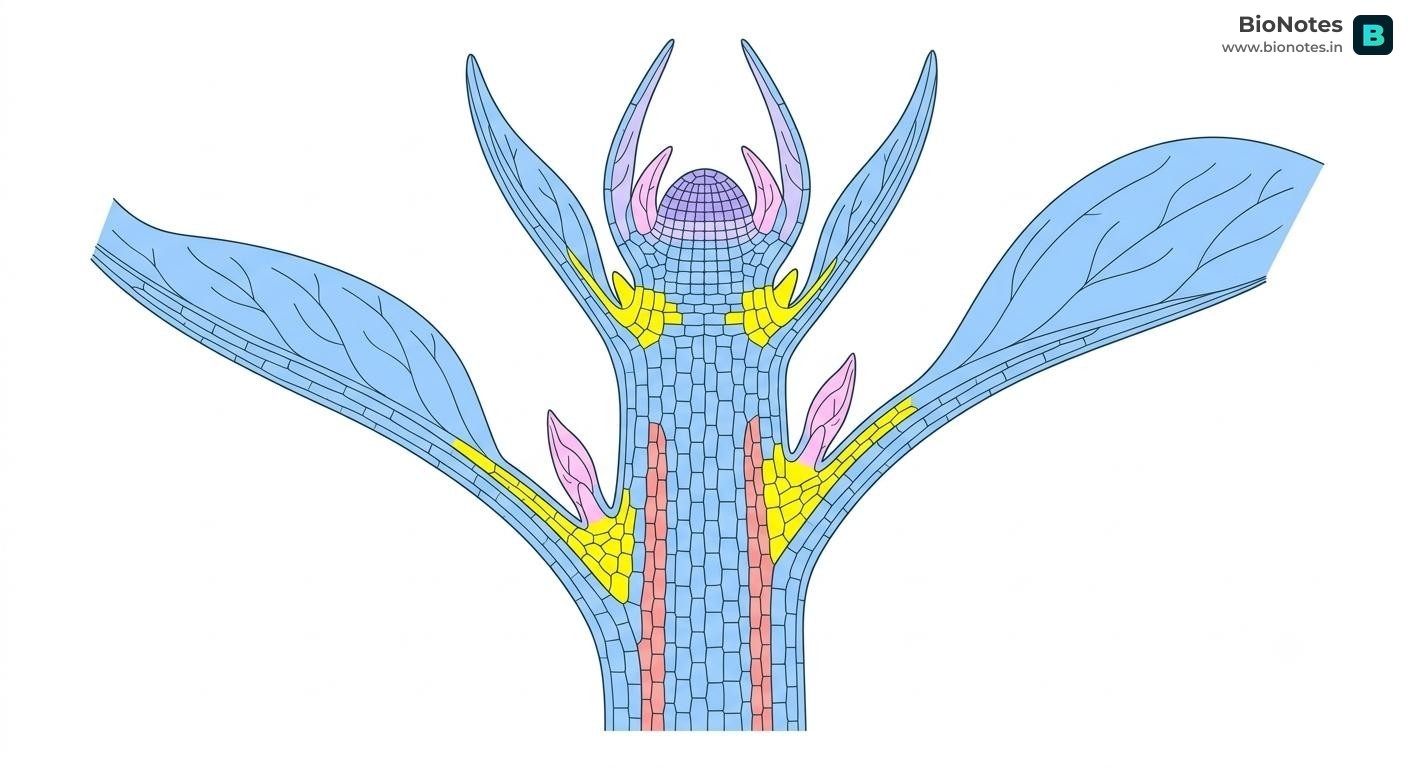
A. Meristematic Tissues (Growth Tissues)
Consist of actively dividing cells with thin walls, dense cytoplasm, and large nuclei.
- Apical Meristem: Located at the tips of roots and shoots; increases length.
- Lateral Meristem: Located in a ring in the stem/root; increases girth (thickness).
- Intercalary Meristem: Located at the base of leaves or nodes; helps in regrowth after cutting/grazing.
B. Permanent Tissues
Formed when meristematic cells stop dividing and take on a permanent shape and function.
- Simple Permanent Tissues (One cell type):
- Parenchyma: Living cells with thin walls; perform storage, photosynthesis, and support.
- Collenchyma: Living cells with thickened corners; provide flexibility and mechanical strength to young stems.
- Sclerenchyma: Dead cells with very thick, lignified walls; provide extreme strength (e.g., coconut husk).
- Protective Tissue (Epidermis/Cork): Forms outer coverings; prevents water loss and entry of pathogens.
- Complex Permanent Tissues (Multiple cell types):
- Xylem: Transports water and minerals upward from roots; consists of tracheids, vessels, xylem parenchyma, and xylem fibers.
- Phloem: Transports food from leaves to other parts; consists of sieve tubes, companion cells, phloem parenchyma, and phloem fibers.
C. Plant Tissue Systems
- Dermal: Outer protective covering.
- Ground: Main body of the plant (Parenchyma, Collenchyma, Sclerenchyma).
- Vascular: Conducting tissues (Xylem and Phloem).
3. Animal Tissues
Animal tissues are categorized into four main types:
A. Epithelial Tissue
Forms the outer covering and internal linings.
- Squamous: Flat cells for rapid diffusion (lungs, blood vessels).
- Stratified: Many layers for protection (skin).
- Cuboidal/Columnar: For secretion and absorption (glands, intestine).
- Ciliated: Have hair-like cilia to move substances (respiratory tract).
B. Connective Tissue
Connects and supports other tissues.
- Fluid: Blood (transports nutrients/gases).
- Hard/Rigid: Bone (supports the body; contains calcium/phosphorus).
- Flexible: Cartilage (cushions joints; found in nose/ears).
- Fibrous: Tendons (Muscle to Bone) and Ligaments (Bone to Bone).
C. Muscular Tissue
Responsible for all body movements.
- Skeletal Muscle: Voluntary, striated, multinucleate; attached to bones.
- Smooth Muscle: Involuntary, spindle-shaped; found in internal organs (stomach).
- Cardiac Muscle: Involuntary, branched, striated; found only in the heart.
D. Nervous Tissue
Specialized for communication.
- Neurons: Consist of a cell body, dendrites (receive signals), and an axon (transmits signals).
4. The Musculoskeletal System and Joints
The coordination of bones and muscles allows for movement and posture.
- Joints: Junctions between bones.
- Ball and Socket: Free movement in all directions (Shoulder, Hip).
- Hinge: Movement in one plane (Elbow, Knee).
- Pivot: Rotation (Neck).
- Fixed: No movement (Skull bones).
5. Specialized Concepts
- Totipotency: The ability of some mature plant cells to revert to a dividing state and develop into an entire new plant (demonstrated by F.C. Steward).
- Crown Gall Disease: Caused by Agrobacterium tumefaciens, which transfers genetic material to plant cells, causing tumors. This bacterium is now used as a tool in genetic engineering.
/CBSE/NCERT/Notes/Class_09_Science/Chapter_03_Tissues_in_Action.mdx