Class 6
Created by Titas Mallick
Biology Teacher • M.Sc. Botany • B.Ed. • CTET (CBSE) • CISCE Examiner
 BioNotes
Created by Titas Mallick
Biology Teacher • M.Sc. Botany • B.Ed. • CTET (CBSE) • CISCE Examiner
Online
The cell is the basic structural and functional unit of all known organisms. It is the smallest unit of life that can replicate independently.
Common Misconceptions
Watch Out! Cells are the building blocks of life:
 www.bionotes.in
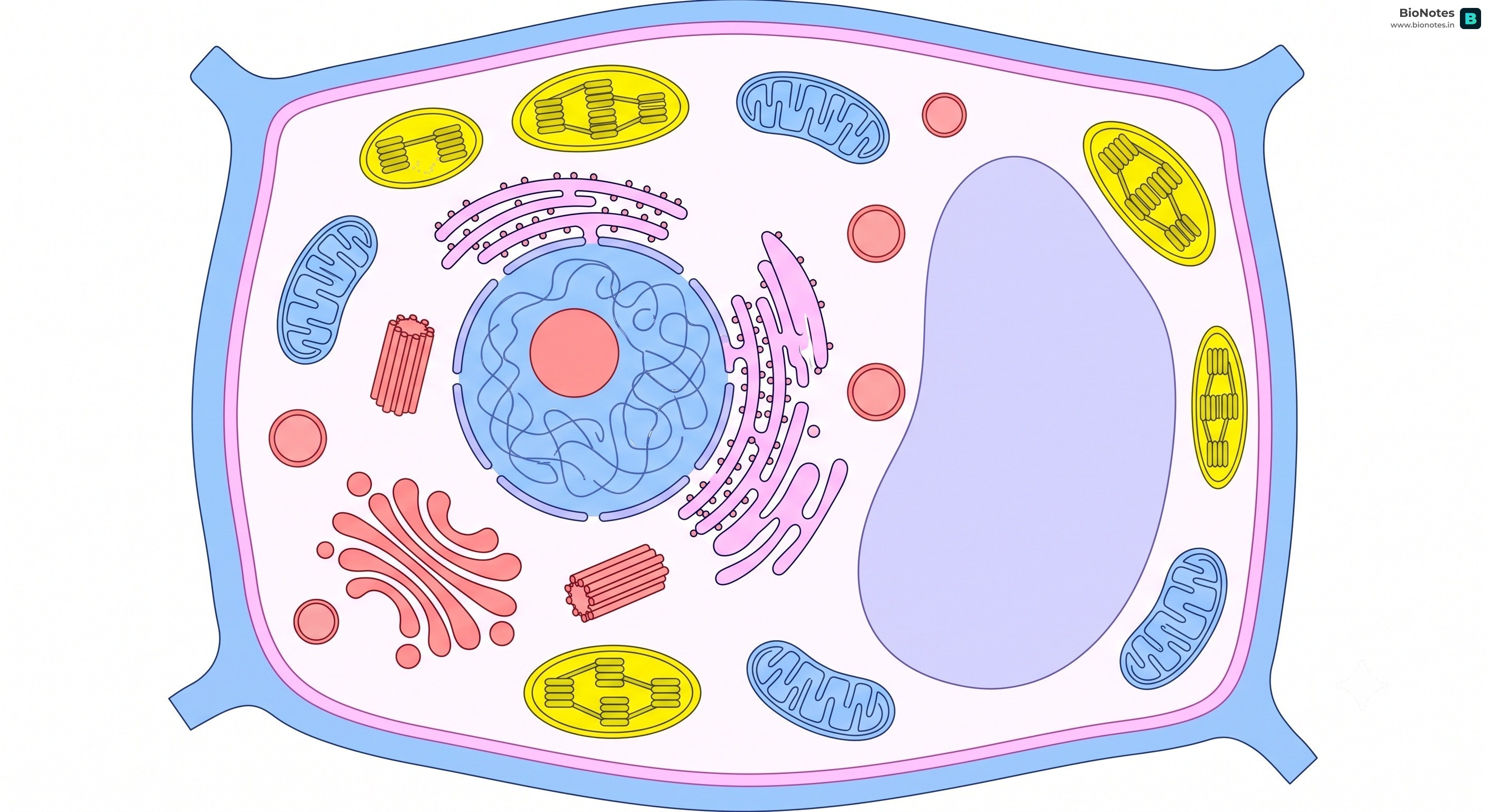
Plant cells are eukaryotic cells that differ from animal cells in several key aspects, primarily due to the presence of a cell wall, chloroplasts, and a large central vacuole.
Animal cells are eukaryotic cells that lack a cell wall, chloroplasts, and a large central vacuole, which are characteristic of plant cells.
The Powerhouse Though not listed above, Mitochondria are essential organelles found in both plant and animal cells. They are known as the "powerhouse of the cell" because they produce energy!
(Note: Diagrams cannot be generated in this format. Please refer to your textbook for labeled diagrams of plant and animal cells to visualize the organelles mentioned above.)
| Feature | Plant Cell | Animal Cell |
|---|---|---|
| Cell Wall | Present (rigid, made of cellulose) | Absent |
| Cell Membrane | Present (inside cell wall) | Present (outer boundary) |
| Plastids | Present (e.g., chloroplasts) | Absent |
| Nucleus | Present (often pushed to periphery by large vacuole) | Present (usually central) |
| Vacuole | One large, central vacuole | Several small, temporary vacuoles (if any) |
| Cytoplasm | Present | Present |
NGSS-MS-LS1-1AQA-KS3-BiologyIB-MYP-Science