Watch Out! Before diving into chromosome structure, let's clear up some common confusion:
Misconception 1:DNA, genes, and chromosomes are all the same thing.Correction: They are related but different! DNA is the chemical molecule, a gene is a specific section of that DNA, and a chromosome is a long, highly coiled thread of DNA.
Misconception 2:Humans have 46 pairs of chromosomes.Correction: Humans have 46 chromosomes in total, which are arranged in 23 pairs.
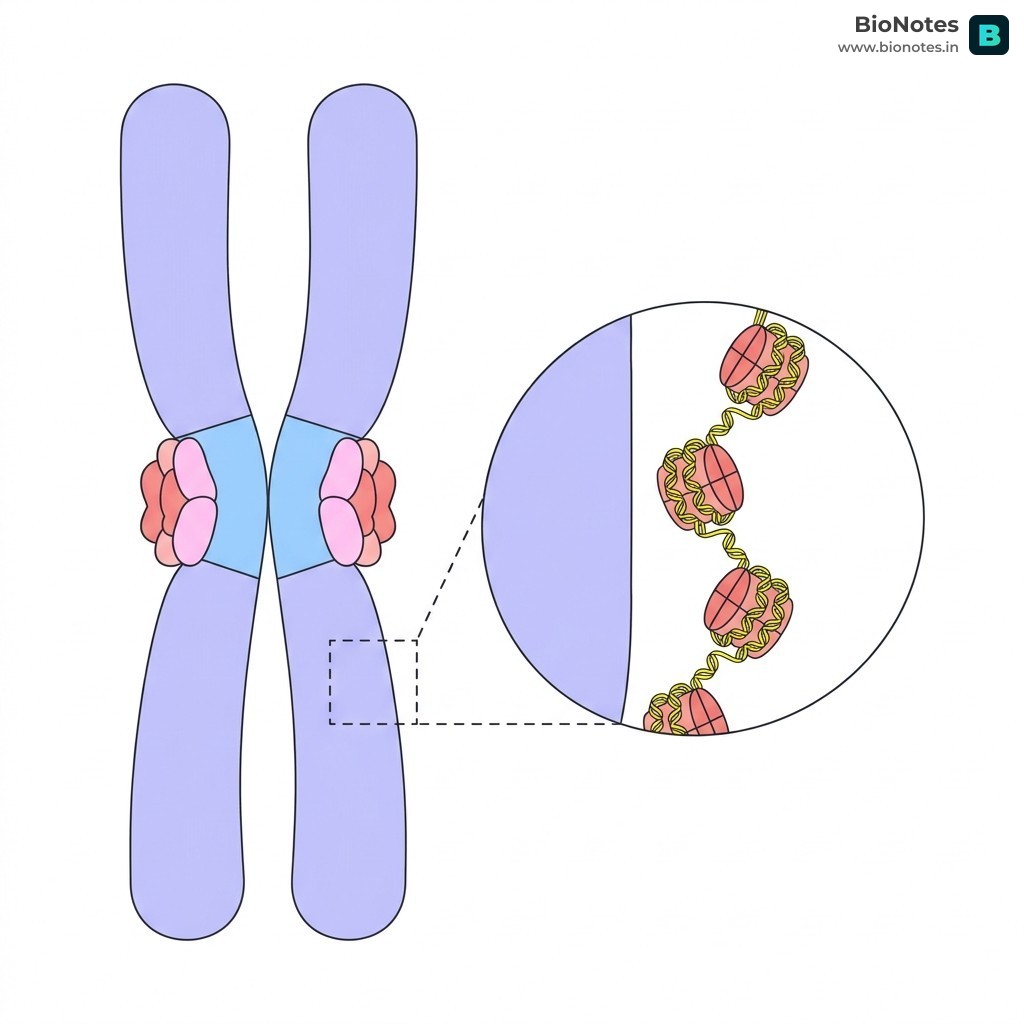
A chromosome is a highly organized structure of DNA and proteins that is found within the nucleus of eukaryotic cells. The term "chromosome" is derived from the Greek words "chroma" (color) and "soma" (body), reflecting their ability to be stained by certain dyes. These structures are the carriers of the genetic material of an organism, which is passed down from one generation to the next.
Chromatin is the complex of DNA and proteins, primarily histones, that makes up chromosomes. It exists in a dispersed, uncondensed state during the interphase of the cell cycle, allowing for DNA replication and transcription.
Deoxyribonucleic acid (DNA) is the molecule that contains the genetic instructions for the development, functioning, growth, and reproduction of all known organisms and many viruses.
Double Helix: DNA has a double helix structure, resembling a twisted ladder. The two strands are antiparallel, meaning they run in opposite directions.
Components: Each strand is a polynucleotide chain, consisting of:
A deoxyribose sugar.
A phosphate group.
A nitrogenous base.
Nitrogenous Bases: There are four types of nitrogenous bases:
Adenine (A)
Guanine (G)
Cytosine (C)
Thymine (T)
Base Pairing: The two strands are held together by hydrogen bonds between the bases, following a specific rule: Adenine pairs with Thymine (A-T), and Cytosine pairs with Guanine (C-G).
A gene is a specific sequence of nucleotides in the DNA that serves as the fundamental unit of heredity. Each gene carries the instructions for synthesizing a specific protein or functional RNA molecule, which in turn determines a particular trait or characteristic of the offspring.
The DNA in a single human cell, if stretched out, would be about 2 meters long. To fit this enormous length of DNA into the microscopic nucleus, it must be tightly coiled and compacted. This process occurs in several hierarchical levels:
Nucleosomes ("Beads on a String"): The DNA double helix is wrapped around a core of eight histone proteins, forming a structure called a nucleosome. This gives the chromatin a "beads on a string" appearance.
Solenoid Fiber: The string of nucleosomes is further coiled into a more compact structure called a solenoid fiber or 30 nm fiber.
Loop Domains: This 30 nm fiber is then organized into a series of loops that are attached to a central protein scaffold.
Metaphase Chromosome: During cell division, the looped domains are further coiled and compacted to form the highly condensed metaphase chromosome, which is visible under a light microscope.
The centromere is a constricted region of the chromosome that plays a crucial role in the segregation of chromosomes during cell division.
It serves as the attachment point for the kinetochore, a protein complex to which the spindle fibers (microtubules) attach to pull the sister chromatids apart.
Telomeres are specialized structures found at the ends of linear chromosomes.
They consist of repetitive nucleotide sequences and act as protective caps, preventing the ends of chromosomes from deteriorating or fusing with neighboring chromosomes.
The Aging Clock
Telomeres shorten every time a cell divides. When they get too short, the cell can no longer divide and eventually dies. This is one of the primary mechanisms behind biological aging.
Autosomes: These are the chromosomes that do not determine the sex of an individual. In humans, there are 22 pairs of autosomes.
Sex Chromosomes (Allosomes): These chromosomes determine the sex of an individual. In humans, the sex chromosomes are X and Y. Females have two X chromosomes (XX), while males have one X and one Y chromosome (XY).
 BioNotes