Class 10
Created by Titas Mallick
Biology Teacher • M.Sc. Botany • B.Ed. • CTET (CBSE) • CISCE Examiner
 BioNotes
Created by Titas Mallick
Biology Teacher • M.Sc. Botany • B.Ed. • CTET (CBSE) • CISCE Examiner
Online
The human reproductive system is responsible for the production of offspring. It consists of a set of organs that work together to produce gametes (sex cells), facilitate fertilization, and in females, to nurture and develop the embryo and fetus.
Common Misconceptions
Watch Out! Reproduction involves overlapping systems. Avoid these errors:
Thermoregulation The scrotum maintains the testes at a temperature lower than the core body temperature. This lower temperature is essential for the maturation of functional sperm.
| Feature | Sperm | Egg (Ovum) |
|---|---|---|
| Size | Microscopic | Largest cell in the human body |
| Motility | Motile (has a tail) | Non-motile |
| Structure | Head (contains nucleus), midpiece (contains mitochondria), tail (for movement) | Round, with a nucleus, cytoplasm, and a protective outer layer (zona pellucida) |
The menstrual cycle is a series of changes a woman's body goes through each month in preparation for the possibility of pregnancy. It is controlled by a complex interplay of hormones.
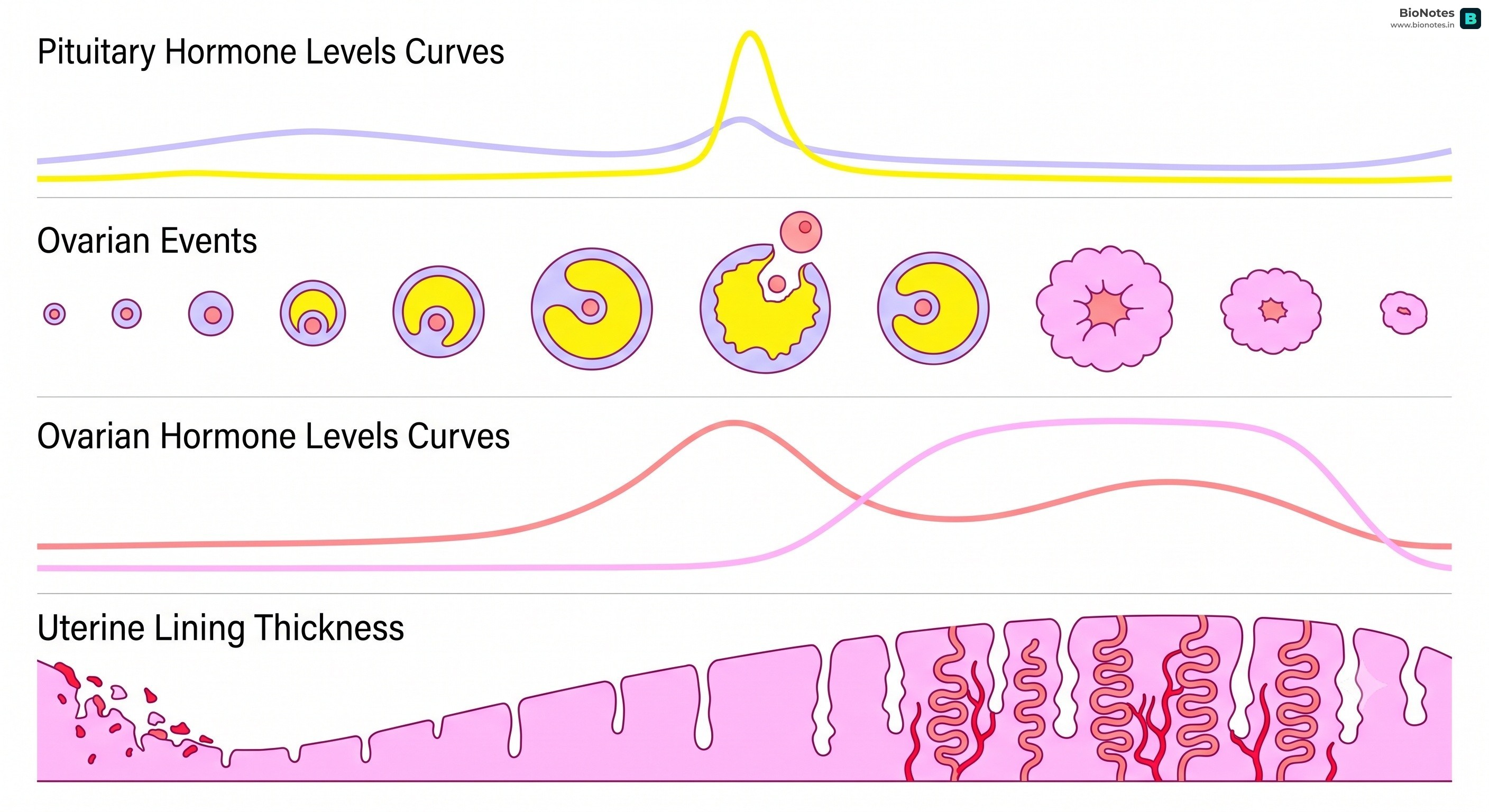 www.bionotes.in
Syllabus History & Status (Menarche & Menopause - ICSE 2028 onwards):
The menstrual cycle is a cyclical physiological process that spans the reproductive years of a female's life, defined by two major biological milestones:
The placenta is a temporary organ that connects the developing fetus to the uterine wall. Its functions include:
Hormones coordinate the development of sexual characteristics, gametogenesis, menstrual cycle control, and pregnancy maintenance.
Syllabus History & Status (Prolactin Hormone):
NGSS-HS-LS1-4AQA-GCSE-4.6.1.2IB-Biology-11.4