Class 10
Created by Titas Mallick
Biology Teacher • M.Sc. Botany • B.Ed. • CTET (CBSE) • CISCE Examiner
 BioNotes
Created by Titas Mallick
Biology Teacher • M.Sc. Botany • B.Ed. • CTET (CBSE) • CISCE Examiner
Online
The endocrine system is a complex network of glands that produce and secrete hormones, which are chemical messengers that regulate various bodily functions. These hormones travel through the bloodstream to target cells and organs, controlling processes like growth, metabolism, and reproduction.
Common Misconceptions
Watch Out! Hormonal control is subtle. Keep these points in mind:
| Feature | Endocrine Glands | Exocrine Glands |
|---|---|---|
| Ducts | Ductless; secrete hormones directly into the bloodstream. | Have ducts to carry secretions to a specific location. |
| Secretions | Hormones | Enzymes, sweat, saliva, etc. |
| Target | Act on distant target cells or organs. | Act locally at the site of secretion. |
| Examples | Pituitary, thyroid, adrenal glands | Salivary, sweat, and sebaceous glands |
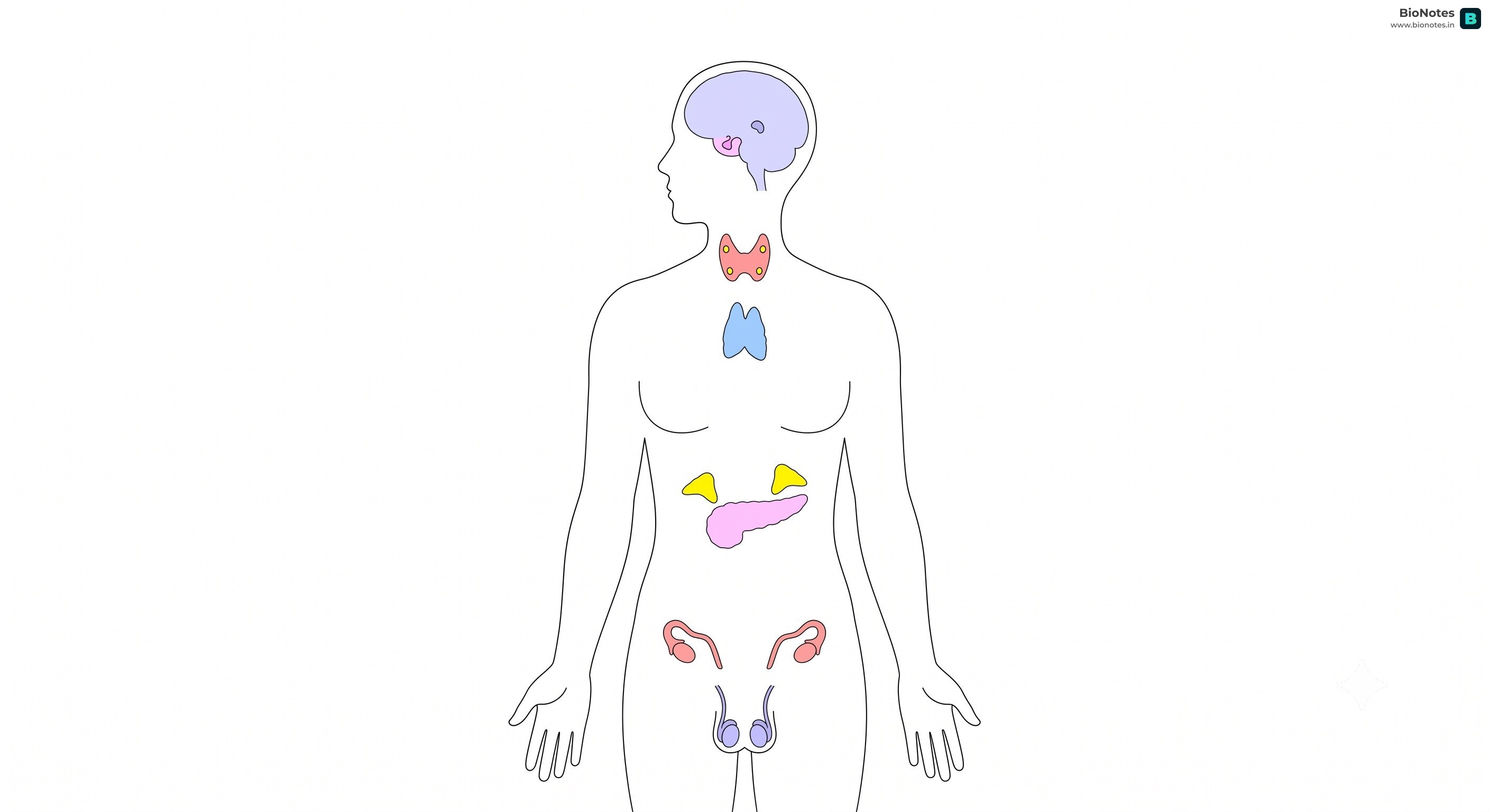 www.bionotes.in
| Gland | Hormone | Hyposecretion (Too Little) | Hypersecretion (Too Much) |
|---|---|---|---|
| Pancreas | Insulin | Hyperglycemia (Diabetes Mellitus): High blood sugar. | Hypoglycemia: Low blood sugar. |
Competitive Edge: The Two "Diabetes" This is a classic point of confusion:
| Thyroid | Thyroxine | Hypothyroidism: Slow metabolism, weight gain, fatigue. | Hyperthyroidism: Rapid metabolism, weight loss, nervousness. | | Adrenal | Cortical Hormones | Addison's Disease: Fatigue, muscle weakness, weight loss. | Cushing's Syndrome: (Cortisol) Weight gain, high BP. Adrenal Virilism: (Androgens) Male traits in females. | | Pituitary | Growth Hormone | Dwarfism in children. | Gigantism in children; Acromegaly in adults. |
The endocrine system is regulated by feedback mechanisms to maintain homeostasis. A key example is the regulation of thyroid hormones.
HORMONES:
| Hormone | Origin | Hyposecretion | Hypersecretion |
|---|---|---|---|
| Insulin | Pancreas | Diabetes mellitus type 1 | Hyperinsulinism |
| Growth Hormone | Pituitary gland | Pituitary dwarfism | Acromegaly |
| Thyroxine | Thyroid gland | Hypothyroidism | Hyperthyroidism |
| Cortisol | Adrenal glands | Addison's disease | Cushing's syndrome |
| Adrenaline | Adrenal glands | Adrenal insufficiency | Pheochromocytoma |
| Estrogen | Ovaries | Primary ovarian insufficiency (POI) | Estrogen dominance |
| Testosterone | Testes | Hypogonadism | Testicular tumors (Leydig cell tumors) |
| Progesterone | Ovaries | Progesterone deficiency | Hyperprogesteronism (rare) |
| Parathyroid hormone | Parathyroid glands | Hypoparathyroidism | Hyperparathyroidism |
| Melatonin | Pineal gland | Seasonal affective disorder (SAD) | Circadian rhythm disorders |
| Oxytocin | Hypothalamus, posterior pituitary gland | Inadequate uterine contractions during labor (inadequate labor progression) | Excessive uterine contractions during labor (uterine hyperstimulation) |
| Aldosterone | Adrenal glands | Addison's disease (secondary adrenal insufficiency) | Hyperaldosteronism |
| Prolactin | Pituitary gland | Hypoprolactinemia | Hyperprolactinemia |
| Thyroid-stimulating hormone (TSH) | Pituitary gland | Hypothyroidism | Hyperthyroidism |
| Follicle-stimulating hormone (FSH) | Pituitary gland | Hypogonadism | Gonadotropin-secreting tumors |
| Luteinizing hormone (LH) | Pituitary gland | Hypogonadism | Gonadotropin-secreting tumors |
| Adrenocorticotropic hormone (ACTH) | Pituitary gland | Adrenal insufficiency (secondary adrenal insufficiency) | Cushing's disease |
| Antidiuretic hormone (ADH) | Hypothalamus | Diabetes insipidus | Syndrome of inappropriate ADH secretion (SIADH) |
| Calcitonin | Thyroid gland | Hypocalcemia | Medullary thyroid cancer |
| Glucagon | Pancreas | Hypoglycemia | Glucagonoma |
| Melanocyte-stimulating hormone (MSH) | Hypothalamus, pituitary gland, skin | Hypopituitarism | Melanosis, hyperpigmentation |
| Ghrelin | Stomach | Prader-Willi syndrome | Ghrelinoma |
| Leptin | Adipose tissue | Leptin deficiency | Leptin resistance (obesity-related) |
| Serotonin | Enterochromaffin cells | Serotonin deficiency syndrome | Serotonin syndrome |
| Vasopressin | Hypothalamus, posterior pituitary gland | Diabetes insipidus | Syndrome of inappropriate ADH secretion (SIADH) |
| Somatostatin | Pancreas, hypothalamus | Diabetes mellitus type 2 (insulin resistance) | Somatostatinoma |
| Atrial natriuretic peptide (ANP) | Heart | Sodium retention | Atrial myxoma |
| Relaxin | Ovaries, placenta | Preterm labor | Overactive relaxin production |
| Thymosin | Thymus | Reduced T cell development | Thymus gland tumors |
| Erythropoietin | Kidneys | Anemia | Polycythemia |
| Cholecystokinin | Intestines | Decreased appetite | Overproduction leading to gallbladder issues |
| Adiponectin | Adipose tissue | Insulin resistance, metabolic syndrome | Not applicable (low levels associated with obesity) |
| Norepinephrine | Adrenal glands | Low blood pressure, depression | Hypertension, anxiety |
| Glucocorticoids | Adrenal glands | Adrenal insufficiency | Cushing's syndrome |
| Inhibin | Gonads | Unknown (potential involvement in some diseases) | Granulosa cell tumors (ovaries), testicular tumors |
| Vasoinhibins | Placenta, hypothalamus | Unknown (potential involvement in various conditions) | Not applicable (no specific hypersecretion condition) |
| Neurotensin | Nervous system, digestive tract | Unknown (potential involvement in various conditions) | Neurotensin-secreting tumors |
| Secretin | Duodenum | Impaired digestion, malabsorption | Not applicable (rapidly inactivated in the body) |
| Thrombopoietin | Liver, kidneys | Thrombocytopenia | Thrombocytosis |
| Fibroblast growth factor 23 (FGF23) | Bones, kidneys | Hypophosphatemic rickets/osteomalacia | Tumor-induced osteomalacia |
| Gastrin | Stomach, duodenum | Hypogastrinemia | Zollinger-Ellison syndrome (gastrinoma) |
| Glucagon-like peptide-1 (GLP-1) | Intestines | Impaired glucose regulation | Not applicable (rapidly degraded in the body) |
| Vasopressin | Hypothalamus, posterior pituitary gland | Diabetes insipidus | Syndrome of inappropriate antidiuretic hormone (SIADH) |
| Serotonin | Enterochromaffin cells | Serotonin deficiency syndrome | Serotonin syndrome |
| Prostaglandins | Various tissues | Dysmenorrhea (painful menstruation) | Excessive menstrual bleeding (menorrhagia) |
| Vasopressin | Hypothalamus, posterior pituitary gland | Diabetes insipidus | Syndrome of inappropriate antidiuretic hormone (SIADH) |
| Natriuretic peptides | Heart | Sodium retention, hypertension | Natriuretic peptide-secreting tumors |
NGSS-HS-LS1-2AQA-GCSE-4.5.3IB-Biology-6.6