Watch Out! Transpiration is more than just plant sweating. Don't make these common mistakes:
Misconception 1:Transpiration is bad for the plant because it loses water.Correction: While excessive water loss is harmful, transpiration is crucial! It creates the 'transpirational pull' that draws water and minerals up from the roots, and it cools the plant.
Misconception 2:Stomata only exist on leaves.Correction: While most abundant on the underside of leaves, stomata can also be found on green stems and other young plant parts.
Transpiration is the process by which water vapor is released from the aerial parts of plants, primarily through small pores called stomata on the leaves. It is essentially the evaporation of water from plant leaves, but it also occurs from stems and flowers. This process is a vital component of the water cycle and plays several critical roles in plant life.
Stomatal Transpiration: The primary route, occurring through stomata (microscopic pores) on the leaves. It accounts for the vast majority (80-90%) of water loss.
Cuticular Transpiration: Occurs directly through the cuticle (the waxy, protective covering) of the leaves and herbaceous stems.
Lenticular Transpiration: Occurs through lenticels, which are minute respiratory openings present on the bark of older, woody stems and twigs.
Transpiration is not merely a loss of water; it is a crucial physiological process with several benefits for the plant:
Creation of Transpirational Pull: The evaporation of water from the leaves creates a negative pressure (tension) in the xylem, which pulls water upwards from the roots. This is the primary force driving the ascent of sap.
Transport of Minerals: The continuous stream of water moving through the plant (transpiration stream) carries dissolved mineral nutrients from the soil to all parts of the plant, especially the leaves where photosynthesis occurs.
Cooling Effect: As water evaporates from the leaf surface, it absorbs latent heat from the leaf, thereby cooling the plant. This is particularly important in hot environments, preventing the plant from overheating.
Maintenance of Turgor Pressure: Transpiration helps in maintaining the turgidity of plant cells, which is essential for keeping the plant erect, for cell enlargement, and for the opening and closing of stomata.
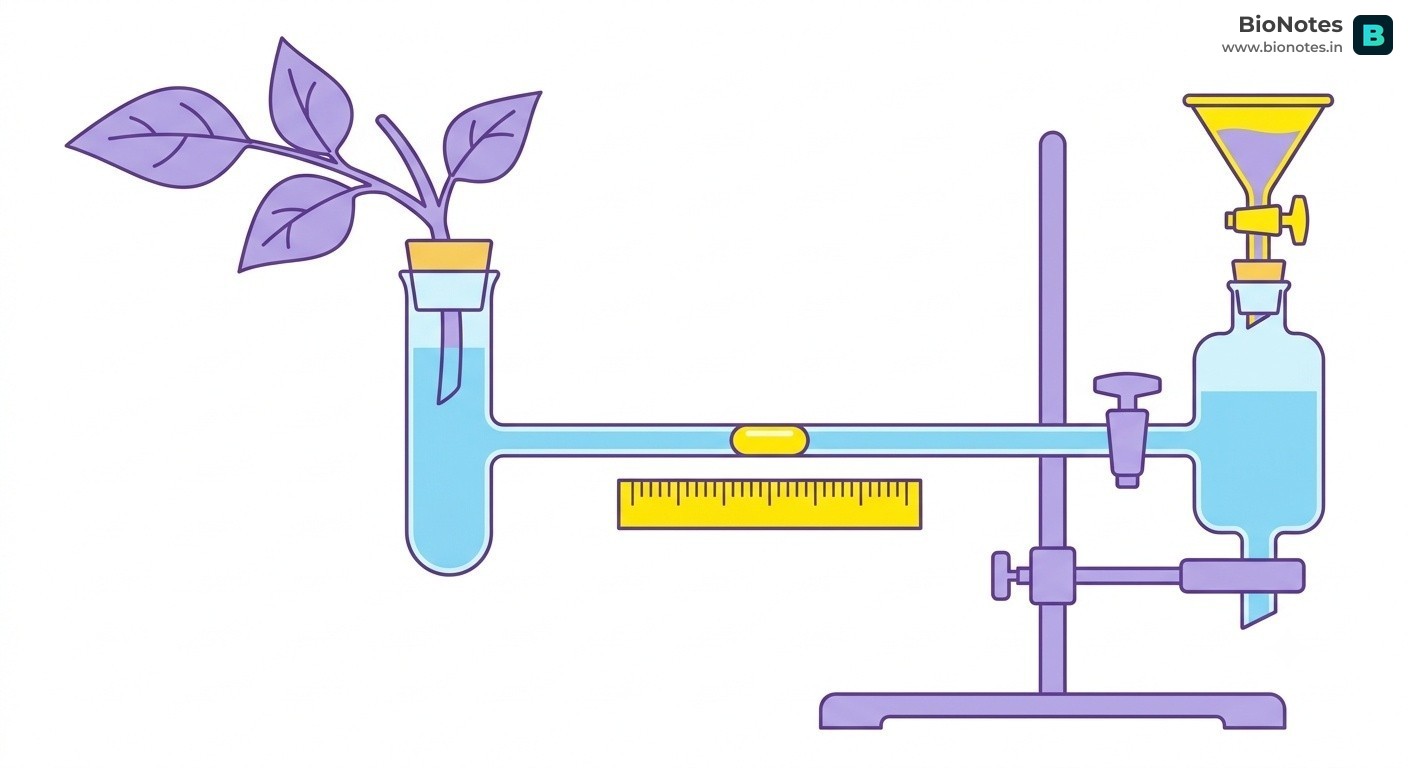
A Ganong’s potometer is a simple apparatus used to measure the rate of water uptake by a leafy shoot, which is assumed to be nearly equal to the rate of transpiration. It works on the principle that as water is transpired from the leaves, it is replaced by water drawn from the potometer, causing an air bubble in a capillary tube to move.
Despite its usefulness, the Ganong’s potometer has several limitations:
Measures Water Uptake, Not Transpiration Directly: It measures the rate of water uptake, which may not always be exactly equal to the rate of transpiration, as some water might be used for photosynthesis or retained by the plant cells.
Airtight Seal is Crucial: Any leakage in the apparatus will lead to inaccurate readings.
Cutting the Shoot: Cutting the shoot can cause damage to the xylem vessels, potentially affecting water conduction.
Environmental Factors: The rate of water uptake is highly sensitive to environmental factors, making it challenging to maintain constant conditions during the experiment.
Air Bubble Issues: The air bubble can get stuck or dissolve in the water, affecting the accuracy of the measurement.
Light Intensity: Increased light intensity generally increases the rate of transpiration because it promotes stomatal opening (for photosynthesis) and raises the leaf temperature, leading to faster evaporation.
Temperature: Higher temperatures increase the kinetic energy of water molecules, leading to a faster rate of evaporation and diffusion of water vapor from the leaf.
Humidity: High atmospheric humidity reduces the water potential gradient between the leaf and the atmosphere, thereby decreasing the rate of transpiration. Conversely, low humidity increases the rate.
Wind Speed: Increased wind speed removes the humid air layer surrounding the leaf, maintaining a steep water potential gradient and thus increasing the rate of transpiration.
Atmospheric Pressure: Lower atmospheric pressure can slightly increase transpiration as it facilitates the diffusion of water vapor.
Availability of Soil Water: If the soil water is scarce, the plant may reduce its transpiration rate by closing stomata to conserve water.
Aim: To demonstrate that plants lose water through transpiration.
Procedure:
Take a potted plant and cover the pot and soil with a plastic sheet to prevent evaporation from the soil surface.
Weigh the potted plant and record its initial weight.
Place the plant in a well-lit area for several hours.
Weigh the plant again after a few hours.
Observation: The weight of the potted plant will decrease, indicating a loss of water due to transpiration.
Variation (Leafy Shoot in a Test Tube):
Take a leafy shoot and place its cut end in a test tube filled with water. Add a layer of oil on top of the water to prevent evaporation from the water surface.
Mark the initial water level in the test tube.
Place the setup in a well-lit area.
Observation: The water level in the test tube will decrease over time, demonstrating water loss from the leafy shoot through transpiration.
Aim: To demonstrate unequal rates of transpiration in a dorsiventral leaf (e.g., a dicot leaf).
Procedure:
Take two dry cobalt chloride papers (blue in color).
Place one paper on the upper surface and the other on the lower surface of a dorsiventral leaf.
Secure the papers with clips or glass slides to ensure good contact with the leaf surfaces.
Observe the color change over time.
Observation: The cobalt chloride paper on the lower surface of the leaf will turn pink much faster than the one on the upper surface. This is because the lower surface of a dorsiventral leaf typically has a higher density of stomata, leading to a higher rate of transpiration from that surface.
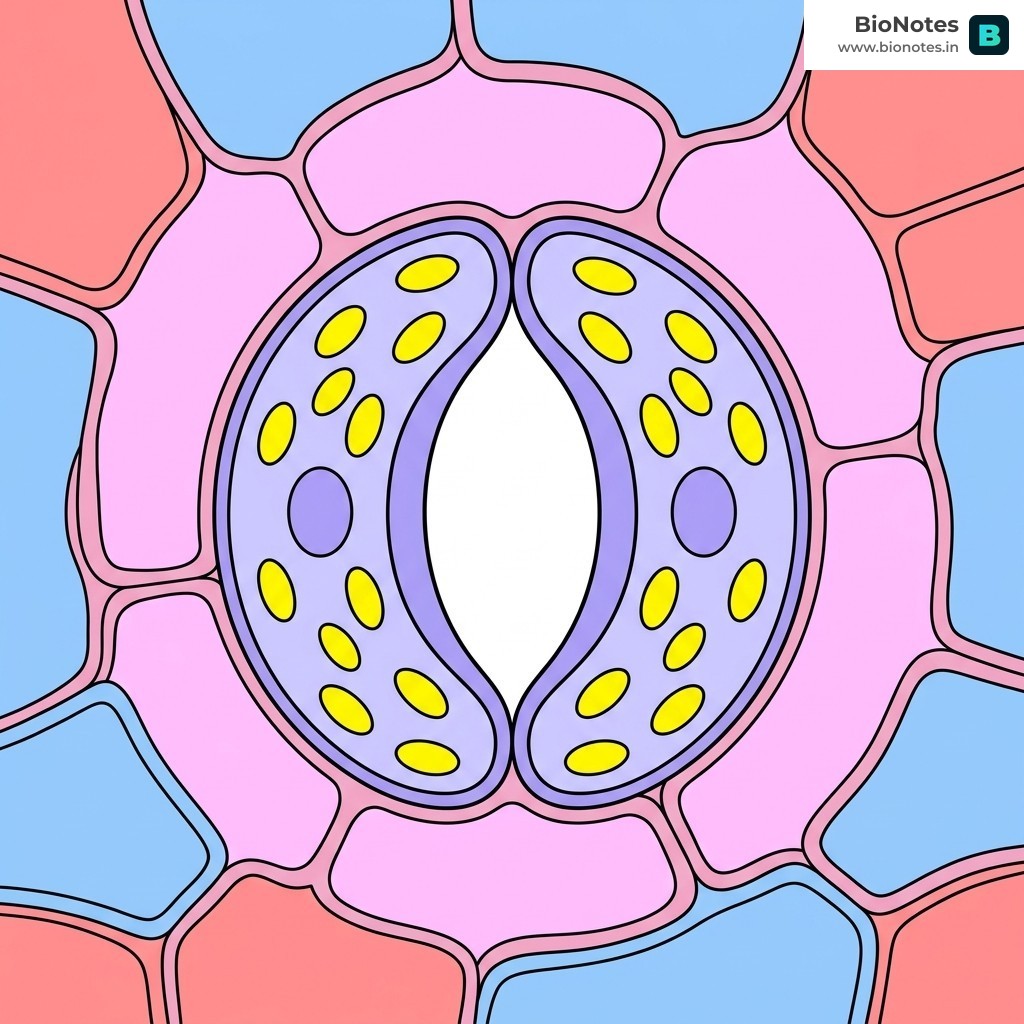
The opening and closing of stomata, which regulate the rate of transpiration, are primarily controlled by the turgor pressure of the guard cells. The Potassium Ion Exchange Theory (also known as the K+ pump theory) explains the mechanism of stomatal movement.
Light Stimulus: In the presence of light, guard cells become photosynthetically active, producing ATP.
K+ Influx: ATP powers proton pumps (H+-ATPases) in the guard cell membrane, which pump H+ ions out of the guard cells. This creates an electrochemical gradient.
Membrane Potential: The outward movement of H+ ions hyperpolarizes the guard cell membrane, making the inside more negative.
K+ Channel Activation: This negative membrane potential activates voltage-gated K+ channels, leading to a rapid influx of K+ ions into the guard cells from the surrounding epidermal cells.
Water Potential Decrease: The accumulation of K+ ions (and sometimes Cl- ions) inside the guard cells lowers their water potential.
Water Influx: Water then moves by osmosis from the surrounding epidermal cells into the guard cells, increasing their turgor pressure.
Stomatal Opening: As the guard cells become turgid, their inner walls (adjacent to the stomatal pore) are thicker and less elastic than their outer walls. This differential thickening causes the guard cells to bow outwards, opening the stomatal pore.
Plants have evolved various adaptations to minimize water loss through transpiration, especially in arid or dry environments:
Thick Cuticle: A thick, waxy layer on the leaf surface reduces water evaporation from the epidermis.
Sunken Stomata: Stomata located in pits or depressions on the leaf surface create a humid microenvironment, reducing the water potential gradient and thus transpiration (e.g., Nerium).
Hairy Leaves (Trichomes): Hairs on the leaf surface trap a layer of moist air, reducing air movement and transpiration.
Rolled Leaves: Some plants roll their leaves to reduce the exposed surface area and create a humid environment around the stomata (e.g., Marram grass).
Reduced Leaf Surface Area: Small leaves, needle-like leaves (e.g., conifers), or spines (e.g., cacti) reduce the surface area available for transpiration.
Succulence: Fleshy stems or leaves store water, allowing plants to survive periods of drought.
Crassulacean Acid Metabolism (CAM) Photosynthesis: CAM plants open their stomata at night to take in CO2 and close them during the day, significantly reducing water loss.
Deep Root Systems: Allow plants to access water from deeper soil layers.
Shedding Leaves: Deciduous plants shed their leaves during dry seasons to avoid water loss.
Anti-transpirants: Chemical substances applied to plants to reduce transpiration without significantly affecting photosynthesis. Examples include Phenylmercuric acetate (PMA) and Abscisic Acid (ABA).
Guttation is the exudation of drops of xylem sap from the tips or edges of leaves of some vascular plants, especially in conditions of high humidity and low transpiration (e.g., at night). It occurs when root pressure is high, and transpiration is low, leading to an accumulation of water in the xylem that is forced out through specialized pores called hydathodes.
Key Difference from Dew: Guttation droplets are secreted by the plant, while dew forms from condensation of atmospheric water vapor.
Spotting the Difference
You can tell Guttation apart from Dew by looking at the location: Guttation occurs at the leaf tips/edges (hydathodes), while Dew covers the entire surface. Also, Guttation fluid leaves a mineral residue when it dries!
Composition: Guttation fluid contains dissolved minerals and sugars, unlike pure water from transpiration.
Bleeding (or weeping) is the exudation of xylem sap from a cut or injured part of a plant. This phenomenon is also driven by root pressure. When a stem is cut, the positive pressure from the roots forces the sap out of the severed xylem vessels. This is commonly observed in grapevines or maple trees when tapped for syrup.
Significance: While not a normal physiological process, bleeding demonstrates the presence of root pressure and the continuous movement of sap within the plant.
 BioNotes