CBSE/NCERT/Notes/Class_12_Biology
Molecular Basis of Inheritance
Note on Molecular Basis of Inheritance (Chapter 5)
Molecular Basis of Inheritance
Key Concepts
The DNA (Deoxyribonucleic Acid)
DNA is a long polymer of deoxyribonucleotides.
- Structure of Polynucleotide Chain:
- Nucleotide: Composed of a nitrogenous base (Purines: A, G; Pyrimidines: C, T/U), a pentose sugar (Deoxyribose/Ribose), and a phosphate group.
- Linkages: N-glycosidic linkage (base to sugar), Phosphoester linkage (phosphate to sugar), and 3'-5' phosphodiester linkage (joining nucleotides).
- Double Helix Model (Watson and Crick, 1953):
- Two polynucleotide chains with anti-parallel polarity (5'→3' and 3'→5').
- Bases pair via H-bonds: A=T (2 bonds), G≡C (3 bonds).
- Right-handed coiling; pitch = 3.4 nm; 10 bp per turn.
- Packaging of DNA:
- Prokaryotes: DNA held by positive proteins in a 'nucleoid'.
- Eukaryotes: DNA wraps around a histone octamer (rich in lysine and arginine) to form a nucleosome (200 bp).
- Chromatin: 'Beads-on-string' structure. Euchromatin (loose, active) and Heterochromatin (dense, inactive).
The Search for Genetic Material
- Transforming Principle (Griffith, 1928): Observed transformation of R-strain Streptococcus pneumoniae into virulent S-strain when mixed with heat-killed S-strain.
- Biochemical Characterisation (Avery, MacLeod, McCarty): Proved DNA is the transforming substance.
- Hershey-Chase Experiment (1952): Unequivocal proof using radioactive isotopes (32P for DNA, 35S for protein) in bacteriophages; DNA entered the bacteria, not protein.
RNA World
- RNA was the first genetic material.
- Functions as a messenger, adapter, and catalyst (ribozymes).
- DNA evolved from RNA for better stability.
DNA Replication
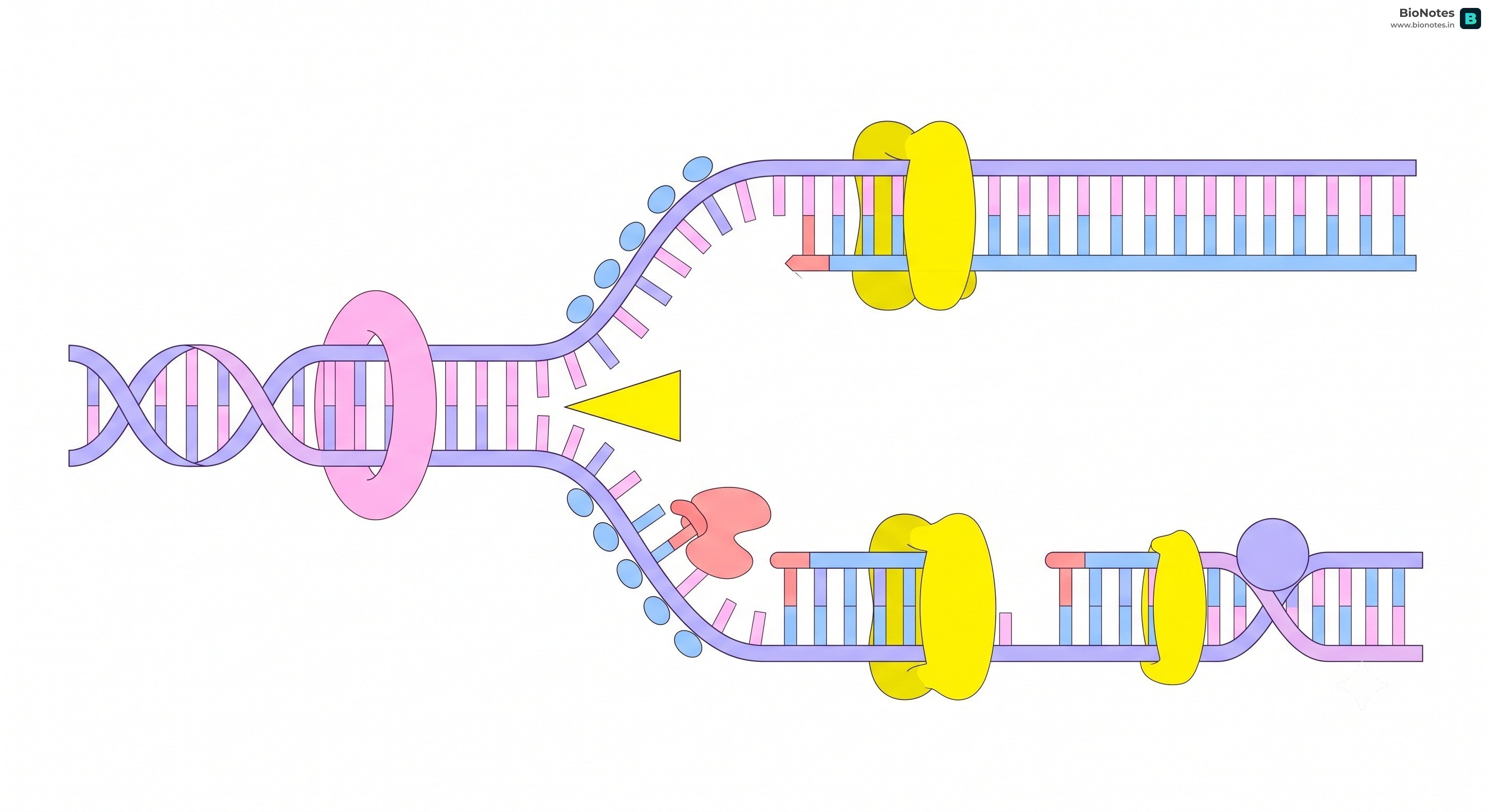
- Semiconservative Mode: Proposed by Watson and Crick; experimentally proven by Meselson and Stahl (1958) using 15N isotope in E. coli.
- Enzymes:
- DNA Polymerase: Synthesizes new strands in 5'→3' direction.
- Helicase: Unwinds DNA.
- DNA Ligase: Joins Okazaki fragments on the lagging strand.
- Replication Fork: Site of active replication. One strand is continuous (leading), the other discontinuous (lagging).
Transcription
Process of copying genetic information from DNA to RNA.
- Transcription Unit: Promoter, Structural gene, and Terminator.
- Strands: Template strand (3'→5') and Coding strand (5'→3').
- Processing (Eukaryotes): Splicing (removing introns), Capping (5'-end), and Tailing (3'-end).
Genetic Code
- Triplet Codon: 64 codons total; 61 code for amino acids, 3 are stop codons (UAA, UAG, UGA).
- Features: Degenerate (many codons for one amino acid), Universal, Non-overlapping, and AUG (dual role: Methionine and Initiator).
Translation
Process of protein synthesis.
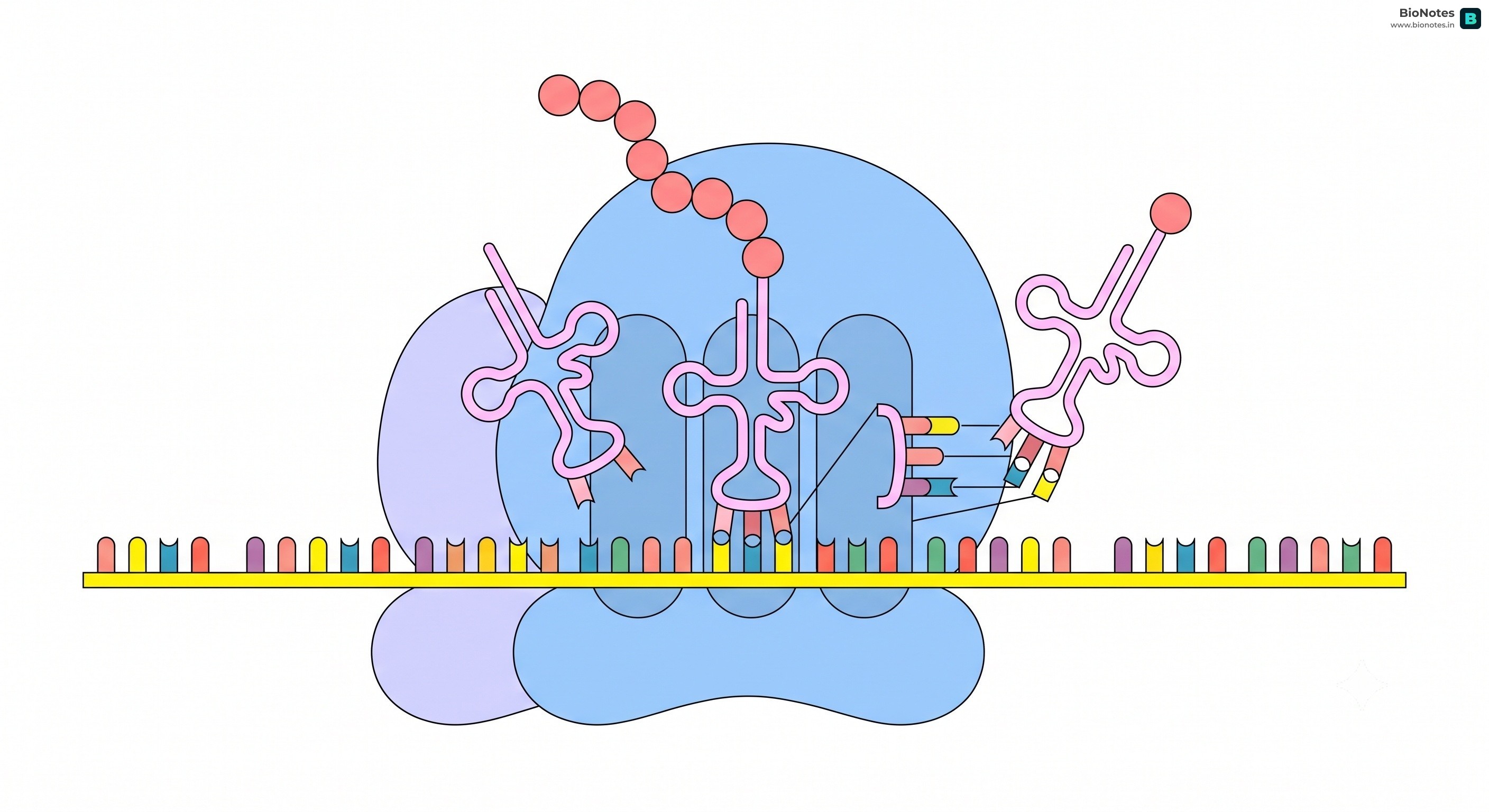
- Charging of tRNA: Aminoacylation using ATP.
- Ribosome: The cellular factory for protein synthesis.
- Steps: Initiation (AUG recognized), Elongation (peptide bond formation), and Termination (release factor).
Regulation of Gene Expression
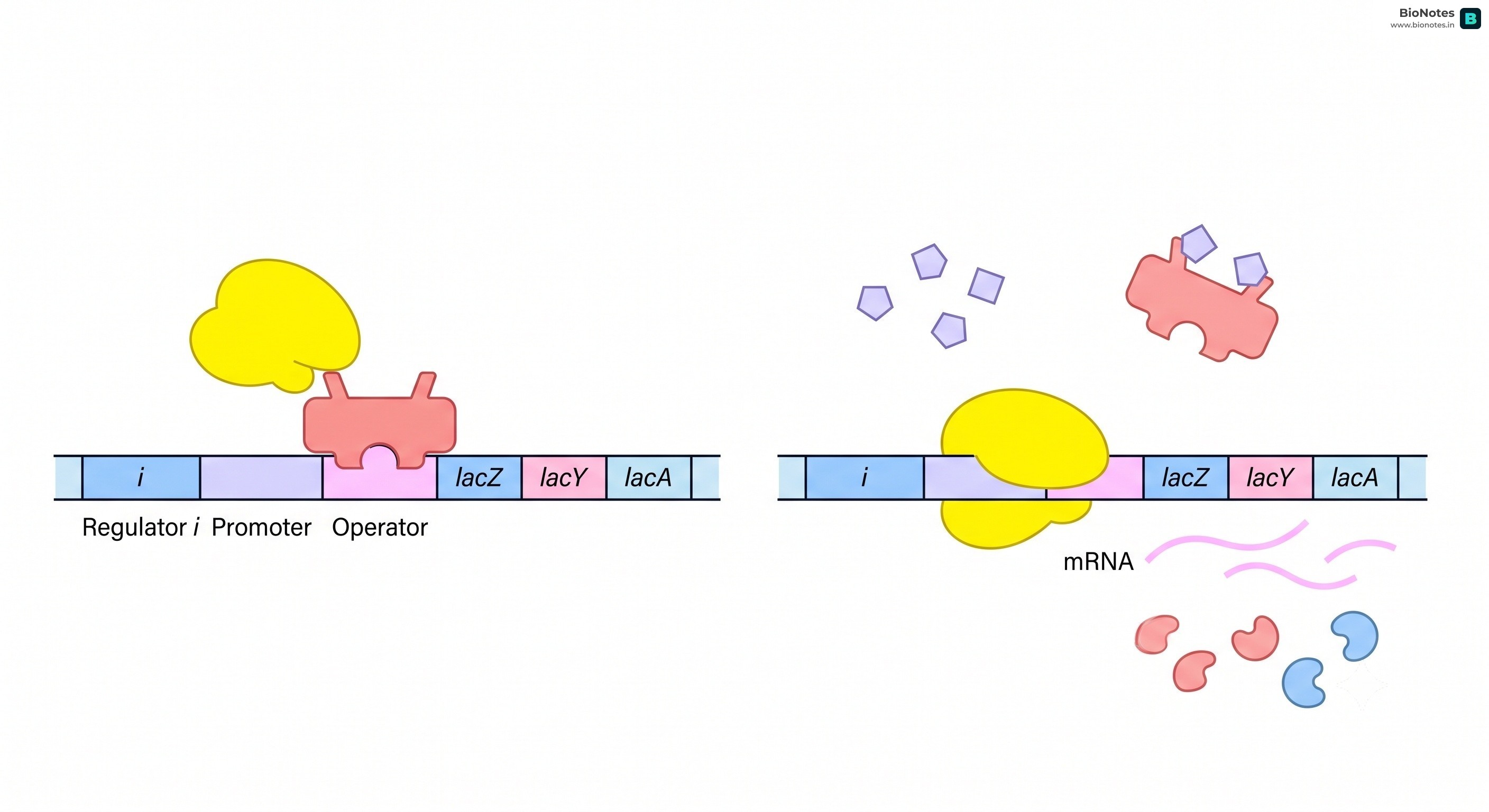
- Lac Operon (Jacob and Monod):
- Regulatory Gene (i): Codes for repressor.
- Structural Genes: z (β-gal), y (permease), a (transacetylase).
- Inducer: Lactose (inactivates the repressor).
- Negative Regulation: Repressor protein prevents transcription.
Human Genome Project (HGP)
- Launched in 1990, completed in 2003.
- Goals: Sequence 3 billion bp, identify ~20,000-25,000 genes, and address ELSI.
- Findings: Genome has 3164.7 million bp; < 2% codes for proteins; SNP (1.4 million locations).
DNA Fingerprinting
- Technique to identify variations at the DNA level using Polymorphism.
- Uses VNTR (Variable Number of Tandem Repeats) as probes.
- Steps: Isolation, Digestion, Electrophoresis, Blotting, Hybridization, and Autoradiography.
Location:
/CBSE/NCERT/Notes/Class_12_Biology/Chapter_05_Molecular_Basis_of_Inheritance.mdx