CBSE/NCERT/Notes/Class_12_Biology
Ecosystem
Note on Ecosystem (Chapter 12)
Ecosystem
Key Concepts
Ecosystem Structure and Function
An ecosystem is a functional unit of nature where living organisms interact among themselves and with their physical environment.
- Categories: Terrestrial (forest, grassland, desert) and Aquatic (pond, lake, wetland, river, estuary).
- Stratification: Vertical distribution of different species occupying different levels (e.g., trees → shrubs → herbs).
- Key Aspects: Productivity, Decomposition, Energy flow, and Nutrient cycling.
Productivity
- Primary Production: Amount of biomass or organic matter produced per unit area by plants during photosynthesis.
- Gross Primary Productivity (GPP): Total rate of production of organic matter.
- Net Primary Productivity (NPP): GPP minus respiration losses (R). NPP = GPP - R. It is the biomass available for heterotrophs.
- Secondary Productivity: Rate of formation of new organic matter by consumers.
- Global NPP: ~170 billion tons. Oceans contribute only 55 billion tons despite covering 70% of Earth's surface.
Decomposition
Breakdown of complex organic matter into inorganic substances (CO2, H2O, nutrients).
- Detritus: Raw material (dead leaves, bark, animal remains).
- Steps:
- Fragmentation: Detritivores (e.g., earthworm) break detritus into smaller particles.
- Leaching: Water-soluble nutrients move down into the soil.
- Catabolism: Bacterial and fungal enzymes degrade detritus into simpler inorganic substances.
- Humification: Formation of dark, amorphous humus (resistant to microbes, nutrient reservoir).
- Mineralisation: Release of inorganic nutrients from humus.
- Factors: Faster if detritus is rich in Nitrogen/Sugars; slower if rich in Lignin/Chitin. Warm and moist environments favour decomposition.
Energy Flow
- PAR: Photosynthetically Active Radiation (< 50% of incident solar radiation).
- First Law of Thermodynamics: Energy is transferred, not created or destroyed.
- Second Law of Thermodynamics: Energy is lost as heat at each transfer (increasing disorder).
- 10 Per Cent Law: Only 10% of energy is transferred to the next trophic level.
- Food Chains:
- Grazing Food Chain (GFC): Producer → Herbivore → Carnivore.
- Detritus Food Chain (DFC): Begins with dead organic matter. Major conduit in terrestrial ecosystems.
- Food Web: Natural interconnection of food chains.
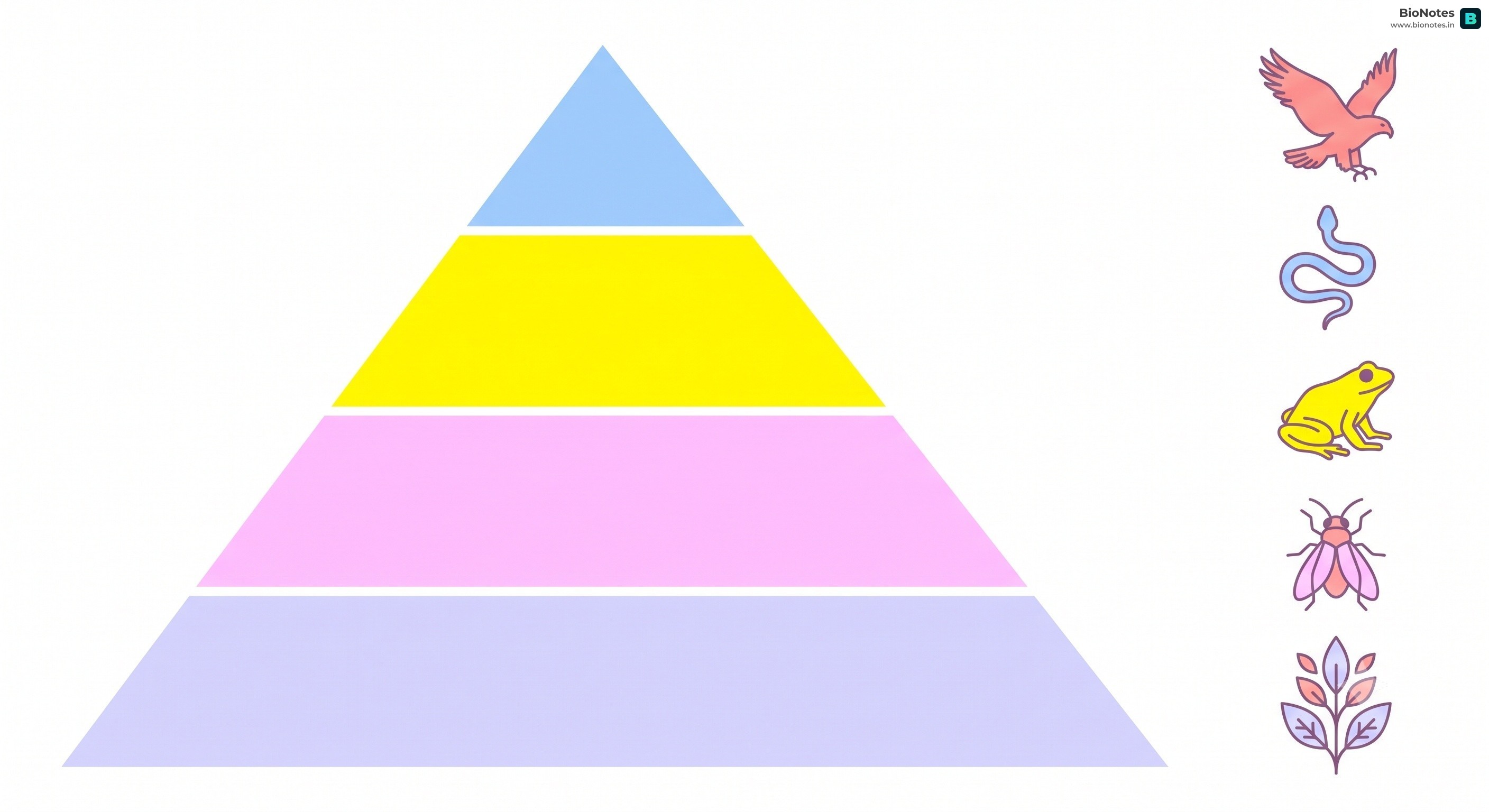
Ecological Pyramids
Express relationship between organisms at different trophic levels in terms of number, biomass, or energy.
- Pyramid of Number: Usually upright (except for a big tree supporting many insects).
- Pyramid of Biomass: Usually upright; Inverted in sea (phytoplankton biomass < fish biomass).
- Pyramid of Energy: Always upright; energy is lost at each step.
- Limitations: Does not account for same species in multiple trophic levels, assumes simple food chains, and ignores saprophytes.
Location:
/CBSE/NCERT/Notes/Class_12_Biology/Chapter_12_Ecosystem.mdx