Principles of Inheritance and Variation - Activities
Activities and Experiments for Chapter 4
Activities
Activity 1: Observing Contrasting Traits
Aim: To identify and list the seven pairs of contrasting traits in pea plants as studied by Mendel.
Procedure:
- Study Figure 4.1 in your textbook.
- Create a table listing the seven characters and their two opposing traits (Dominant and Recessive).
- Observe plants in your local garden and try to identify any variations in flower colour, seed shape, or plant height.
Observation Table:
| Character | Dominant Trait | Recessive Trait |
|---|---|---|
| Seed Shape | Round | Wrinkled |
| Seed Colour | Yellow | Green |
| Flower Colour | Violet | White |
| Pod Shape | Full (Inflated) | Constricted |
| Pod Colour | Green | Yellow |
| Flower Position | Axial | Terminal |
| Stem Height | Tall | Dwarf |
Conclusion: Mendel’s choice of discrete, non-blending traits was crucial for his success in formulating the laws of inheritance.
Activity 2: Pedigree Analysis Exercise
Aim: To understand the standard symbols used in human pedigree analysis and trace a specific trait.
Procedure:
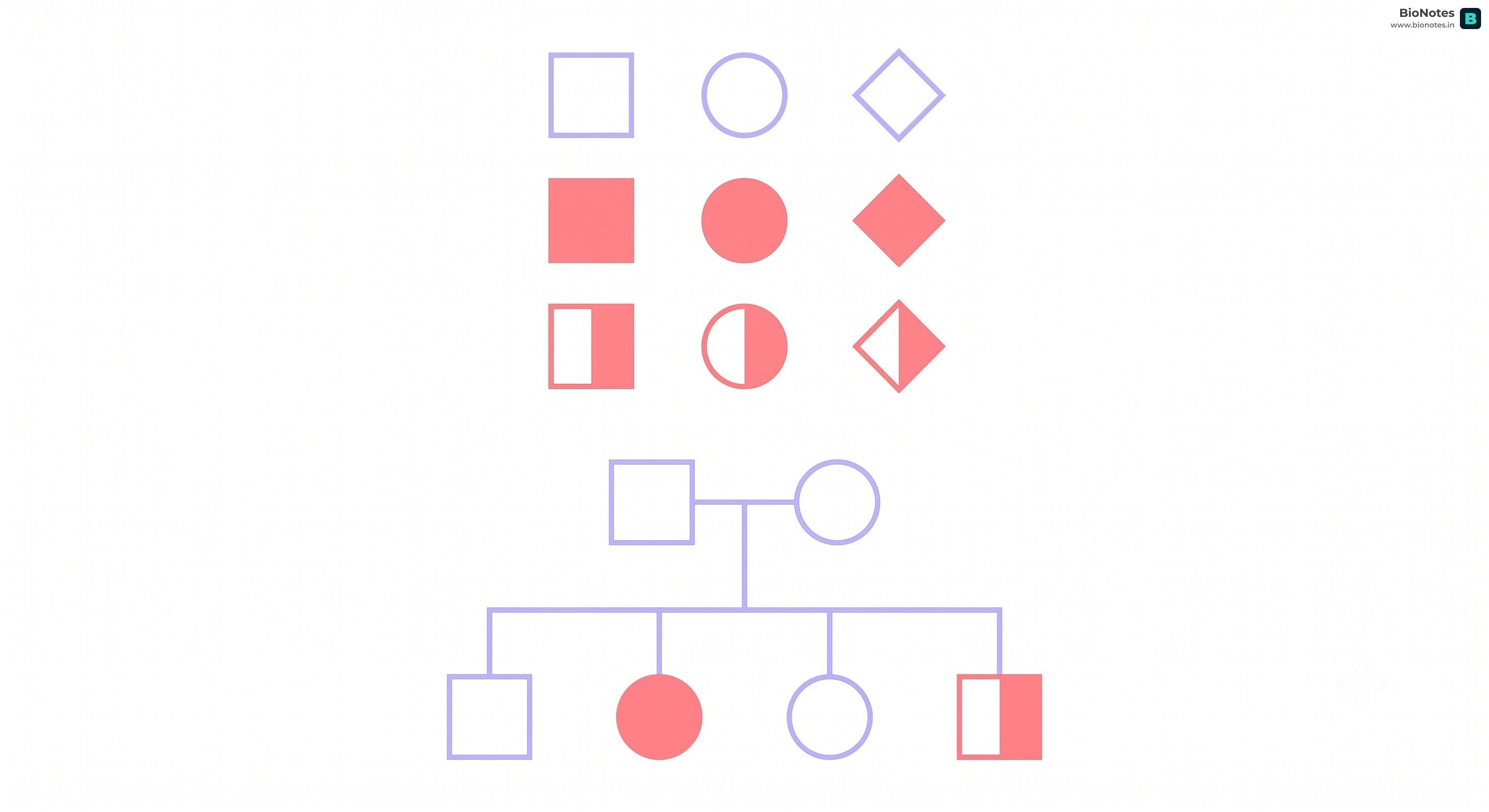
- Learn the standard symbols for pedigree analysis (e.g., Circle for female, Square for male, Filled symbol for affected individual).
- Study Figure 4.14 (a) and (b) in the textbook.
- Identify the inheritance pattern (Autosomal Dominant vs. Autosomal Recessive) in each case.
- Try to construct a simple pedigree chart for a trait in your own family (e.g., presence of earlobes or ability to roll the tongue).
Conclusion: Pedigree analysis is a powerful tool in human genetics to predict the likelihood of inheriting specific traits or disorders.
Activity 3: Researching Polygenic Inheritance
Aim: To investigate how traits like human skin colour and height show continuous variation.
Procedure:
- Measure the heights of your classmates and record them.
- Plot the data on a graph (Frequency vs. Height).
- Observe if the graph resembles a 'Bell Curve' (Normal Distribution).
- Research how many genes are thought to control skin colour in humans.
Observation: Unlike Mendel's pea plants, human height does not fall into two distinct categories (Tall/Dwarf) but shows a gradient of variations.
Conclusion: Polygenic traits are controlled by multiple genes, and their expression is often influenced by environmental factors.
Activity 4: Chromosomal vs. Genic Behaviour
Aim: To compare the behaviour of chromosomes and genes during cell division.
Procedure:
- Study Table 4.3 in your textbook.
- Note the similarities in how both occur in pairs and segregate during gamete formation.
- Discuss why Sutton and Boveri concluded that chromosomes are the carriers of genes.
Comparison Table:
| Genes | Chromosomes |
|---|---|
| Occur in pairs | Occur in pairs |
| Segregate at gamete formation | Segregate at gamete formation |
| Independent pairs assort independently | One pair segregates independently of another pair |
Conclusion: The parallel behaviour of chromosomes and genes forms the basis of the Chromosomal Theory of Inheritance.
/CBSE/NCERT/Activities/Class_12_Biology/Chapter_04_Principles_of_Inheritance_and_Variation.mdx