BioNotes

Molecular Basis of Inheritance - Activities

Activities and Experiments for Chapter 5

Activities

Activity 1: Calculating DNA Length

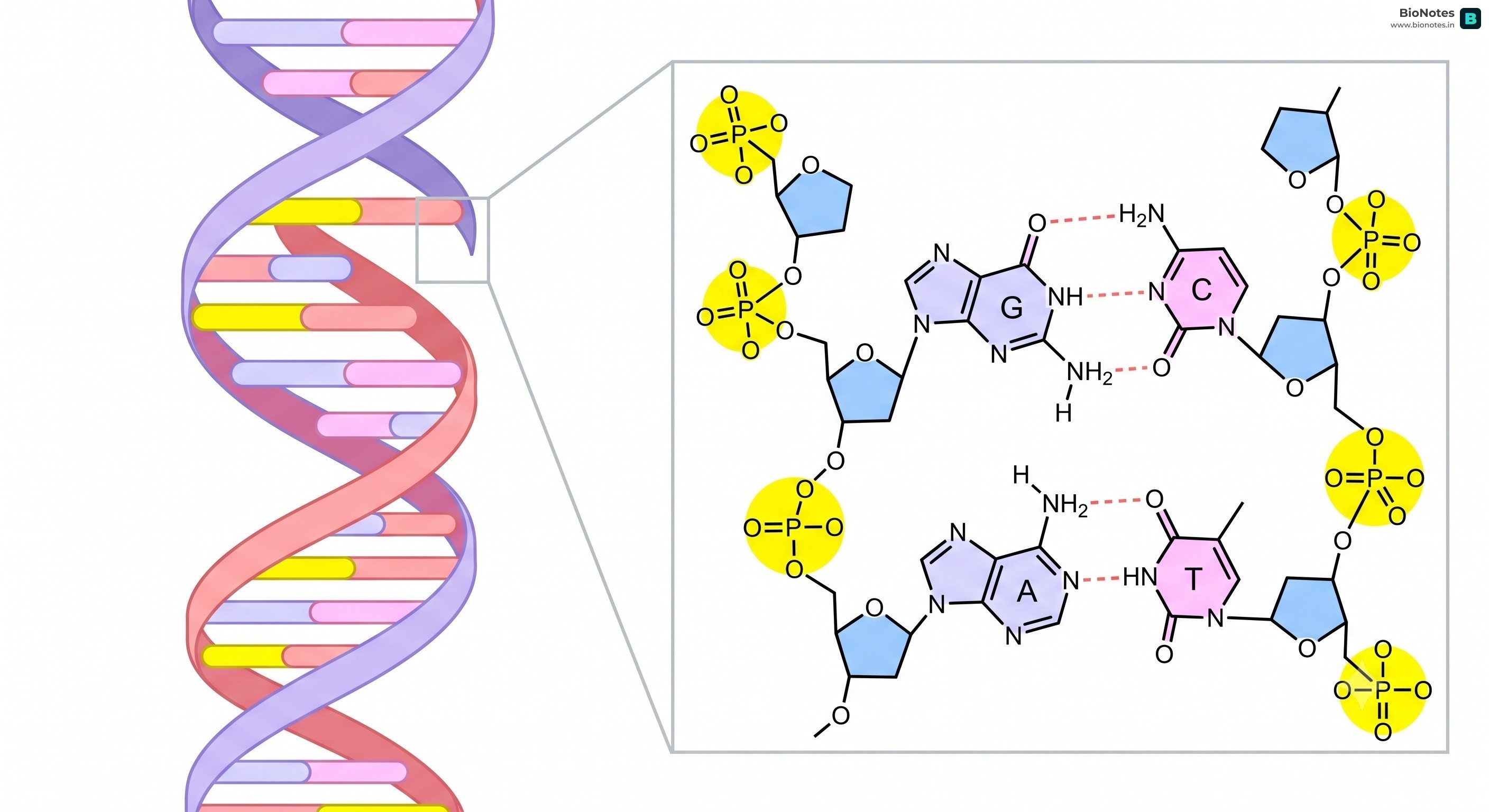
Aim: To calculate the length of the DNA double helix in a typical mammalian cell.

Procedure:

  1. Recall the total number of base pairs (bp) in a diploid human cell: 6.6 × 10^9 bp.
  2. Recall the distance between two consecutive base pairs: 0.34 nm (0.34 × 10^-9 m).
  3. Multiply the total number of base pairs by the distance between them.

Calculation:

  • Length = (6.6 × 10^9 bp) × (0.34 × 10^-9 m/bp)
  • Result: Approximately 2.2 metres.

Inquiry: Compare this length (2.2 m) with the dimension of a typical nucleus (~10^-6 m). Discuss how such a long polymer is packaged inside such a small space.


Activity 2: Deciphering the Genetic Code

Aim: To practice translating mRNA sequences into amino acid sequences using the genetic code checkerboard.

Procedure:

  1. Refer to Table 5.1 (The Checkerboard) in your textbook.
  2. Translate the following mRNA sequence: -AUG UUU UUC UUC UUU UUU UUC-
  3. Identify the amino acids coded by each triplet.

Observation:

  • AUG: Methionine
  • UUU: Phenylalanine
  • UUC: Phenylalanine
  • Amino Acid Sequence: Met - Phe - Phe - Phe - Phe - Phe - Phe

Conclusion: The genetic code is read in mRNA in a contiguous, non-overlapping fashion.


Activity 3: Reading Frame Mutation Exercise

Aim: To understand the effect of insertion and deletion mutations on the reading frame.

Procedure:

  1. Take the sentence: RAM HAS RED CAP.
  2. Case A (Insertion): Insert the letter 'B' between HAS and RED.
    • New Sentence: RAM HAS BRE DCA P (The reading frame is altered from the point of insertion).
  3. Case B (Insertion of Triplets): Insert the letters 'BIG' between HAS and RED.
    • New Sentence: RAM HAS BIG RED CAP (The original reading frame is restored after the insertion).
  4. Case C (Deletion): Delete the letter 'R' from RED.
    • New Sentence: RAM HAS EDC AP (The reading frame is altered).

Conclusion: Insertion or deletion of one or two bases changes the reading frame (Frameshift mutation), whereas insertion/deletion of three bases adds/removes a codon without altering the subsequent reading frame.


Activity 4: DNA Fingerprinting Case Study

Aim: To analyze DNA banding patterns to identify a match.

Procedure:

  1. Study Figure 5.16 in the textbook.
  2. Examine the DNA banding patterns obtained from the crime scene (C) and two suspects (A and B).
  3. Compare the number and positions of bands for individual chromosomes.

Observation: The banding pattern of the DNA from the crime scene matches Suspect B exactly, but does not match Suspect A.

Conclusion: DNA fingerprinting is an extremely reliable tool for forensic identification due to the high degree of polymorphism in repetitive DNA sequences (VNTRs).

Location:/CBSE/NCERT/Activities/Class_12_Biology/Chapter_05_Molecular_Basis_of_Inheritance.mdx

Created by Titas Mallick

Biology Teacher • M.Sc. Botany • B.Ed. • CTET Qualified • 10+ years teaching experience