BioNotes

Biotechnology: Principles and Processes - Activities

Activities and Experiments for Chapter 9

Activities

Activity 1: Identifying Palindromic Sequences

Aim: To identify and verify palindromic DNA sequences used by common restriction enzymes.

Procedure:

  1. Verify if the sequence 5'-GAATTC-3' is a palindrome.
    • Strand 1: 5'-G A A T T C-3'
    • Complement: 3'-C T T A A G-5'
    • Read complement in 5' to 3' direction: 5'-G A A T T C-3' (Match!)
  2. Try to create your own 6-bp palindromic sequence following base-pairing rules (A-T, G-C).
  3. Discuss why restriction enzymes cut a little away from the centre of the palindrome to create sticky ends.

Conclusion: Palindromes allow restriction enzymes to bind and cut both strands at identical positions relative to the sequence.


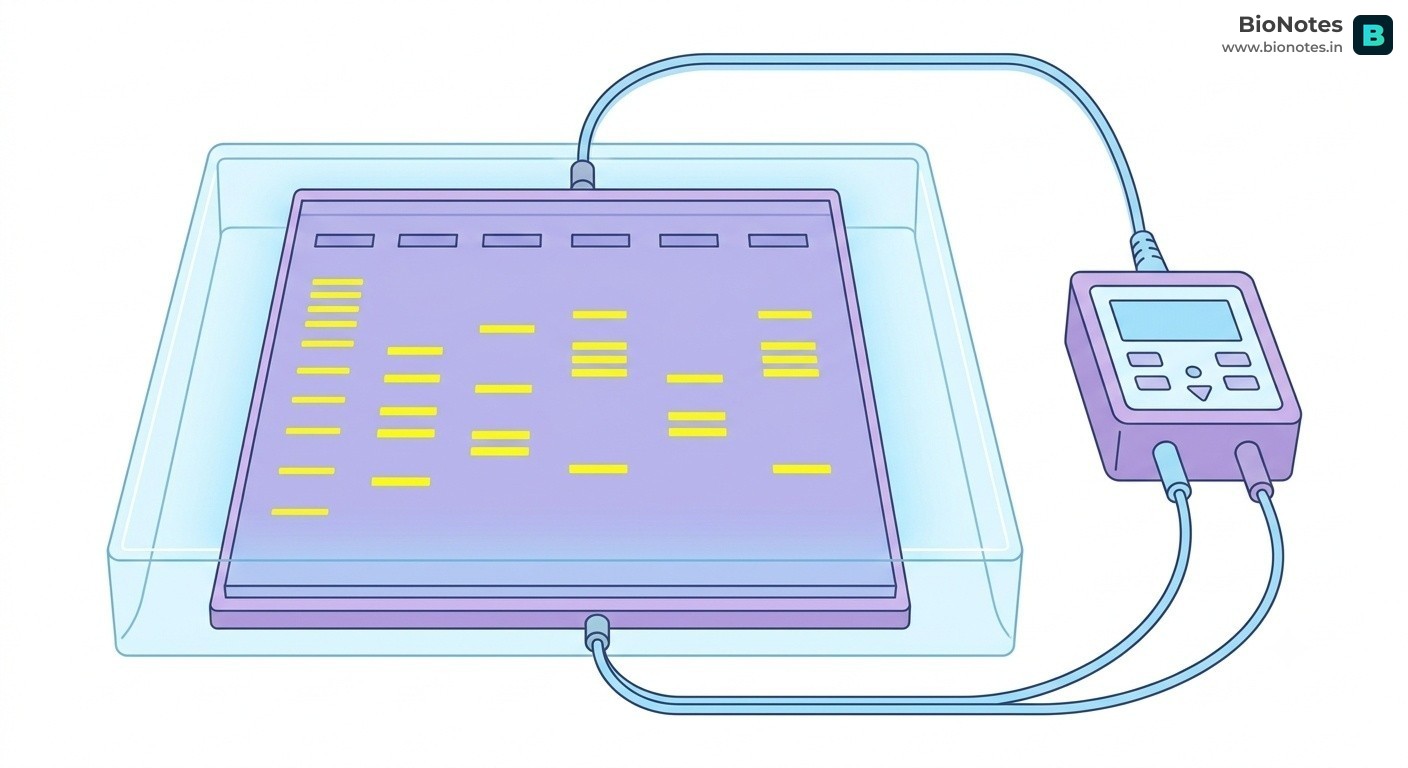
Activity 2: Gel Electrophoresis Simulation

Aim: To understand how DNA fragments are separated based on size.

Procedure:

  1. Study Figure 9.3 in the textbook.
  2. Observe the migration of DNA bands in lanes 2, 3, and 4.
  3. Identify the anode (+) and cathode (-) based on DNA's negative charge.
  4. Inquiry: If you have fragments of sizes 100 bp, 500 bp, and 2000 bp, which one will be found closest to the bottom (anode) of the gel? (Answer: 100 bp).

Conclusion: Agarose gel acts as a sieve; smaller fragments move faster and farther through the matrix.


Activity 3: Mapping the pBR322 Vector

Aim: To understand the functional regions of a standard cloning vector.

Procedure:

  1. Refer to Figure 9.4 in the textbook.
  2. Locate and sketch the following features:
    • ori: Origin of replication.
    • ampR and tetR: Antibiotic resistance genes (selectable markers).
    • BamHI and SalI sites: Located within the tetR gene.
    • PstI and PvuI sites: Located within the ampR gene.
    • EcoRI and HindIII sites: Unique cloning sites.
  3. Discuss why having a unique cloning site is preferable for gene insertion.

Conclusion: pBR322 is a versatile vector with multiple selectable markers and specific restriction sites for cloning.


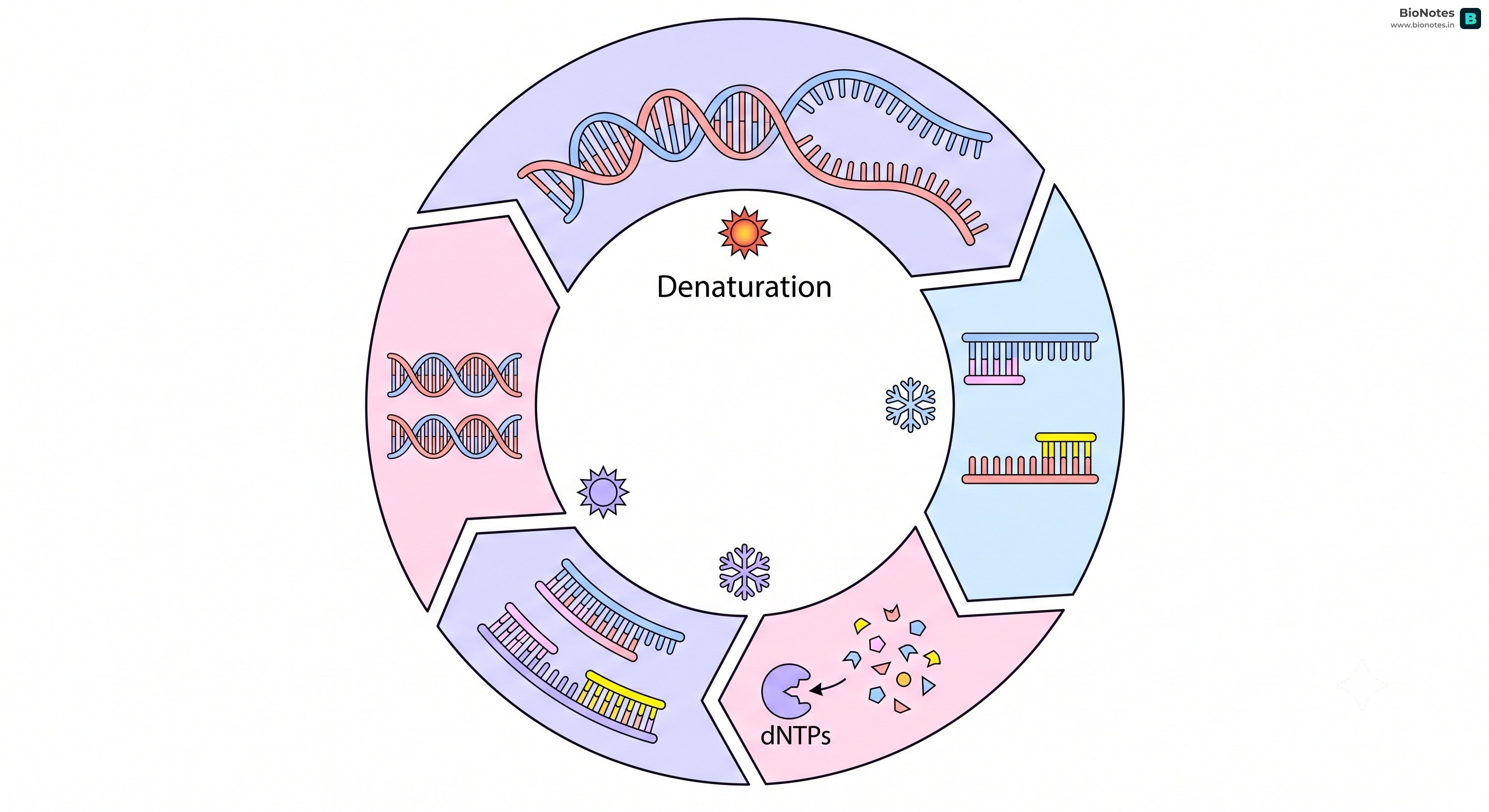
Activity 4: PCR Cycle Flowchart

Aim: To visualize the three main steps of the Polymerase Chain Reaction.

Procedure:

  1. Study Figure 9.6 in the textbook.
  2. Create a flowchart for one cycle of PCR:
    • Step 1: Denaturation (~94°C) → Double-stranded DNA becomes single-stranded.
    • Step 2: Annealing (~50-60°C) → Primers bind to the template.
    • Step 3: Extension (~72°C) → Taq polymerase synthesizes new strands.
  3. Inquiry: Why is a special DNA polymerase (Taq polymerase) required for this process? (Answer: To remain active during the high-temperature denaturation step).

Conclusion: PCR allows for the rapid, exponential amplification of a specific DNA segment in a short period.


Activity 5: Inquiry into Bioreactor Technology

Aim: To compare the efficiency of lab-scale cultures vs. industrial bioreactors.

Procedure:

  1. Compare a shake flask and a stirred-tank bioreactor (Figure 9.7).
  2. List the features in a bioreactor that are absent in a shake flask (e.g., pH control, foam control, oxygen delivery system).
  3. Research why "continuous culture" leads to higher yields compared to "batch culture".

Conclusion: Bioreactors provide the precise environment necessary for the large-scale production of high-quality recombinant proteins.

Location:/CBSE/NCERT/Activities/Class_12_Biology/Chapter_09_Biotechnology_Principles_and_Processes.mdx

Created by Titas Mallick

Biology Teacher • M.Sc. Botany • B.Ed. • CTET Qualified • 10+ years teaching experience