Class 11 Biology - Cell: The Unit of Life
NCERT Biology Exercises for Class 11 Biology - Cell: The Unit of Life - Class_11_Biology
Class 11 Biology - Cell: The Unit of Life
Exercises
1. Which of the following is not correct?
(a) Robert Brown discovered the cell. (b) Schleiden and Schwann formulated the cell theory. (c) Virchow explained that cells are formed from pre-existing cells. (d) A unicellular organism carries out its life activities within a single cell.
Answer: (a) Robert Brown discovered the cell. Explanation: Robert Brown discovered the nucleus in 1831. The cell was first seen and described by Antonie van Leeuwenhoek (live cell) and Robert Hooke (dead cell).
2. New cells generate from
(a) bacterial fermentation (b) regeneration of old cells (c) pre-existing cells (d) abiotic materials
Answer: (c) pre-existing cells. Explanation: Rudolf Virchow (1855) first explained that cells divide and new cells are formed from pre-existing cells (Omnis cellula-e cellula).
3. Match the following:
| Column I | Column II |
|---|---|
| (a) Cristae | (i) Flat membranous sacs in stroma |
| (b) Cisternae | (ii) Infoldings in mitochondria |
| (c) Thylakoids | (iii) Disc-shaped sacs in Golgi apparatus |
Answer: (a) — (ii) (b) — (iii) (c) — (i)
4. Which of the following is correct:
(a) Cells of all living organisms have a nucleus. (b) Both animal and plant cells have a well defined cell wall. (c) In prokaryotes, there are no membrane bound organelles. (d) Cells are formed de novo from abiotic materials.
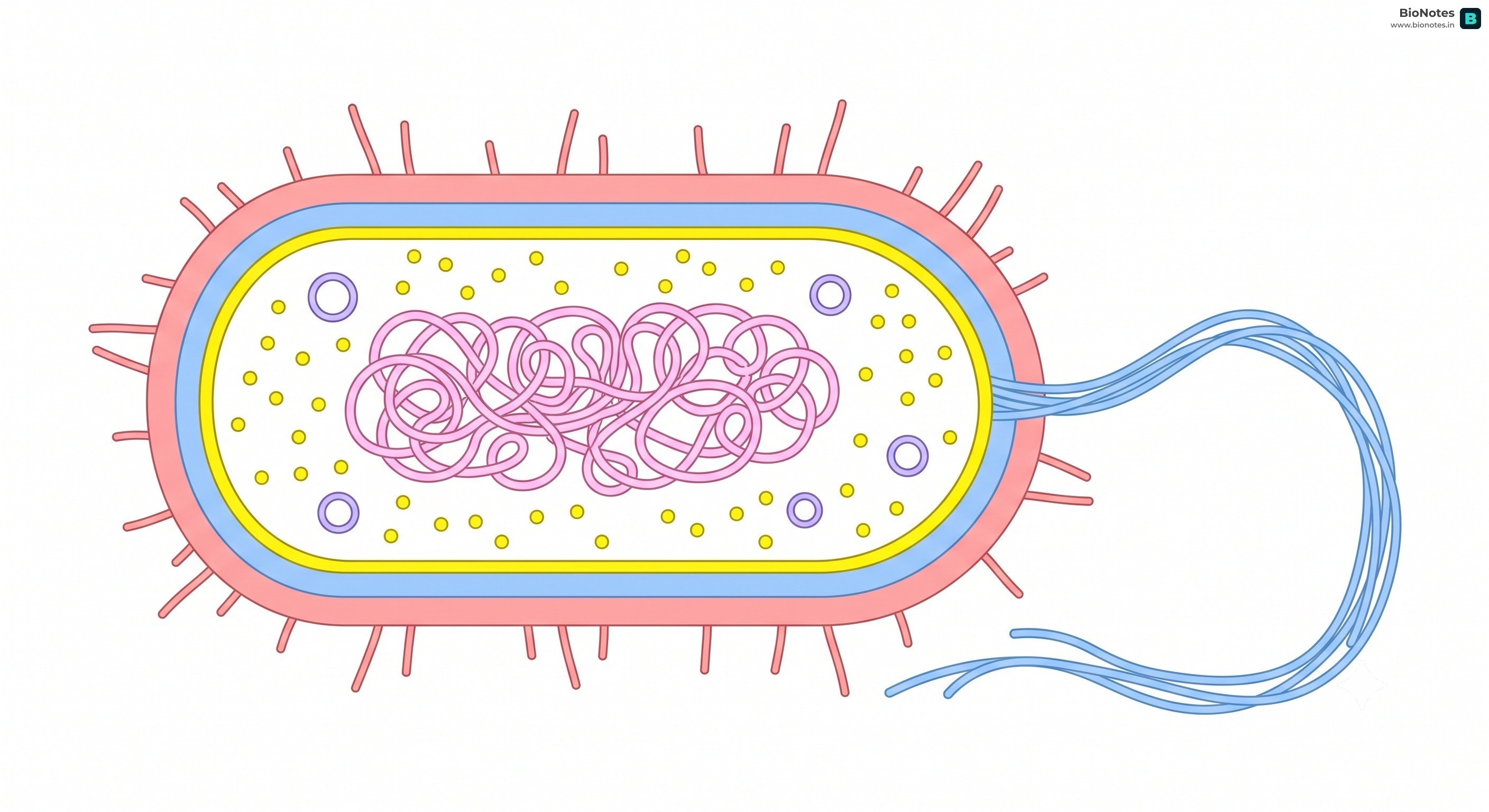
Answer: (c) In prokaryotes, there are no membrane bound organelles.
5. What is a mesosome in a prokaryotic cell? Mention the functions that it performs.
Answer: A mesosome is a specialized, differentiated form of the cell membrane found in prokaryotic cells. It is formed by the extensions of the plasma membrane into the cell in the form of vesicles, tubules, and lamellae.
Functions of Mesosomes:
- Cell Wall Formation: They help in the synthesis and formation of the cell wall.
- DNA Replication: They assist in the process of DNA replication.
- Distribution of DNA: They help in the distribution of genetic material to the daughter cells during division.
- Respiration and Secretion: They play a role in aerobic respiration and secretion processes.
- Surface Area Increase: They increase the surface area of the plasma membrane and the enzymatic content.
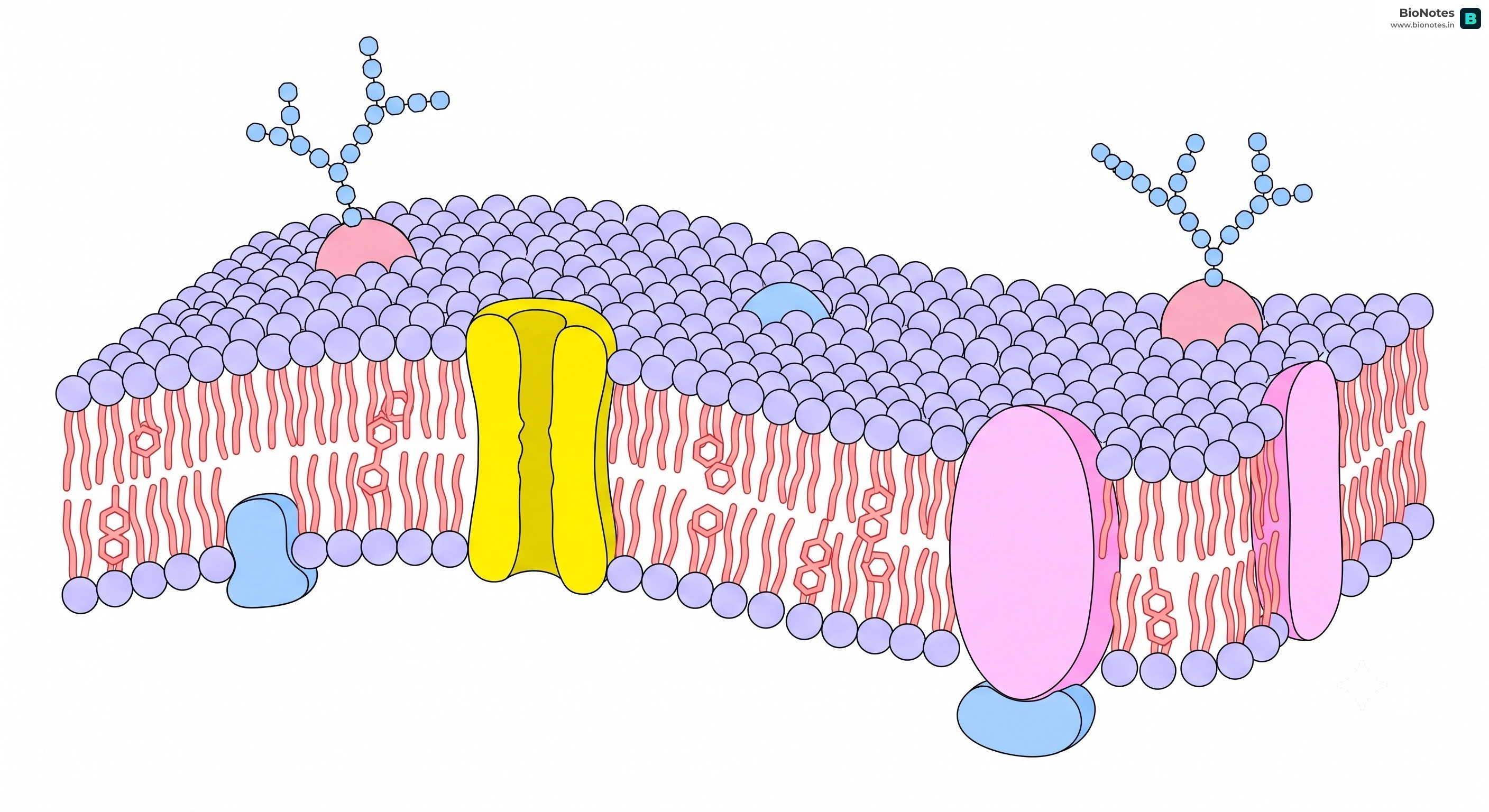
6. How do neutral solutes move across the plasma membrane? Can the polar molecules also move across it in the same way? If not, then how are these transported across the membrane?
Answer: Neutral Solutes: These move across the plasma membrane by the process of simple diffusion along the concentration gradient (from higher concentration to lower concentration).
Polar Molecules: No, polar molecules cannot pass through the non-polar lipid bilayer in the same way. Transport of Polar Molecules: They require carrier proteins of the membrane to facilitate their transport across the membrane (Facilitated Diffusion). Some ions or molecules are also transported against their concentration gradient (from lower to higher) via active transport, which is an energy-dependent process utilizing ATP (e.g., Na⁺/K⁺ pump).
7. Name two cell-organelles that are double membrane bound. What are the characteristics of these two organelles? State their functions and draw labelled diagrams of both.
Answer: Two double-membrane bound organelles are Mitochondria and Chloroplasts.
Mitochondria:
- Characteristics: Sausage-shaped or cylindrical. Possess an outer membrane and an inner membrane. The inner membrane forms infoldings called cristae which increase surface area. The inner compartment is called the matrix.
- Functions: Sites of aerobic respiration. They produce cellular energy in the form of ATP, earning them the title "power houses of the cell." They contain their own circular DNA, RNA, and 70S ribosomes.
Chloroplasts:
- Characteristics: Lens-shaped, oval, or discoid. Bound by two membranes; the inner one is less permeable. The space inside is called the stroma, which contains flattened sacs called thylakoids arranged in stacks called grana.
- Functions: Responsible for trapping light energy for photosynthesis. Stroma contains enzymes for carbohydrate and protein synthesis, as well as double-stranded circular DNA and 70S ribosomes.
8. What are the characteristics of prokaryotic cells?
Answer:
- Organisms: Represented by bacteria, blue-green algae, mycoplasma, and PPLO.
- Size and Speed: Generally smaller and multiply more rapidly than eukaryotic cells.
- Genetic Material: Lack a well-defined nucleus; genetic material is "naked" and not enveloped by a nuclear membrane.
- Organelles: Lack membrane-bound organelles (like ER, Golgi, etc.). Ribosomes are of the 70S type.
- Cell Envelope: Usually consists of a three-layered structure (glycocalyx, cell wall, and plasma membrane).
- Unique Structures: Contain mesosomes (infoldings of the membrane) and inclusion bodies for reserve material storage.
9. Multicellular organisms have division of labour. Explain.
Answer: In multicellular organisms, different groups of cells are specialized to perform specific functions. This is known as division of labour. Since one cell cannot perform every task efficiently, different tissues and organs take on specialized roles. For example, in humans, heart cells are specialized for pumping blood, nerve cells for transmitting impulses, and muscle cells for movement. This increases the overall efficiency and survival capability of the organism.
10. Cell is the basic unit of life. Discuss in brief.
Answer: The cell is called the basic unit of life because:
- It is the structural unit: Every living organism is composed of cells and their products.
- It is the functional unit: All essential life processes (metabolism, respiration, etc.) occur within cells.
- Independent Existence: Anything less than a complete cell structure does not ensure independent living (e.g., viruses).
- Reproduction: All cells arise from pre-existing cells, ensuring the continuity of life.
11. What are nuclear pores? State their function.
Answer: Nuclear pores are minute passages in the nuclear envelope formed by the fusion of its outer and inner membranes. Function: They act as channels for the movement of RNA and protein molecules in both directions between the nucleus and the cytoplasm.
12. Both lysosomes and vacuoles are endomembrane structures, yet they differ in terms of their functions. Comment.
Answer: While both belong to the endomembrane system, their roles are distinct:
- Lysosomes: Act as the "digestive system" of the cell. They contain hydrolytic enzymes (lipases, proteases, etc.) that break down carbohydrates, proteins, lipids, and nucleic acids. They are primarily involved in intracellular digestion and waste removal.
- Vacuoles: Act primarily as storage units. They contain water, sap, and excretory products. In plants, the tonoplast helps in the transport of ions against concentration gradients. Vacuoles also play roles in osmoregulation (contractile vacuoles in Amoeba) and feeding (food vacuoles).
13. Describe the structure of the following with the help of labelled diagrams.
(i) Nucleus (ii) Centrosome Answer: (i) Nucleus: Consists of a nuclear envelope (double membrane), nuclear matrix (nucleoplasm), nucleoli (sites of rRNA synthesis), and chromatin (DNA and proteins). The envelope has pores for molecular exchange. (ii) Centrosome: Contains two cylindrical centrioles lying perpendicular to each other. Each centriole has a "cartwheel" organization with nine peripheral triplets of tubulin. They form the basal bodies for cilia/flagella and spindle fibres for cell division.
14. What is a centromere? How does the position of centromere form the basis of classification of chromosomes. Support your answer with a diagram showing the position of centromere on different types of chromosomes.
Answer: The centromere (primary constriction) is the region of a chromosome that holds two sister chromatids together and where kinetochores are attached.
Classification based on Centromere position:
- Metacentric: Centromere is in the middle, forming two equal arms.
- Sub-metacentric: Centromere is slightly away from the middle, resulting in one shorter and one longer arm.
- Acrocentric: Centromere is situated close to the end, forming one extremely short and one very long arm.
- Telocentric: Centromere is at the terminal end.
/CBSE/NCERT/Exercises/Class_11_Biology/Chapter_08_Cell_The_Unit_of_Life.mdx