Class 11 Biology - Breathing and Exchange of Gases
NCERT Biology Exercises for Class 11 Biology - Breathing and Exchange of Gases - Class_11_Biology
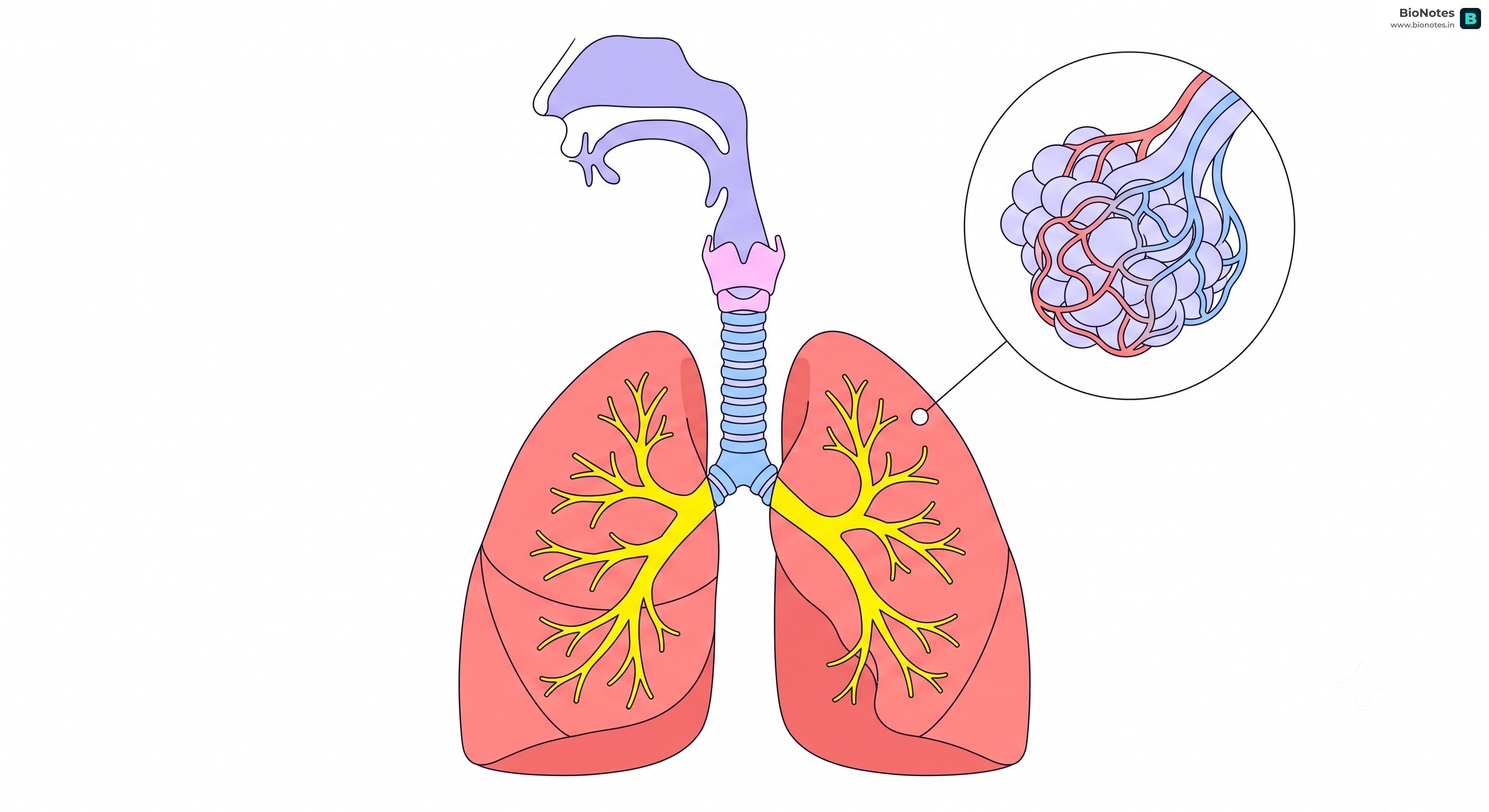
Class 11 Biology - Breathing and Exchange of Gases
Exercises
1. Define vital capacity. What is its significance?
Answer: Vital Capacity (VC) is the maximum volume of air a person can breathe out after a forced inspiration. It includes Expiratory Reserve Volume (ERV), Tidal Volume (TV), and Inspiratory Reserve Volume (IRV). It is significant because it represents the maximum amount of air that can be utilized for gas exchange and is an important indicator of lung function and health.
2. State the volume of air remaining in the lungs after a normal breathing.
Answer: The volume of air remaining in the lungs after a normal expiration is called the Functional Residual Capacity (FRC). It averages about 2100 mL to 2300 mL and consists of Expiratory Reserve Volume (ERV) and Residual Volume (RV).
3. Diffusion of gases occurs in the alveolar region only and not in the other parts of respiratory system. Why?
Answer: Diffusion occurs only in the alveolar region because it is the only part of the respiratory system that possesses the diffusion membrane. This membrane is extremely thin (less than 1 mm), vascularized, and made of simple squamous epithelium, which allows for the rapid exchange of gases. Other parts of the system, like the trachea and bronchi, act only as conducting passages.
4. What are the major transport mechanisms for CO2? Explain.
Answer: Carbon dioxide is transported by the blood in three ways:
- As Bicarbonate (70%): $CO_2$ enters RBCs, reacts with water to form carbonic acid (catalyzed by carbonic anhydrase), which then dissociates into bicarbonate and hydrogen ions.
- As Carbamino-haemoglobin (20–25%): $CO_2$ binds directly to the amino groups of haemoglobin.
- In Dissolved State (7%): Carried as dissolved gas in the blood plasma.
5. What will be the pO2 and pCO2 in the atmospheric air compared to those in the alveolar air?
Answer: The correct option is (ii) pO2 higher, pCO2 lesser. Atmospheric air has a $pO_2$ of 159 mm Hg and $pCO_2$ of 0.3 mm Hg, while alveolar air has a $pO_2$ of 104 mm Hg and $pCO_2$ of 40 mm Hg.
6. Explain the process of inspiration under normal conditions.
Answer: Inspiration is an active process initiated by the contraction of the diaphragm (which increases thoracic volume in the antero-posterior axis) and the contraction of external intercostal muscles (which lifts the ribs and sternum, increasing volume in the dorso-ventral axis). These actions increase the thoracic and pulmonary volume, leading to a decrease in intra-pulmonary pressure below atmospheric pressure, causing air to rush into the lungs.
7. How is respiration regulated?
Answer: Respiration is primarily regulated by the Respiratory Rhythm Centre in the medulla, which maintains the basic rhythm. A Pneumotaxic Centre in the pons moderates this rhythm by reducing the duration of inspiration. Additionally, chemosensitive areas in the medulla and receptors in the aortic arch/carotid artery sense increases in $CO_2$ and $H^+$ levels, signaling the rhythm centre to adjust the breathing rate to eliminate these substances.
8. What is the effect of pCO2 on oxygen transport?
Answer: High $pCO_2$ reduces the affinity of haemoglobin for oxygen, leading to the dissociation of oxyhaemoglobin. This is known as the Bohr effect. In tissues where $pCO_2$ is high, oxygen is released more readily, while in the alveoli where $pCO_2$ is low, oxygen binding to haemoglobin is favored.
9. What happens to the respiratory process in a man going up a hill?
Answer: At high altitudes, the partial pressure of oxygen in the atmosphere decreases. To compensate for the reduced oxygen availability, the person experiences altitude sickness (nausea, fatigue). The body responds by:
- Increasing the breathing rate.
- Increasing the production of RBCs.
- Decreasing the binding affinity of haemoglobin to release more oxygen to the tissues.
10. What is the site of gaseous exchange in an insect?
Answer: The site of gaseous exchange in an insect is the network of tracheal tubes and smaller tracheoles that carry oxygen directly to the body cells.
11. Define oxygen dissociation curve. Can you suggest any reason for its sigmoidal pattern?
Answer: The Oxygen Dissociation Curve is a sigmoid (S-shaped) curve that plots the percentage saturation of haemoglobin with oxygen against the partial pressure of oxygen ($pO_2$). The sigmoidal pattern is due to the cooperative binding of oxygen to the four subunits of the haemoglobin molecule; as one oxygen molecule binds, it changes the shape of the protein, making it easier for the subsequent oxygen molecules to bind.
12. Have you heard about hypoxia?
Answer: Hypoxia is a condition in which the body or a specific region of the body is deprived of adequate oxygen supply at the tissue level. It can be caused by low atmospheric oxygen (altitude), respiratory diseases (like pneumonia), or circulatory problems.
13. Distinguish between:
(a) IRV and ERV (b) IC and EC (c) VC and TLC
Answer: (a) IRV vs. ERV: IRV is the extra volume of air one can inspire after a normal inspiration. ERV is the extra volume one can expire after a normal expiration. (b) IC vs. EC: IC is the total volume one can inspire after a normal expiration ($TV+IRV$). EC is the total volume one can expire after a normal inspiration ($TV+ERV$). (c) VC vs. TLC: VC is the maximum air one can breathe out after forced inspiration. TLC is the total volume of air in the lungs after forced inspiration ($VC+RV$).
14. What is Tidal volume? Find for a healthy human in an hour.
Answer: Tidal Volume (TV) is the volume of air inspired or expired during a normal breath, which is approximately 500 mL. A healthy human breathes 12–16 times per minute.
- Per minute: $500$ mL $\times 12 = 6000$ mL (minimum).
- Per hour: $6000$ mL $\times 60 = 360,000$ mL or 360 Litres (approximate value).
/CBSE/NCERT/Exercises/Class_11_Biology/Chapter_14_Breathing_and_Exchange_of_Gases.mdx