BioNotes
CBSE/NCERT/Exercises/Class_11_Biology

Class 11 Biology - Respiration in Plants

NCERT Biology Exercises for Class 11 Biology - Respiration in Plants - Class_11_Biology

Class 11 Biology - Respiration in Plants

Exercises

1. Differentiate between:

(a) Respiration and Combustion (b) Glycolysis and Krebs’ cycle (c) Aerobic respiration and Fermentation
Answer: (a) Respiration vs. Combustion: Respiration is a biochemical process occurring within cells where energy is released in small, step-wise reactions controlled by enzymes and trapped as ATP. Combustion is a physiochemical process where energy is released in a single step as heat and light, not controlled by enzymes. (b) Glycolysis vs. Krebs' Cycle: Glycolysis occurs in the cytoplasm and involves the partial oxidation of glucose into pyruvic acid, yielding a net of 2 ATP. Krebs' cycle occurs in the mitochondrial matrix and involves the complete oxidation of acetyl CoA, yielding CO2, ATP, NADH, and FADH2. (c) Aerobic Respiration vs. Fermentation: Aerobic respiration requires oxygen for the complete oxidation of glucose to CO2 and H2O, yielding high ATP (up to 38). Fermentation occurs under anaerobic conditions, involves incomplete oxidation, and yields only 2 ATP.


2. What are respiratory substrates? Name the most common respiratory substrate.

Answer: Respiratory substrates are the organic compounds that are oxidized during the process of respiration to release energy. The most common respiratory substrate is glucose (a carbohydrate). Others include fats, proteins, and organic acids.


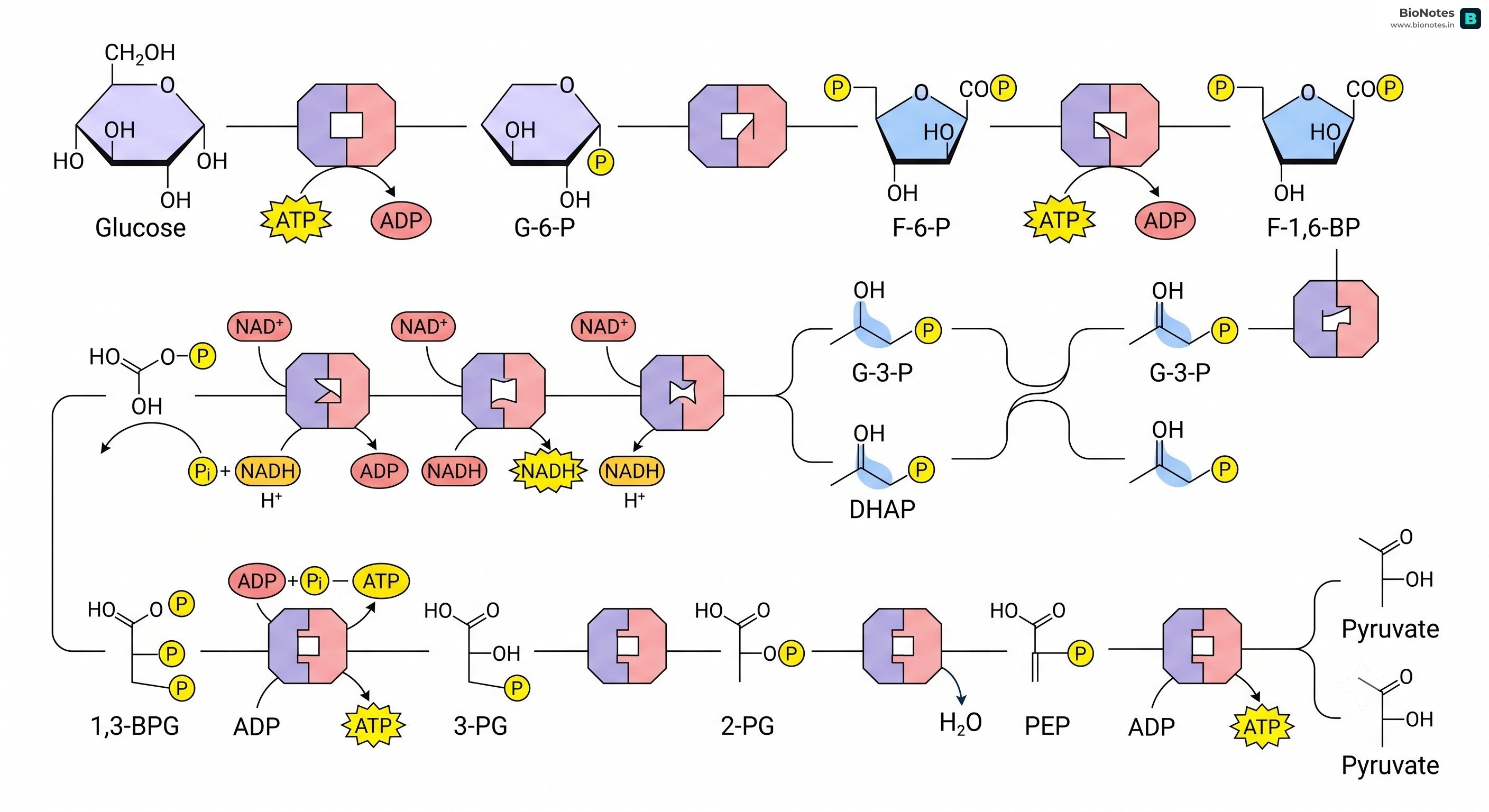
3. Give the schematic representation of glycolysis?

Answer:

  • Step 1: Glucose $\rightarrow$ Glucose-6-phosphate (Uses 1 ATP)
  • Step 2: Glucose-6-phosphate $\rightarrow$ Fructose-6-phosphate
  • Step 3: Fructose-6-phosphate $\rightarrow$ Fructose-1,6-bisphosphate (Uses 1 ATP)
  • Step 4: Fructose-1,6-bisphosphate $\rightarrow$ DHAP + PGAL
  • Step 5: PGAL $\rightarrow$ 1,3-bisphosphoglyceric acid (Produces 2 NADH)
  • Step 6: 1,3-bisphosphoglyceric acid $\rightarrow$ 3-phosphoglyceric acid (Produces 2 ATP)
  • Step 7: 3-phosphoglyceric acid $\rightarrow$ 2-phosphoglycerate
  • Step 8: 2-phosphoglycerate $\rightarrow$ Phosphoenolpyruvate (PEP)
  • Step 9: PEP $\rightarrow$ Pyruvic acid (Produces 2 ATP)

4. What are the main steps in aerobic respiration? Where does it take place?

Answer: The main steps are:

  1. Glycolysis: Occurs in the cytoplasm.
  2. Oxidative Decarboxylation of Pyruvate: Occurs in the mitochondrial matrix.
  3. Krebs' Cycle (TCA Cycle): Occurs in the mitochondrial matrix.
  4. Electron Transport System (ETS) & Oxidative Phosphorylation: Occurs on the inner mitochondrial membrane.

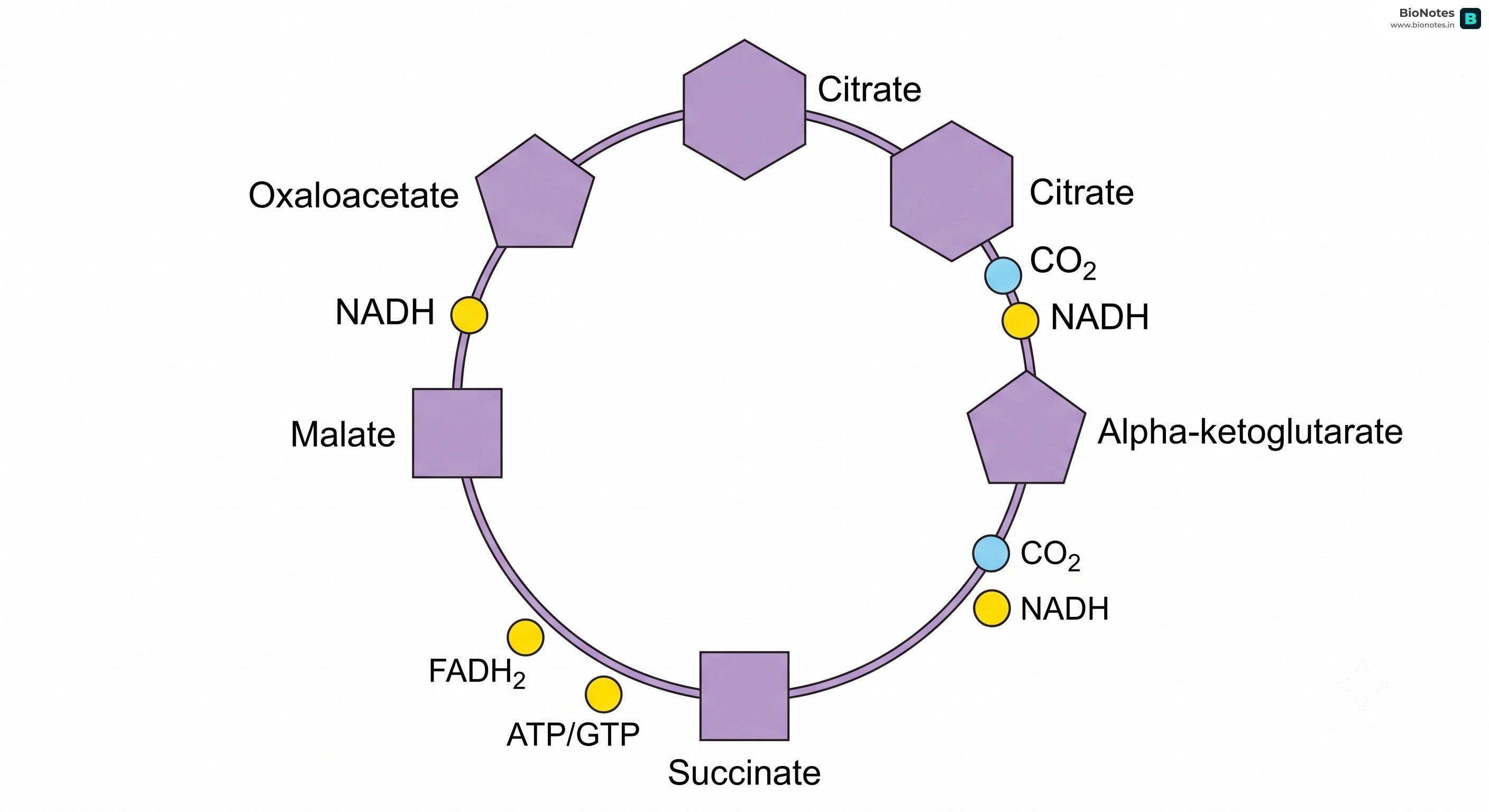
5. Give the schematic representation of an overall view of Krebs’ cycle.

Answer:

  • Acetyl CoA (2C) + Oxaloacetic acid (4C) $\rightarrow$ Citric acid (6C)
  • Citric acid $\rightarrow$ Isocitric acid $\rightarrow$ $\alpha$-ketoglutaric acid (5C) + CO2 + NADH
  • $\alpha$-ketoglutaric acid $\rightarrow$ Succinyl-CoA (4C) + CO2 + NADH
  • Succinyl-CoA $\rightarrow$ Succinic acid + GTP (ATP)
  • Succinic acid $\rightarrow$ Fumaric acid $\rightarrow$ Malic acid + FADH2
  • Malic acid $\rightarrow$ Oxaloacetic acid + NADH

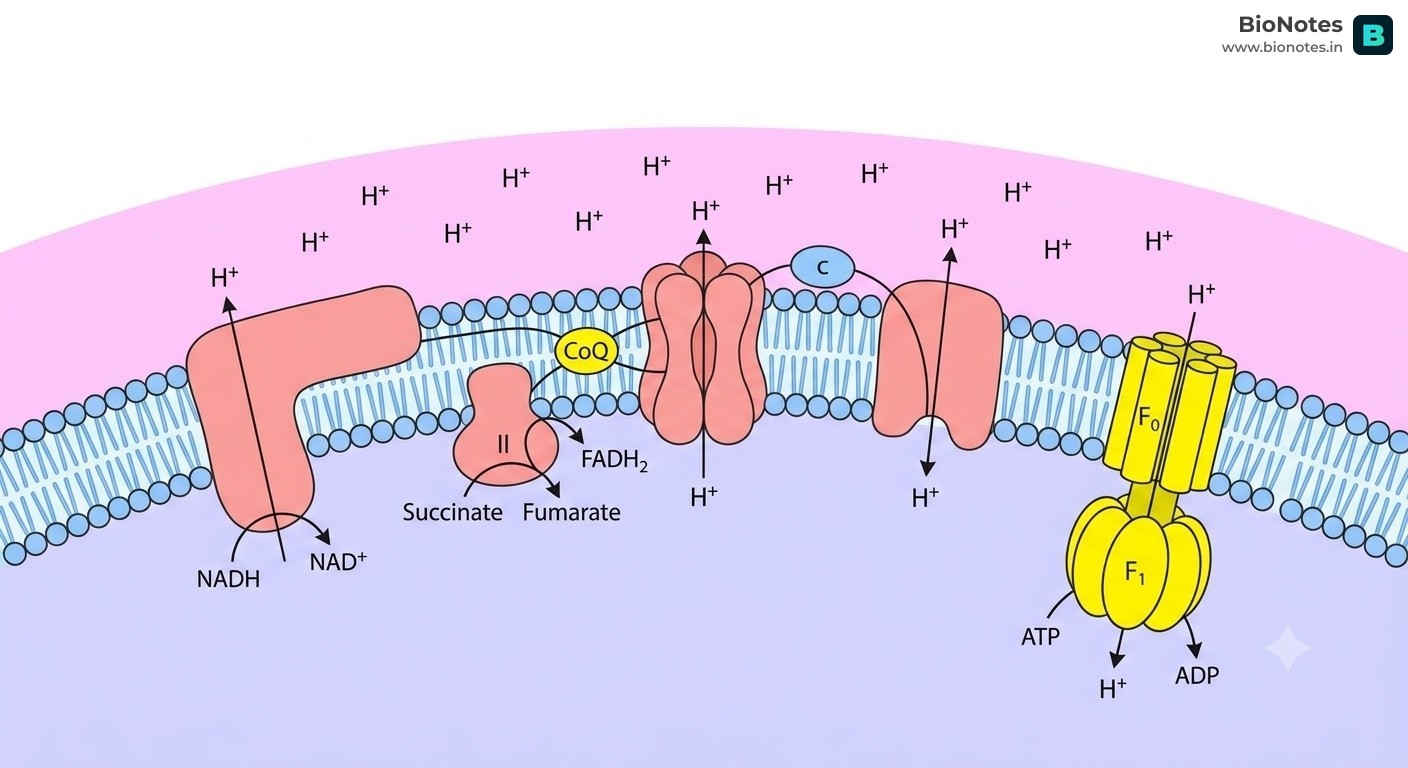
6. Explain ETS.

Answer: The Electron Transport System (ETS) is a series of electron carriers located on the inner mitochondrial membrane. Electrons from NADH and FADH2 are passed through complexes (I to IV). This movement is coupled to the pumping of protons into the intermembrane space, creating a gradient. Finally, oxygen acts as the ultimate electron acceptor, combining with protons to form water. The proton gradient drives ATP synthesis through Complex V (ATP Synthase).


7. Distinguish between the following:

(a) Aerobic respiration and Anaerobic respiration (b) Glycolysis and Fermentation (c) Glycolysis and Citric acid Cycle
Answer: (a) Aerobic vs. Anaerobic: Aerobic uses oxygen and yields 38 ATP. Anaerobic does not use oxygen and yields only 2 ATP. (b) Glycolysis vs. Fermentation: Glycolysis is the first step of both aerobic and anaerobic respiration where glucose is split into pyruvate. Fermentation follows glycolysis in anaerobic conditions to regenerate NAD+ by forming ethanol or lactic acid. (c) Glycolysis vs. Citric Acid Cycle: Glycolysis is linear, occurs in cytoplasm, and produces pyruvate. Citric Acid Cycle is cyclic, occurs in mitochondria, and completes the oxidation of acetyl group to CO2.


8. What are the assumptions made during the calculation of net gain of ATP?

Answer:

  1. The pathways (Glycolysis, TCA, ETS) function sequentially and orderly.
  2. NADH produced in glycolysis is transferred into the mitochondria for phosphorylation.
  3. None of the intermediates are diverted for other biosynthetic purposes.
  4. Only glucose is used as the respiratory substrate.

9. Discuss “The respiratory pathway is an amphibolic pathway.”

Answer: Respiration was traditionally considered catabolic because it involves the breakdown of substrates like glucose to release energy. However, many intermediates of the respiratory pathway are also precursors for the synthesis (anabolism) of other molecules. For example, Acetyl CoA is used to synthesize fatty acids, and Krebs' cycle intermediates are used for amino acid synthesis. Since it involves both catabolism and anabolism, it is called an amphibolic pathway.


10. Define RQ. What is its value for fats?

Answer: Respiratory Quotient (RQ) is the ratio of the volume of CO2 evolved to the volume of O2 consumed during respiration. For fats (like tripalmitin), the RQ value is 0.7.


11. What is oxidative phosphorylation?

Answer: Oxidative phosphorylation is the process of ATP synthesis using the energy released during the oxidation-reduction reactions of the electron transport system in the mitochondria, where oxygen acts as the final electron acceptor.


12. What is the significance of step-wise release of energy in respiration?

Answer: The step-wise release of energy ensures that:

  1. The energy is released in small, manageable amounts that can be efficiently trapped as ATP.
  2. The cell is protected from sudden high temperatures that would result if energy were released all at once.
  3. Intermediates produced at different steps can be utilized for various biosynthetic pathways.
Location:/CBSE/NCERT/Exercises/Class_11_Biology/Chapter_12_Respiration_in_Plants.mdx

Created by Titas Mallick

Biology Teacher • M.Sc. Botany • B.Ed. • CTET Qualified • 10+ years teaching experience