Class 11
Created by Titas Mallick
Biology Teacher • M.Sc. Botany • B.Ed. • CTET (CBSE) • CISCE Examiner
 BioNotes
Created by Titas Mallick
Biology Teacher • M.Sc. Botany • B.Ed. • CTET (CBSE) • CISCE Examiner
Online
Note on Heart Attack and Cardiac Arrest
It is crucial to understand the distinction between a heart attack and cardiac arrest, as they are often confused but represent fundamentally different medical emergencies with distinct causes, symptoms, and immediate treatments.
Plumbing vs. Wiring A simple way to remember: A Heart Attack is a Plumbing problem (blocked pipe/artery). Cardiac Arrest is a Wiring problem (electrical glitch).
Clarification:
| Feature | Heart Attack (Myocardial Infarction) | Cardiac Arrest |
|---|---|---|
| Definition | Death of heart muscle tissue due to prolonged lack of blood supply. | Abrupt loss of heart function, breathing, and consciousness due to an electrical problem. |
| Primary Problem | Circulatory (Plumbing): Blockage in a coronary artery. | Electrical (Wiring): Malfunction in the heart's electrical system. |
| Cause | Usually a blood clot in a coronary artery, often due to atherosclerosis. | Most commonly a life-threatening arrhythmia (e.g., ventricular fibrillation). Can be caused by MI, electrocution, drowning, severe trauma, etc. |
| Symptoms | Chest pain (pressure, tightness), shortness of breath, pain radiating to arm/jaw/back, nausea, sweating, lightheadedness. Patient is usually conscious. | Sudden collapse, no breathing, no pulse, loss of consciousness. Occurs without warning or with very brief symptoms. |
| Consciousness | Conscious (though may feel faint or lightheaded). | Unconscious immediately. |
| Breathing | May have shortness of breath, but still breathing. | Not breathing (or only gasping/agonal breaths). |
| Pulse | Present (though may be weak or irregular). | Absent. |
| ECG Findings | ST-segment elevation (STEMI) or depression/T-wave inversion (NSTEMI), pathological Q waves. | Ventricular Fibrillation (VF), Pulseless Ventricular Tachycardia (pVT), Asystole, Pulseless Electrical Activity (PEA). |
| Immediate Treatment | Restore blood flow (e.g., angioplasty/stent, thrombolytics), oxygen, pain relief, antiplatelets. | CPR (chest compressions) and Defibrillation (if shockable rhythm). |
| Prognosis | Depends on extent of damage and promptness of treatment. Can lead to heart failure or arrhythmias. | Very poor without immediate CPR and defibrillation. Survival rates are low. |
| Relationship | A heart attack can lead to cardiac arrest (if the damage causes a severe electrical disturbance). | Cardiac arrest is a consequence of a severe underlying problem, which may or may not be a heart attack. |
A myocardial infarction (MI), commonly known as a heart attack, occurs when blood flow to a part of the heart muscle is severely reduced or completely blocked. This blockage is almost always due to a buildup of plaque (atherosclerosis) in the coronary arteries, which supply blood to the heart. When a plaque ruptures, a blood clot forms at the site, obstructing blood flow. Without oxygen and nutrients, the affected heart muscle tissue begins to die (infarct).
Symptoms can vary widely among individuals and may not always be severe. Common symptoms include:
Crucially, the patient remains conscious and typically has a pulse and is breathing, although breathing may be labored.
 www.bionotes.in
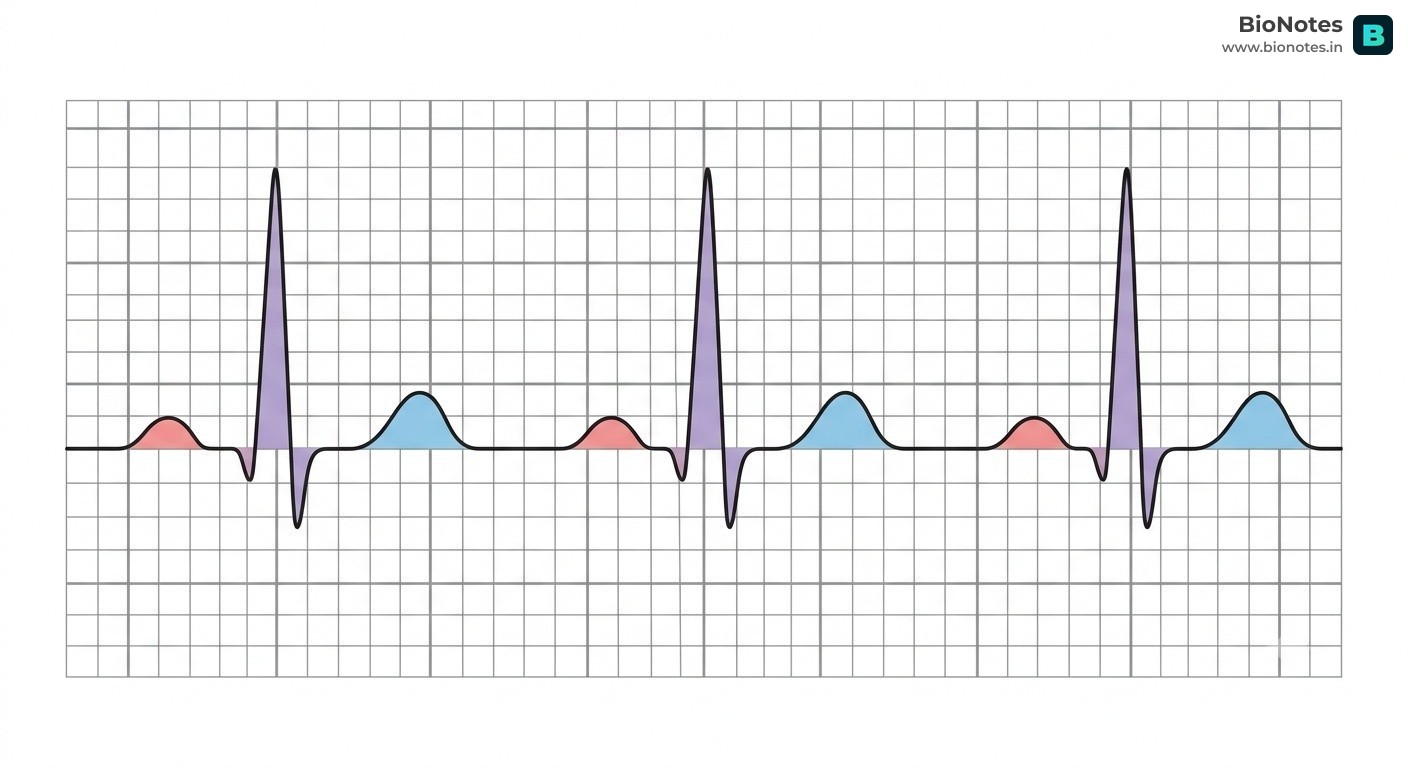
ECG changes depend on the type and location of the MI:
Immediate treatment focuses on restoring blood flow to the heart muscle and minimizing damage:
The prognosis depends heavily on the extent of heart muscle damage and the speed of treatment. A heart attack can lead to complications such as heart failure, arrhythmias, and cardiogenic shock.
Cardiac arrest is an abrupt and complete cessation of the heart's pumping function, leading to the immediate loss of effective blood circulation. It is primarily an electrical problem where the heart's electrical activity becomes chaotic (e.g., ventricular fibrillation) or ceases entirely (asystole), preventing the heart from pumping blood to the brain and other vital organs.
While a heart attack can lead to cardiac arrest, cardiac arrest can also be caused by many other factors:
Cardiac arrest is characterized by a sudden and dramatic onset:
The patient is unconscious, not breathing, and has no pulse.
ECG during cardiac arrest will show a life-threatening arrhythmia:
Immediate action is critical for survival:
Survival from cardiac arrest is very low, especially outside of a hospital setting, and depends heavily on the speed of CPR and defibrillation. Every minute without these interventions significantly reduces the chance of survival and increases the likelihood of neurological damage.
While distinct, a heart attack can be a cause of cardiac arrest. The damage to the heart muscle from a heart attack can disrupt the heart's electrical system, leading to life-threatening arrhythmias like ventricular fibrillation, which then cause cardiac arrest. However, not all heart attacks lead to cardiac arrest, and not all cardiac arrests are caused by heart attacks.
Understanding these differences is vital for recognizing the emergency and initiating the correct, life-saving interventions.