BioNotes
CBSE/NCERT/Notes/Class_11_Biology

Morphology of Flowering Plants

Comprehensive notes on NCERT Class 11 Biology Chapter 5

Morphology of Flowering Plants

The study of the external structure or forms of plants is known as morphology. Angiosperms (flowering plants) are characterized by the presence of roots, stems, leaves, flowers, and fruits.
Key Concepts

1. The Root

The underground part of the plant is the root system.

  • Types of Root Systems:
    • Tap Root System: Primary root (from radicle) and its lateral branches (e.g., Mustard). Common in dicots.
    • Fibrous Root System: Primary root is short-lived, replaced by numerous roots originating from the base of the stem (e.g., Wheat). Common in monocots.
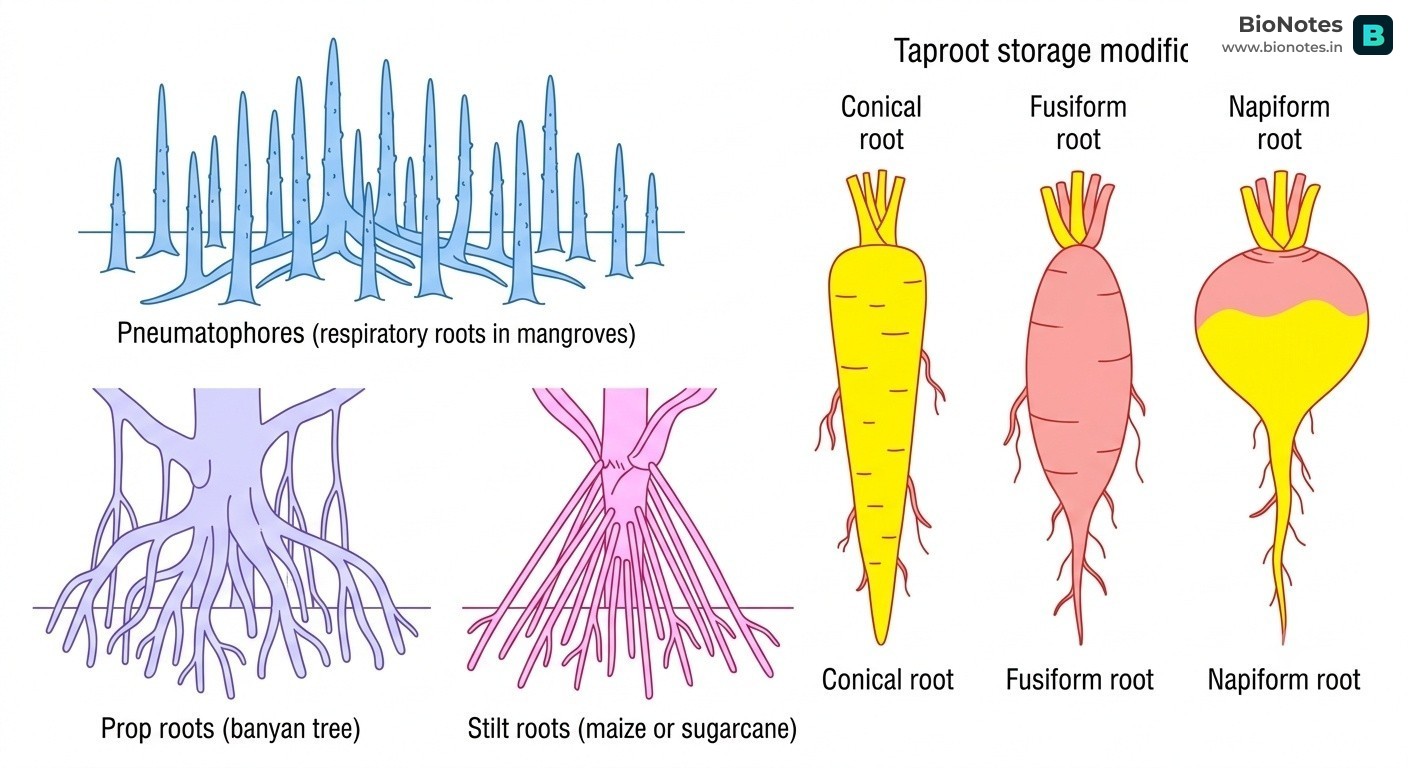
    • Adventitious Roots: Roots arising from parts other than the radicle (e.g., Grass, Monstera, Banyan tree).
  • Regions of the Root:
    1. Root Cap: Thimble-like structure protecting the apex.
    2. Region of Meristematic Activity: Small, thin-walled cells with dense protoplasm that divide repeatedly.
    3. Region of Elongation: Cells undergo rapid elongation and enlargement, responsible for root growth in length.
    4. Region of Maturation: Cells differentiate and mature.
    5. Root Hairs: Fine, delicate, thread-like structures from epidermal cells that absorb water and minerals.

2. The Stem

The ascending part of the axis that develops from the plumule.

  • Features: Bears nodes (where leaves are born) and internodes (portions between nodes). Bears terminal or axillary buds.
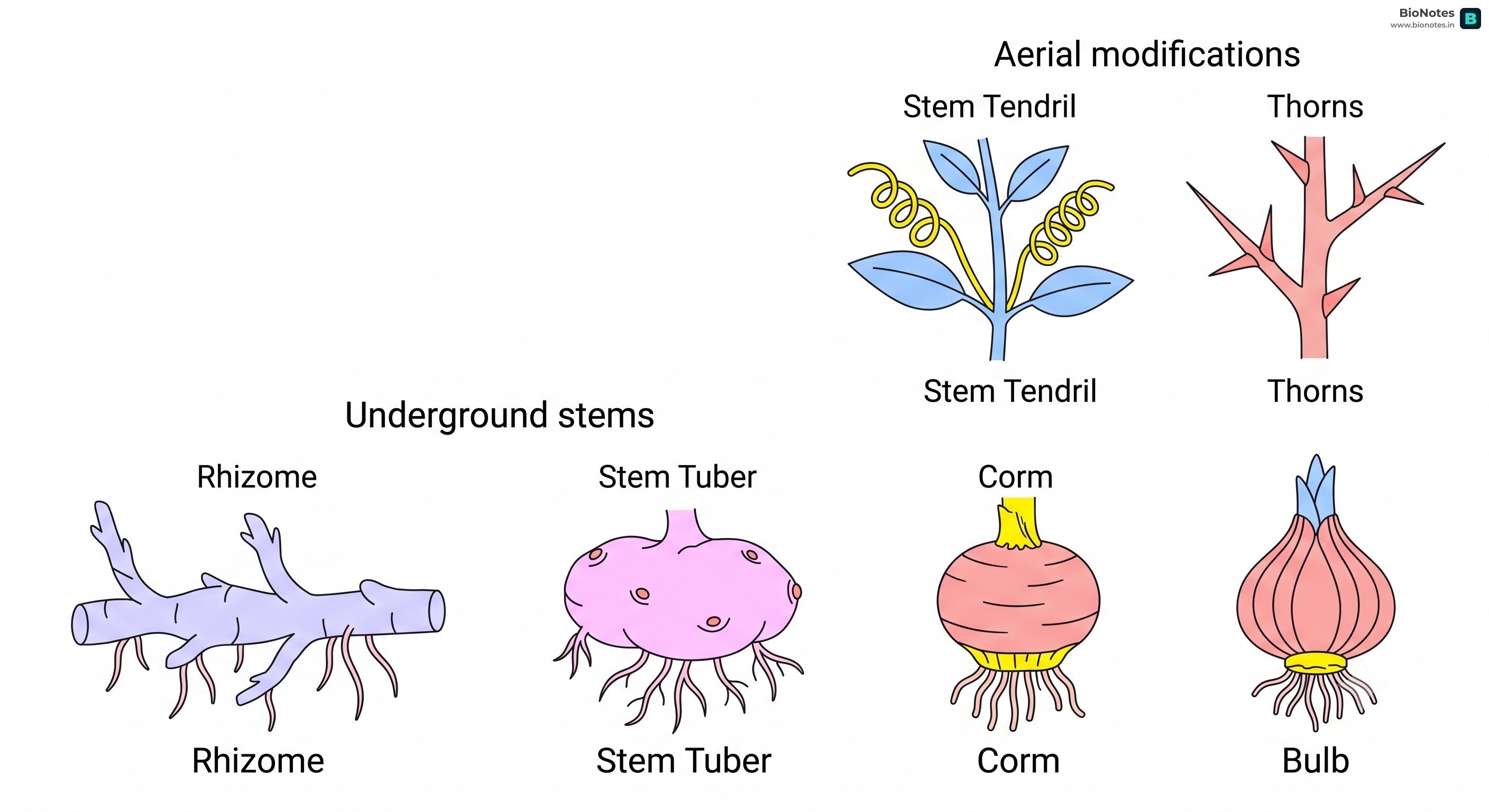
  • Functions: Spreading branches, conducting water/minerals/photosynthates, and sometimes storage, support, or vegetative propagation.

3. The Leaf

A lateral, flattened structure developed at the node.
  • Parts of a Typical Leaf:
    • Leaf Base: Attachment to stem; may have stipules. Swollen leaf base is called pulvinus (e.g., legumes).
    • Petiole: Holds the blade to light and allows fluttering for cooling.
    • Lamina (Leaf Blade): Green expanded part with veins and midrib.
  • Venation:
    • Reticulate: Veinlets form a network (mostly dicots).
    • Parallel: Veins run parallel to each other (mostly monocots).
  • Types of Leaves:
    • Simple: Lamina is entire or incisions do not touch midrib.
    • Compound: Incisions reach midrib, breaking it into leaflets.
      • Pinnately Compound: Leaflets on a common axis (rachis) (e.g., Neem).
      • Palmately Compound: Leaflets attached at the tip of the petiole (e.g., Silk cotton).
  • Phyllotaxy: Arrangement of leaves on stem.
    • Alternate: Single leaf at each node (China rose, Mustard).
    • Opposite: Pair of leaves at each node (Calotropis, Guava).
    • Whorled: More than two leaves at a node (Alstonia).

4. The Inflorescence

Arrangement of flowers on the floral axis.
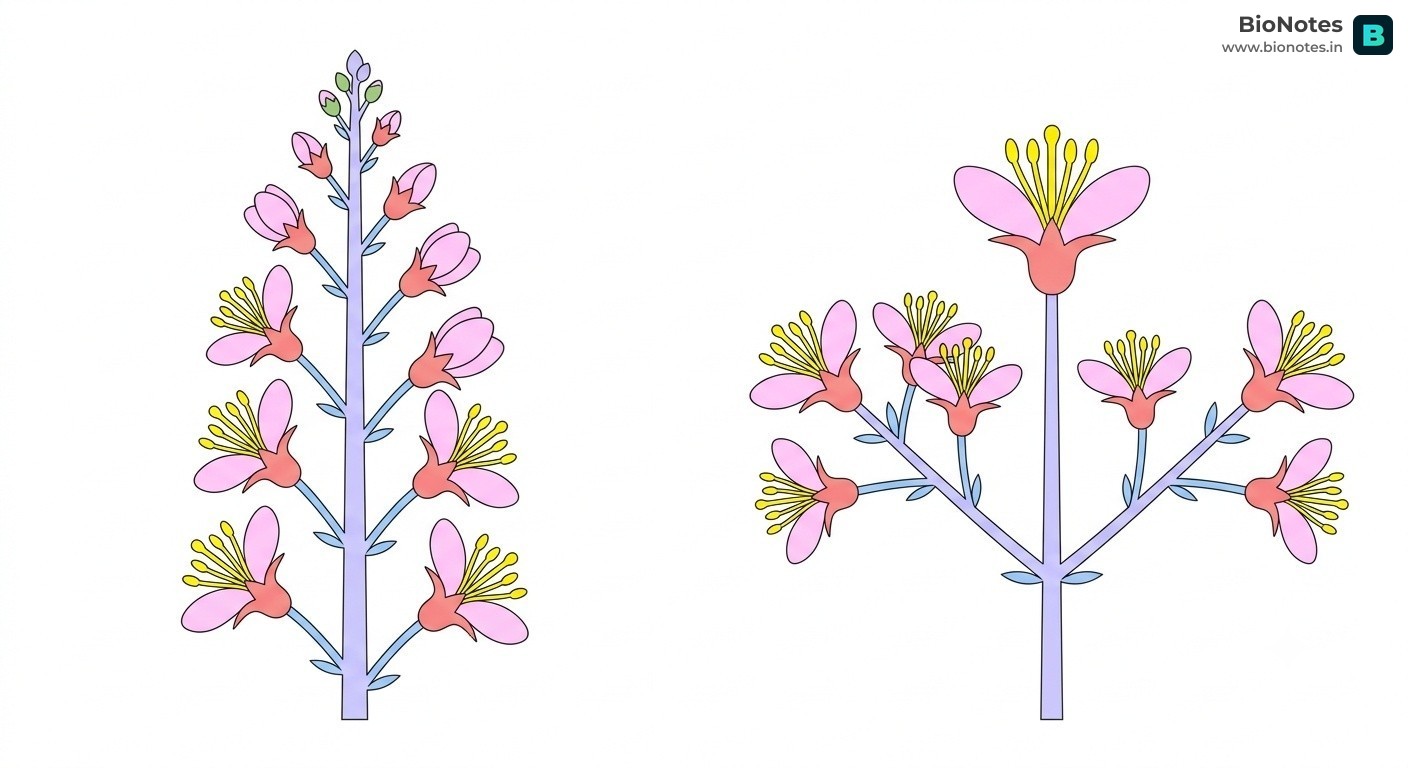
  • Racemose: Main axis continues to grow; flowers in acropetal succession.
  • Cymose: Main axis terminates in a flower; limited growth; flowers in basipetal order.

5. The Flower

The reproductive unit of angiosperms.

  • Symmetry:
    • Actinomorphic (Radial): Can be divided into equal halves in any radial plane (Mustard, Chilli).
    • Zygomorphic (Bilateral): Can be divided into similar halves in only one vertical plane (Pea, Gulmohur).
    • Asymmetric: Cannot be divided into similar halves (Canna).
  • Position of Floral Parts on Thalamus:
    • Hypogynous: Gynoecium at the highest position; ovary superior (Mustard, Brinjal).
    • Perigynous: Gynoecium in the centre, other parts on the rim; ovary half-inferior (Plum, Rose).
    • Epigynous: Thalamus encloses ovary completely; ovary inferior (Guava, Cucumber).
  • Parts of a Flower:
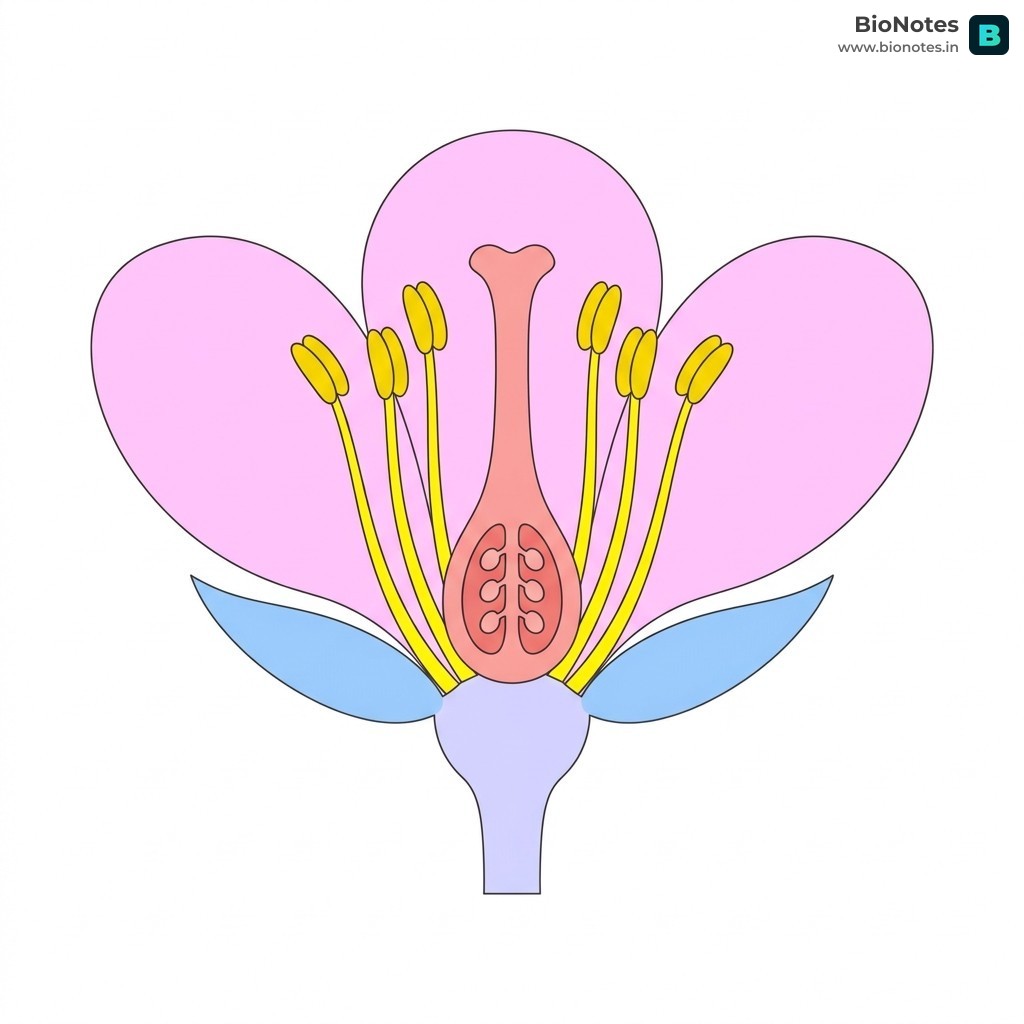
    1. Calyx: Outermost whorl of sepals.
    2. Corolla: Whorl of petals; colorful to attract pollinators. Aestivation (arrangement of sepals/petals) can be valvate, twisted, imbricate, or vexillary.
    3. Androecium: Male part (stamens). Each has a filament and anther.
    4. Gynoecium: Female part (carpels). Consists of stigma, style, and ovary. Placentation (arrangement of ovules) can be marginal, axile, parietal, free central, or basal.

6. The Fruit

A mature or ripened ovary developed after fertilization.
  • Drupe: Fleshy fruit with a stony endocarp (Mango, Coconut).
  • Parthenocarpic Fruit: Formed without fertilization (e.g., Banana).

7. The Seed

The developed ovule.

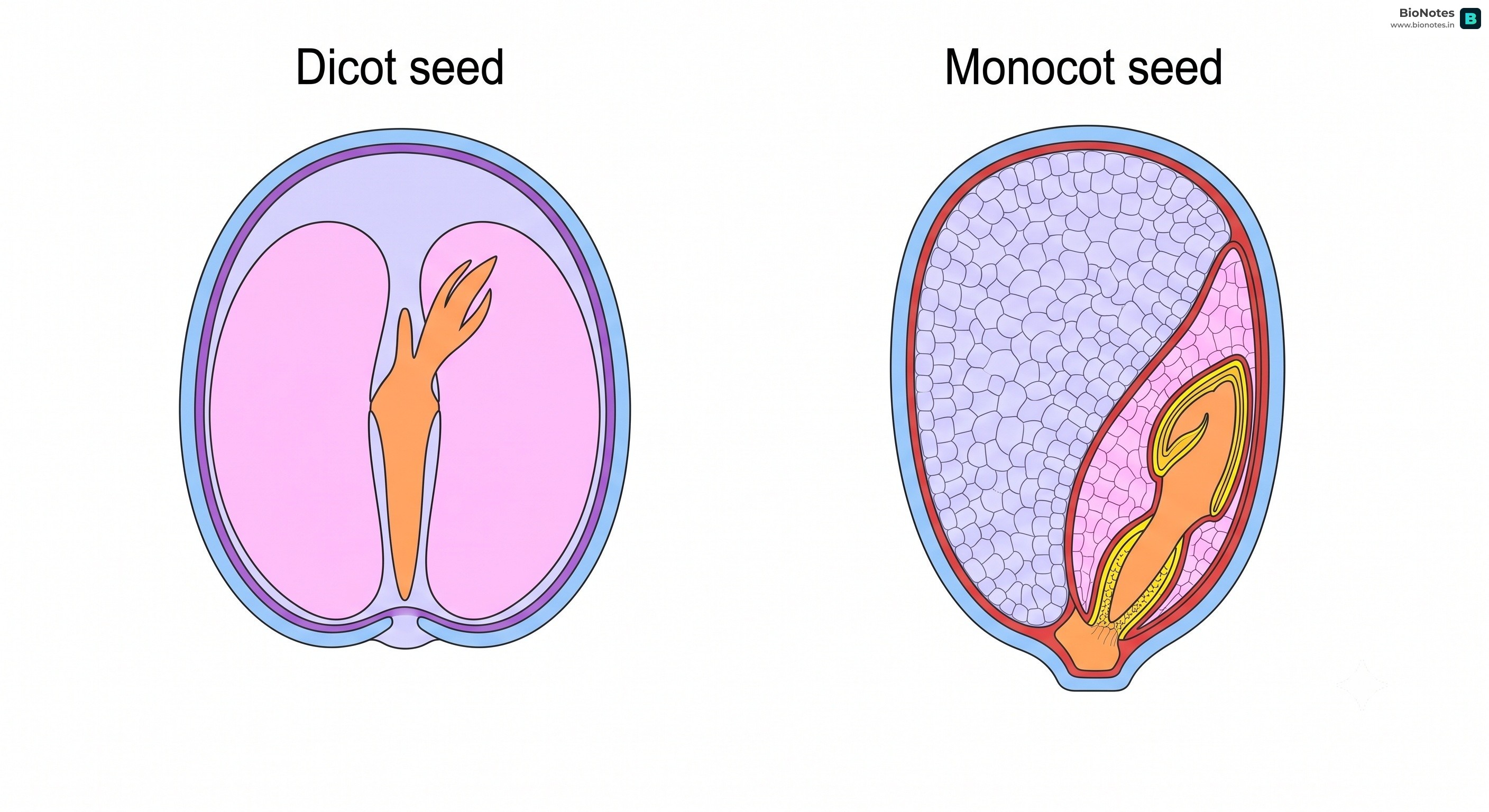
  • Dicotyledonous Seed: Seed coat (testa and tegmen), hilum, micropyle, and embryo with two fleshy cotyledons (Gram, Pea).
  • Monocotyledonous Seed: Generally endospermic. Has a single shield-shaped cotyledon called scutellum. Plumule and radicle are enclosed in coleoptile and coleorhiza respectively (Maize).

8. Family: Solanaceae (Potato Family)

  • Vegetative: Mostly herbs/shrubs, alternate simple leaves, reticulate venation.
  • Floral: Actinomorphic, bisexual; calyx persistent; androecium epipetalous; gynoecium bicarpellary syncarpous with superior ovary.
  • Economic Importance: Food (Tomato, Potato), Spices (Chilli), Medicine (Ashwagandha), Ornamentals (Petunia).
Location:/CBSE/NCERT/Notes/Class_11_Biology/Chapter_05_Morphology_of_Flowering_Plants.mdx

Created by Titas Mallick

Biology Teacher • M.Sc. Botany • B.Ed. • CTET Qualified • 10+ years teaching experience