Respiration is the process of breaking down complex organic compounds (C-C bonds) through oxidation within the cells, leading to the release of a considerable amount of energy. This energy is not released in a single step but in a series of slow, enzyme-controlled reactions and is trapped as chemical energy in the form of ATP (Adenosine Triphosphate).
Respiratory Substrates: The compounds that are oxidized during respiration. Glucose is the most favored substrate, but proteins, fats, and organic acids can also be used.
Energy Currency: ATP acts as the energy currency of the cell, utilized in various energy-requiring processes.
Plants require oxygen (O2) for respiration and release carbon dioxide (CO2). Unlike animals, they lack specialized respiratory organs but use stomata and lenticels for gaseous exchange.
Self-Sufficiency: Each plant part takes care of its own gas-exchange needs.
Low Demand: Plants have lower respiratory rates compared to animals.
Diffusion: In large plants, most living cells are located close to the surface, and loose packing of parenchyma cells provides interconnected air spaces.
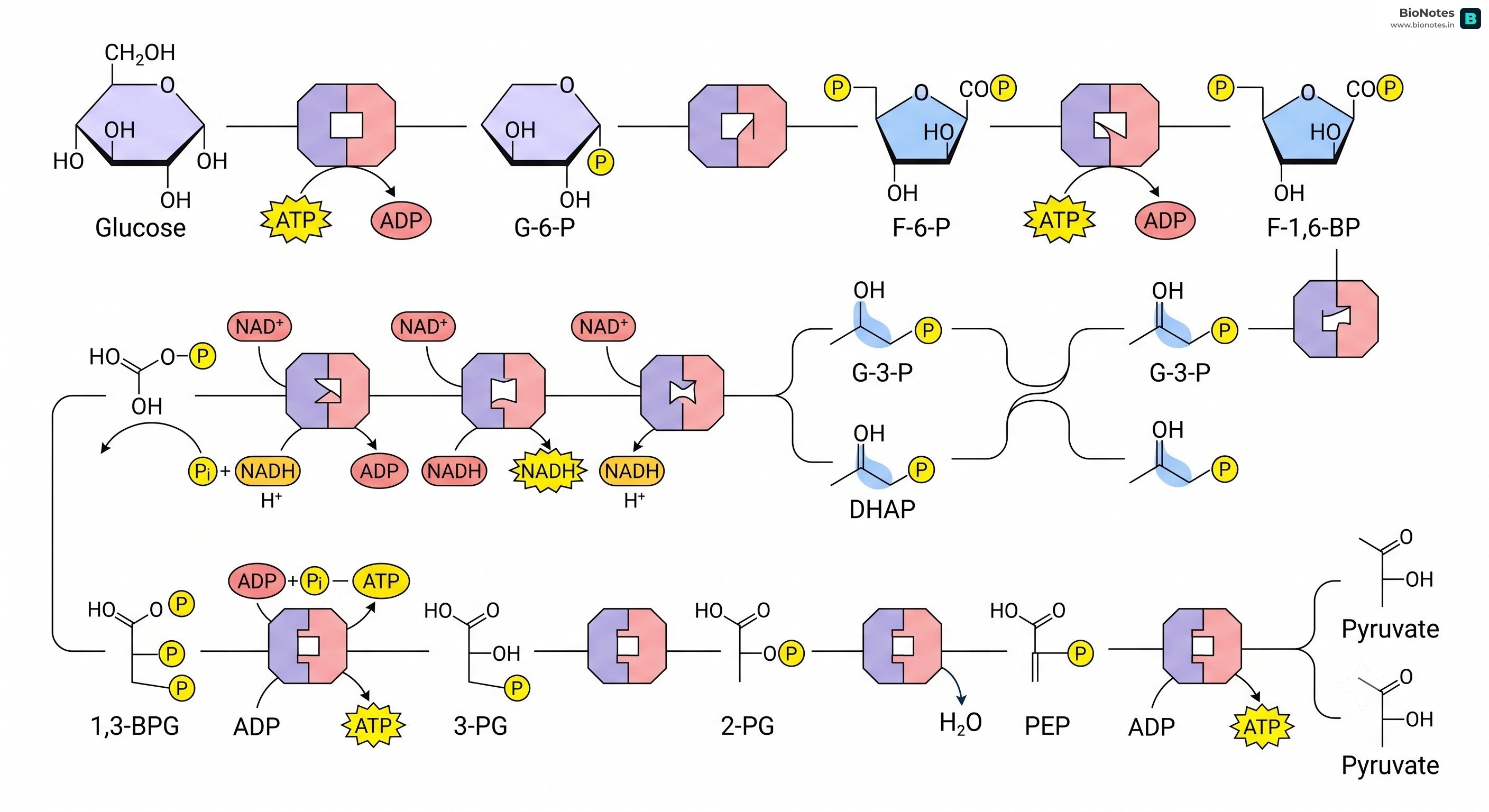
Glycolysis (from Greek glycos for sugar and lysis for splitting) occurs in the cytoplasm and is the partial oxidation of glucose to form two molecules of pyruvic acid.
Mechanism: A chain of ten reactions discovered by Embden, Meyerhof, and Parnas.
ATP Usage: 2 ATP molecules are consumed (Glucose to Glucose-6-P and Fructose-6-P to Fructose-1,6-bisphosphate) during the preparatory phase.
Energy Yield: 4 ATP molecules are synthesized via substrate-level phosphorylation, and 2 NADH+H+ are formed.
Net Gain: 2 ATP and 2 NADH+H+ per glucose molecule.
Glycolysis Net Gain
Although 4 ATP are produced during the payoff phase, 2 ATP were consumed in the investment phase. Thus, the net gain of energy molecules is exactly 2 ATP and 2 NADH.
Hexokinase Step (Irreversible): Glucose is phosphorylated to Glucose-6-phosphate by Hexokinase, consuming 1 ATP and requiring Mg2+. This traps glucose inside the cytoplasm.
Phosphoglucose Isomerase Step (Reversible): Glucose-6-phosphate is isomerized to Fructose-6-phosphate.
Phosphofructokinase-1 Step (Irreversible): Fructose-6-phosphate is phosphorylated to Fructose-1,6-bisphosphate by PFK-1, consuming a 2nd ATP. This is the committed, rate-limiting pacemaking step of glycolysis.
Aldolase Step (Reversible): Fructose-1,6-bisphosphate (6C) is cleaved into Dihydroxyacetone phosphate (DHAP) and Glyceraldehyde-3-phosphate (G3P / PGAL).
Triose Phosphate Isomerase Step (Reversible): DHAP is isomerized to G3P. From here on, all reactions happen twice per glucose molecule.
GAPDH Step (Reversible): G3P is oxidized and phosphorylated to 1,3-Bisphosphoglycerate by Glyceraldehyde-3-phosphate Dehydrogenase, yielding 2 NADH+H+ (1 per G3P) and using inorganic phosphate (Pi).
Phosphoglycerate Kinase Step (Reversible): 1,3-Bisphosphoglycerate transfers a high-energy phosphate to ADP, yielding 2 ATP (substrate-level phosphorylation) and 3-Phosphoglycerate.
Phosphoglycerate Mutase Step (Reversible): 3-Phosphoglycerate isomerizes to 2-Phosphoglycerate by shifting the phosphate group.
Enolase Step (Reversible): 2-Phosphoglycerate undergoes dehydration to Phosphoenolpyruvate (PEP), a highly reactive enol phosphate intermediate, releasing 2 H2O. Requires Mg2+.
Pyruvate Kinase Step (Irreversible): PEP transfers its phosphate to ADP, yielding 2 ATP (substrate-level phosphorylation) and 2 molecules of Pyruvate (Pyruvic acid). Requires Mg2+ and K+.
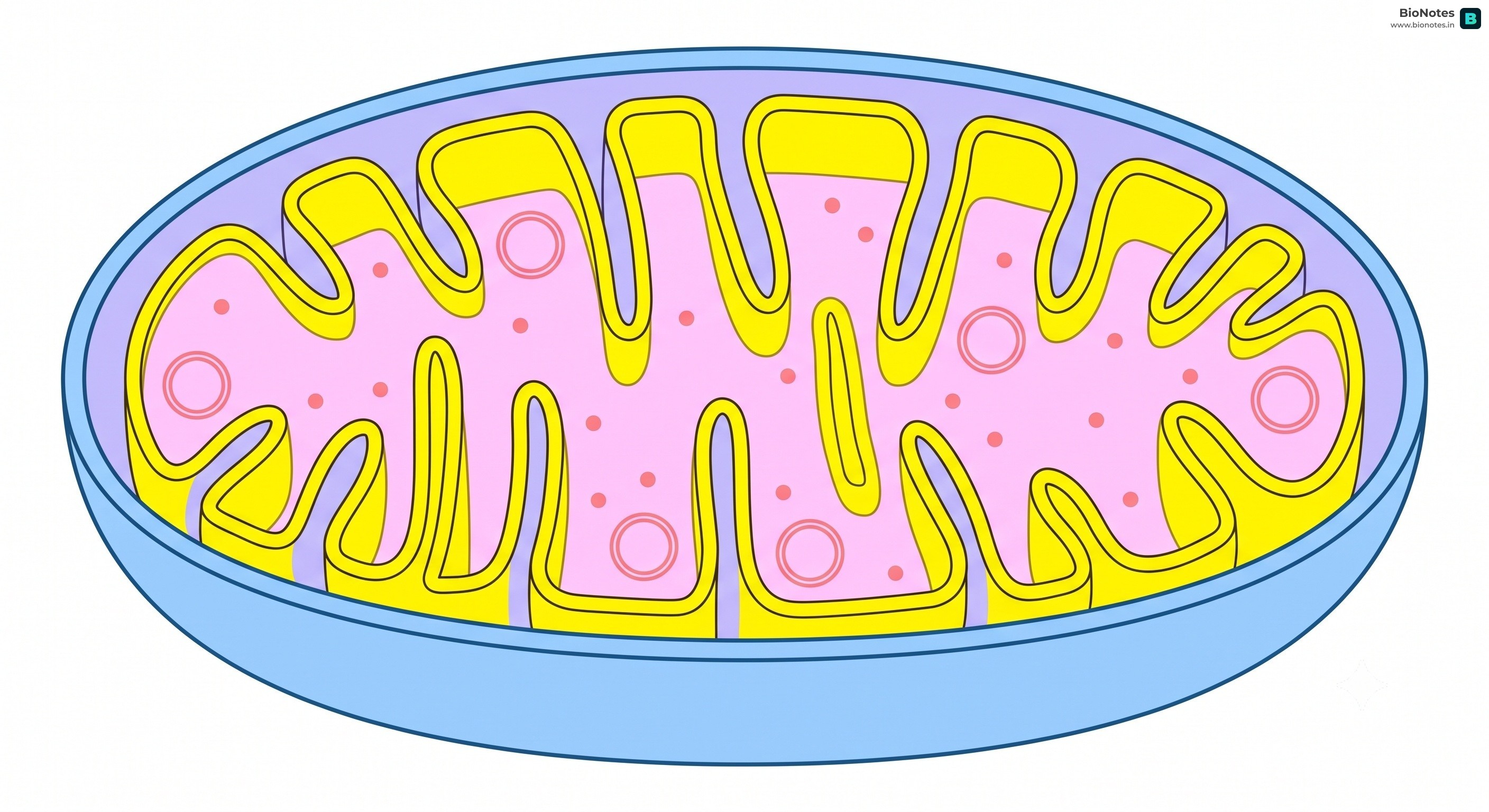
Occurs in the mitochondria and involves the complete oxidation of organic substances in the presence of oxygen, releasing water, carbon dioxide, and a large quantity of energy.
Often referred to as the gateway step, the Link Reaction connects cytosolic glycolysis to the mitochondrial Krebs cycle. Pyruvate is transported into the mitochondrial matrix via the Mitochondrial Pyruvate Carrier (MPC).
Enzyme Complex: Catalyzed by the multi-subunit Pyruvate Dehydrogenase Complex (PDC).
Five Essential Cofactors: Requires Thiamine Pyrophosphate (TPP), Lipoamide (Lipoic acid), Coenzyme A (CoA-SH), Flavin Adenine Dinucleotide (FAD), and Nicotinamide Adenine Dinucleotide (NAD+). Magnesium ions (Mg2+) are also required.
Condensation: Acetyl-CoA (2C) and Oxaloacetate (OAA, 4C) condense with the help of water to form Citrate (6C), catalyzed by Citrate Synthase.
Isomerization: Citrate is converted to Isocitrate (6C) by Aconitase (requires Fe2+).
First Oxidative Decarboxylation: Isocitrate (6C) is oxidized and decarboxylated to α-Ketoglutarate (5C) by Isocitrate Dehydrogenase (requires Mn2+), producing 1 NADH and releasing 1 CO2. This is the rate-limiting step of the cycle.
Second Oxidative Decarboxylation:α-Ketoglutarate (5C) is oxidized and decarboxylated to Succinyl-CoA (4C) by the α-Ketoglutarate Dehydrogenase Complex (requires TPP, Lipoamide, CoA-SH, FAD, and NAD+), producing 1 NADH and releasing 1 CO2.
Substrate-Level Phosphorylation: Succinyl-CoA (4C) is converted to Succinate (4C) by Succinyl-CoA Synthetase (Succinic Thiokinase), generating 1 GTP (in animal cells) or 1 ATP (in plant cells) through high-energy thioester bond cleavage.
Dehydrogenation (Oxidation): Succinate (4C) is oxidized to Fumarate (4C) by Succinate Dehydrogenase (embedded in the inner membrane, also acting as Complex II of the ETS), producing 1 FADH2.
Hydration: Fumarate (4C) is hydrated to L-Malate (4C) by Fumarase.
Third Oxidation: L-Malate (4C) is oxidized to Oxaloacetate (OAA, 4C) by Malate Dehydrogenase, producing 1 NADH and regenerating OAA for the next turn.
While theoretically 38 ATP molecules can be generated from one glucose molecule during aerobic respiration, the actual yield may vary due to metabolic complexities and the utilization of intermediates in other pathways.
Respiration is not purely a catabolic (breaking down) process. Many intermediates are withdrawn from the pathway to synthesize other molecules (e.g., Acetyl CoA for fatty acids). Because it involves both anabolism and catabolism, the respiratory pathway is described as amphibolic.
The Respiratory Quotient (RQ) is the ratio of the volume of carbon dioxide (CO2) evolved to the volume of oxygen (O2) consumed during respiration:
RQ=Volume of O2 consumedVolume of CO2 evolved
The RQ value depends on the type of respiratory substrate being oxidized in the cell:
Carbohydrates:RQ=1.0 (equal volume of CO2 evolved and O2 consumed).
C6H12O6+6O2→6CO2+6H2O+EnergyRQ=66=1.0
Fats (e.g., Tripalmitin):RQ=0.7 (fats are oxygen-poor relative to carbon/hydrogen and require more oxygen for oxidation).
2C51H98O6+145O2→102CO2+98H2O+EnergyRQ=145102≈0.7
Proteins:RQ≈0.9
Organic Acids (e.g., Malic Acid):RQ>1.0 (typically around 1.33, as organic acids are rich in oxygen).
 BioNotes