CBSE/NCERT/Notes/Class_11_Biology
Anatomy of Flowering Plants
Comprehensive notes on NCERT Class 11 Biology Chapter 6
Anatomy of Flowering Plants
Anatomy is the study of the internal structure and functional organization of higher plants. In plants, cells are organized into tissues, and tissues are organized into organs.
Key Concepts
1. The Tissue System
There are three types of tissue systems based on structure and location:
A. Epidermal Tissue System
- Forms the outermost covering of the plant.
- Components: Epidermal cells, stomata, and epidermal appendages (trichomes and hairs).
- Cuticle: A waxy thick layer on the outside of the epidermis that prevents water loss (absent in roots).
- Stomata: Regulate transpiration and gaseous exchange. Composed of two guard cells (bean-shaped in dicots, dumb-bell shaped in grasses) enclosing a stomatal pore.
- Stomatal Apparatus: Consists of the stomatal aperture, guard cells, and surrounding subsidiary cells.
- Root Hairs: Unicellular elongations that absorb water and minerals.
- Trichomes: Multicellular hairs on the stem that help prevent water loss.
B. Ground (Fundamental) Tissue System
- All tissues except epidermis and vascular bundles.
- Consists of simple tissues: Parenchyma, Collenchyma, and Sclerenchyma.
- In leaves, it consists of chloroplast-containing cells called mesophyll.
C. Vascular Tissue System
- Consists of complex tissues: Xylem and Phloem.
- Vascular Bundles:
- Radial: Xylem and phloem arranged alternately along different radii (common in roots).
- Conjoint: Xylem and phloem situated along the same radius (common in stems and leaves).
- Open: Presence of cambium between xylem and phloem; allows secondary growth (dicot stems).
- Closed: No cambium present; no secondary growth (monocots).
2. Anatomy of Roots
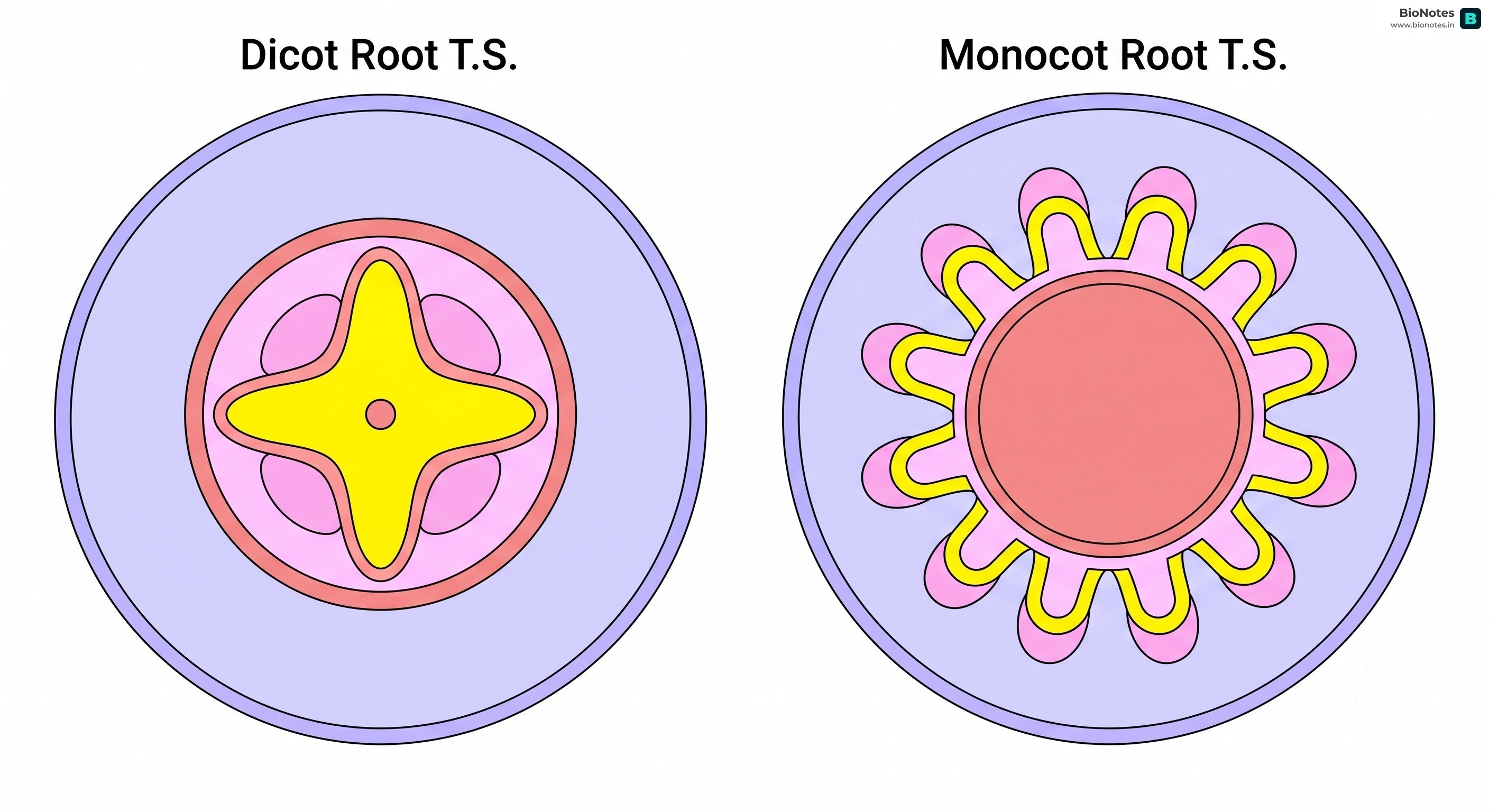
- Dicotyledonous Root:
- Epiblema (outermost), Cortex (parenchyma), Endodermis (with Casparian strips of suberin).
- Pericycle (site of lateral root initiation), small Pith.
- 2 to 4 xylem and phloem patches.
- Monocotyledonous Root:
- Similar to dicot root but has more than six (polyarch) xylem bundles.
- Pith is large and well-developed.
- No secondary growth.
3. Anatomy of Stems
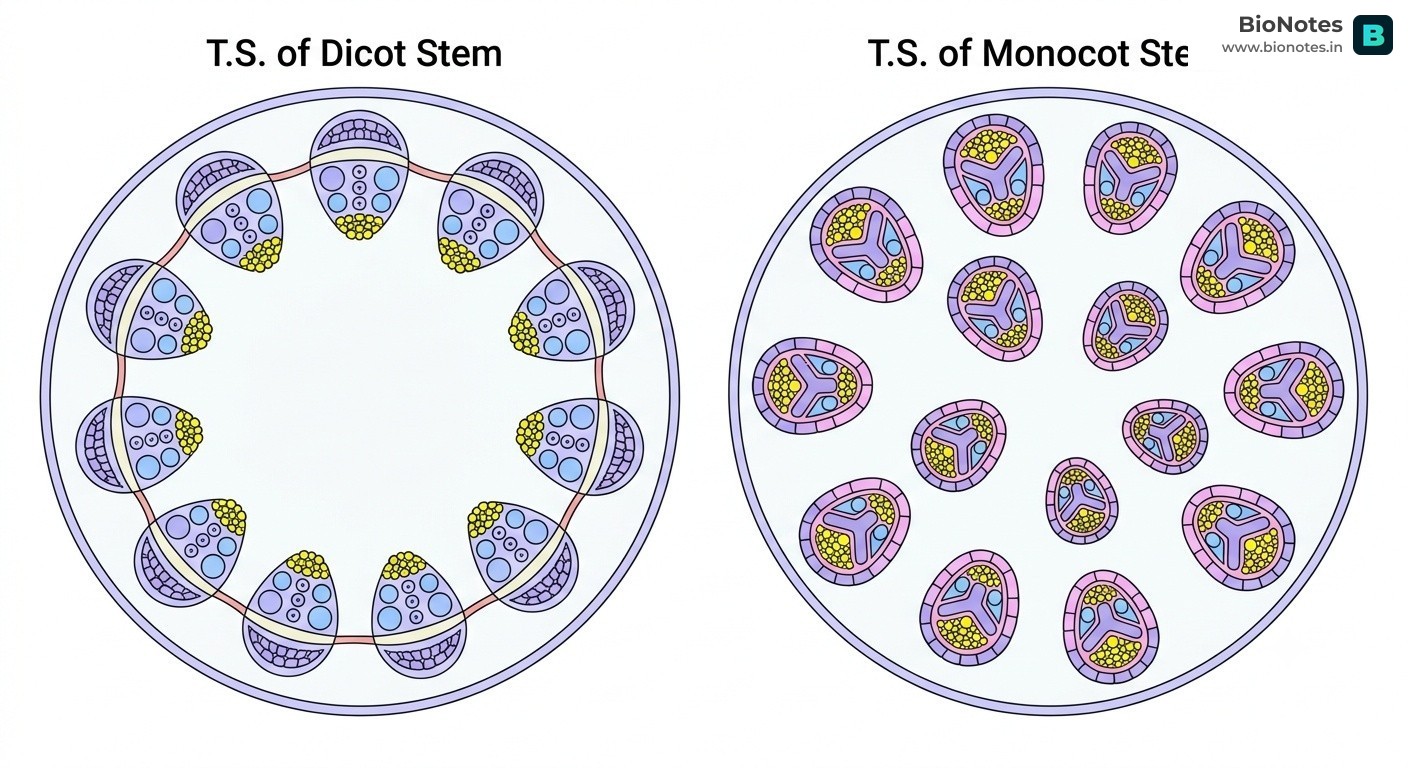
- Dicotyledonous Stem:
- Epidermis with cuticle and trichomes.
- Cortex divided into Hypodermis (collenchyma), Cortical layers, and Endodermis (starch sheath).
- Vascular bundles arranged in a ring (conjoint, open, endarch protoxylem).
- Medullary rays and a central Pith.
- Monocotyledonous Stem:
- Sclerenchymatous hypodermis.
- Scattered vascular bundles, each surrounded by a sclerenchymatous bundle sheath.
- Vascular bundles are conjoint and closed.
- Phloem parenchyma is absent.
4. Anatomy of Leaves
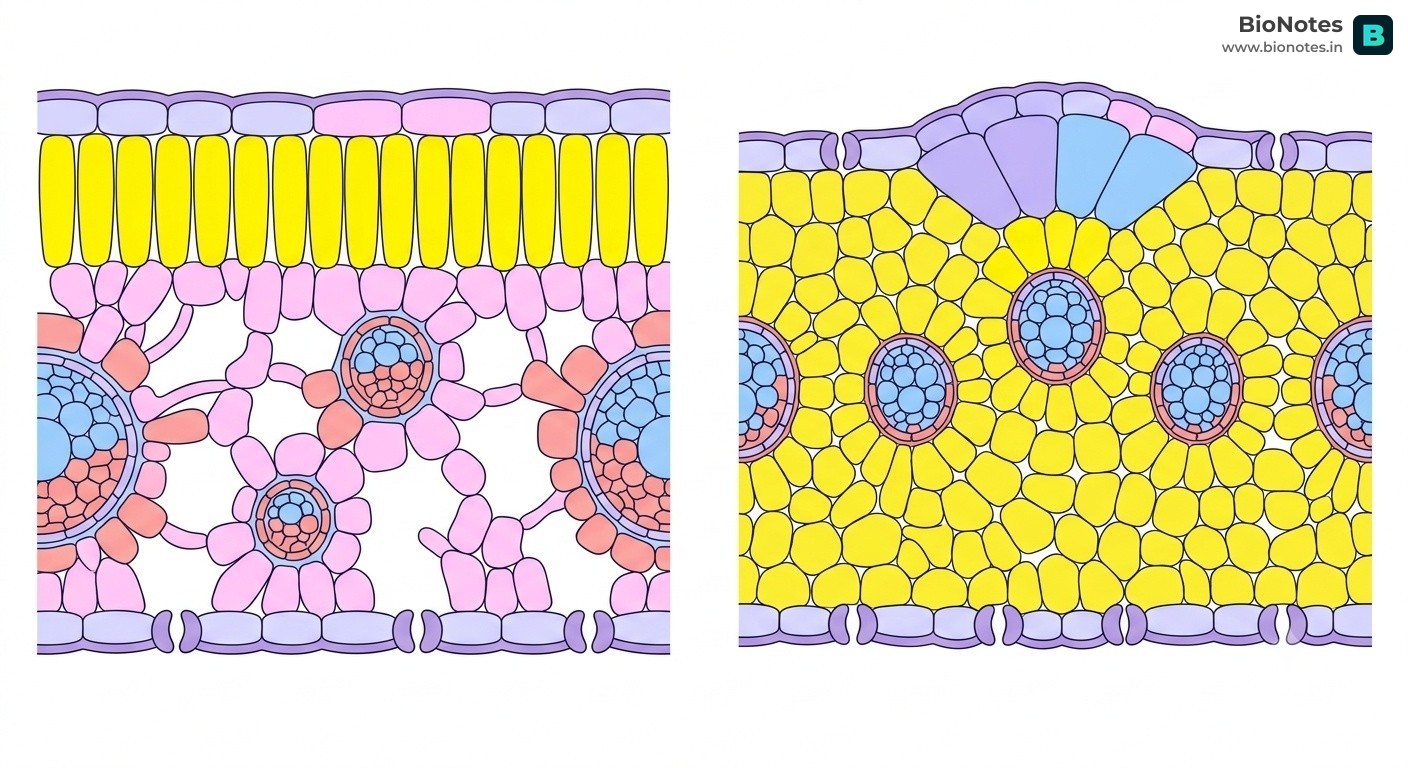
- Dorsiventral (Dicot) Leaf:
- Epidermis covers both adaxial (upper) and abaxial (lower) surfaces.
- Mesophyll is differentiated into Palisade parenchyma (vertical cells) and Spongy parenchyma (loosely arranged).
- Vascular bundles are seen in veins and midrib.
- Isobilateral (Monocot) Leaf:
- Stomata present on both surfaces.
- Mesophyll is not differentiated.
- Bulliform cells: Large, empty cells in grasses that regulate leaf curling to minimize water loss during stress.
Location:
/CBSE/NCERT/Notes/Class_11_Biology/Chapter_06_Anatomy_of_Flowering_Plants.mdx