BioNotes
CBSE/NCERT/Notes/Class_11_Biology

Breathing and Exchange of Gases

Detailed notes on the human respiratory system, mechanism of breathing, gas exchange, and respiratory disorders.

Breathing and Exchange of Gases

Key Concepts

Introduction to Respiration

Respiration (or breathing) is the process of exchange of oxygen ($O_2$) from the atmosphere with carbon dioxide ($CO_2$) produced by the cells during catabolic activities.
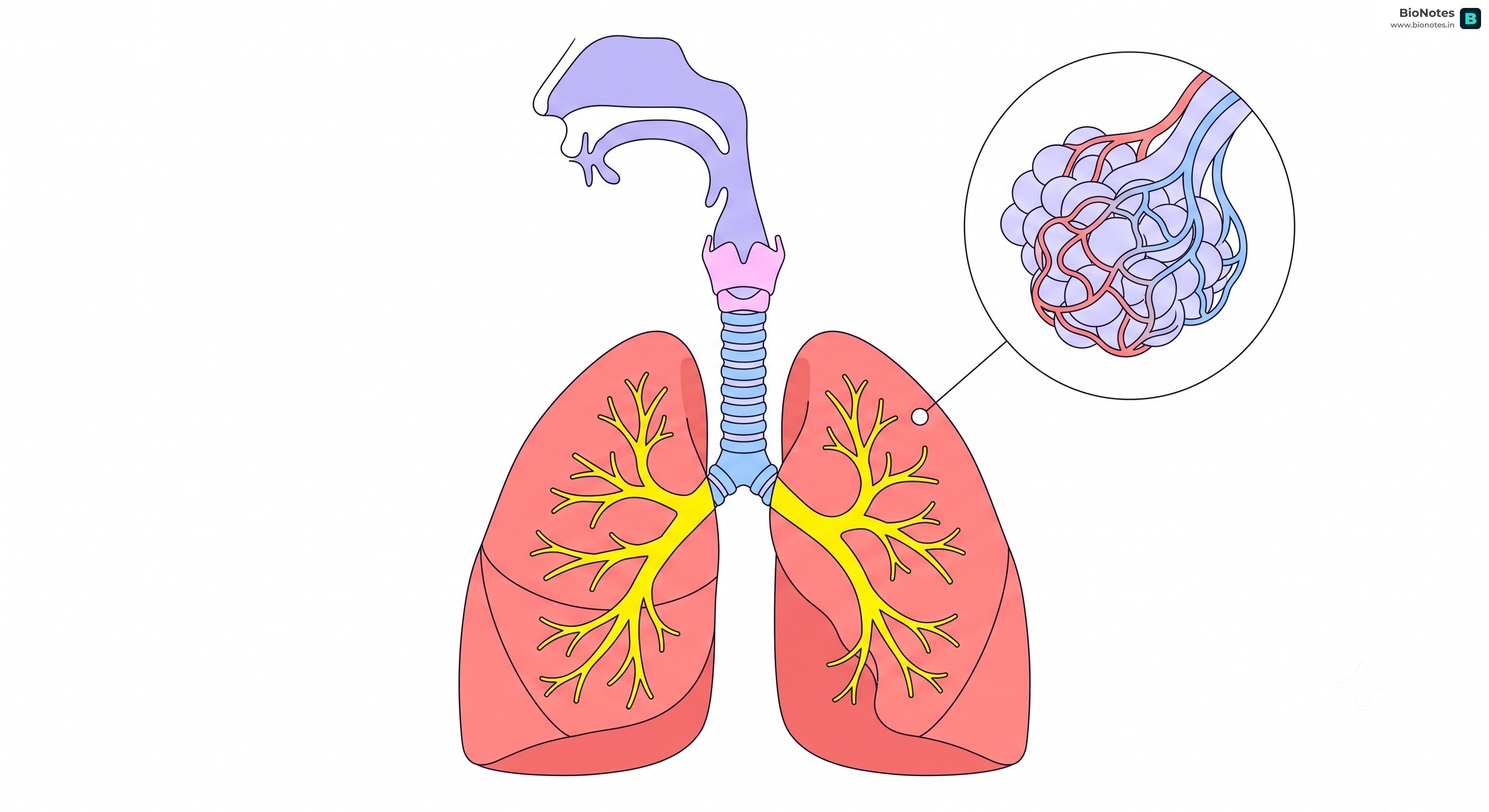
  • Respiratory Organs: Differ across animal groups. Sponges/Coelenterates use simple diffusion; Earthworms use moist cuticle; Insects use tracheal tubes; Aquatic animals use gills; Terrestrial animals use lungs.

Human Respiratory System

  1. Conducting Part: From external nostrils to terminal bronchioles. It transports air, clears it of foreign particles, humidifies, and brings it to body temperature.
  2. Respiratory/Exchange Part: Alveoli and their ducts. This is the site of actual diffusion of $O_2$ and $CO_2$ between blood and atmospheric air.
  • Larynx: A cartilaginous "sound box."
  • Epiglottis: A thin elastic cartilaginous flap that prevents food from entering the larynx.
  • Pleura: Double-layered membrane covering the lungs, with pleural fluid to reduce friction.

Mechanism of Breathing

Breathing involves creating a pressure gradient between the lungs and the atmosphere.
  • Inspiration: Diaphragm and external intercostal muscles contract, increasing thoracic volume and decreasing intra-pulmonary pressure, forcing air in.
  • Expiration: Muscles relax, decreasing thoracic volume and increasing intra-pulmonary pressure, expelling air.

Respiratory Volumes and Capacities

  • Tidal Volume (TV): Volume of air inspired/expired during normal breathing ($\approx 500$ mL).
  • Inspiratory Reserve Volume (IRV): Forcible inspiration ($\approx 2500–3000$ mL).
  • Expiratory Reserve Volume (ERV): Forcible expiration ($\approx 1000–1100$ mL).
  • Residual Volume (RV): Air remaining after forced expiration ($\approx 1100–1200$ mL).
  • Vital Capacity (VC): Maximum volume of air one can breathe out after forced inspiration ($VC = ERV + TV + IRV$).
  • Total Lung Capacity (TLC): Total air in lungs after forced inspiration ($TLC = VC + RV$).

Exchange of Gases

Occurs by simple diffusion based on partial pressure/concentration gradients.

  • Partial Pressure: Pressure contributed by an individual gas in a mixture ($pO_2$, $pCO_2$).
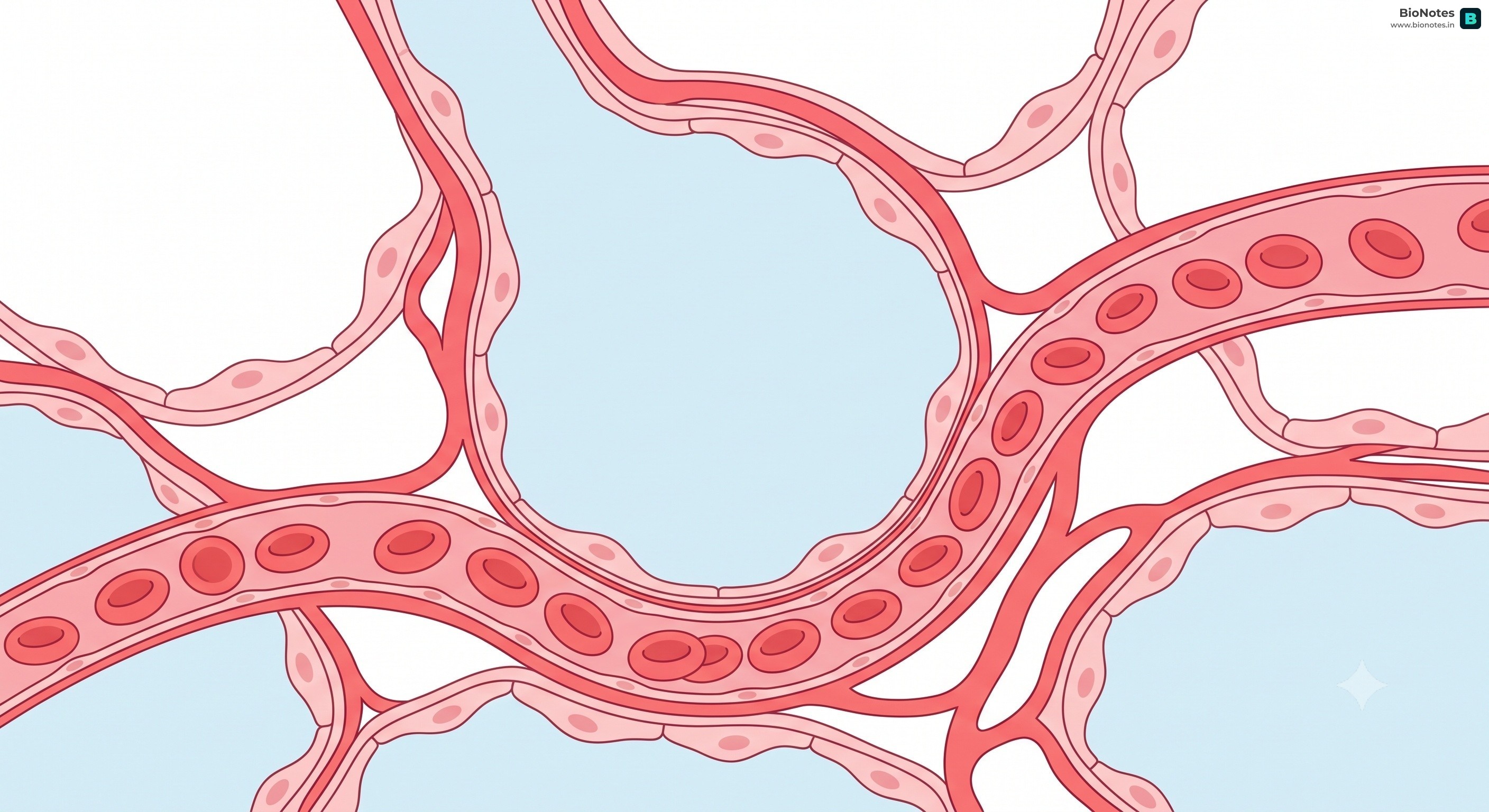
  • Diffusion Membrane: Composed of thin squamous epithelium of alveoli, endothelium of alveolar capillaries, and the basement substance. Total thickness is less than 1 mm.
  • Solubility: $CO_2$ is 20–25 times more soluble than $O_2$.

Transport of Gases

  • Oxygen Transport: 97% by RBCs (as oxyhaemoglobin) and 3% dissolved in plasma. Each haemoglobin molecule can carry 4 $O_2$ molecules.
  • Oxygen Dissociation Curve: A sigmoid curve plotting percentage saturation of haemoglobin against $pO_2$. Low $pH$, high $pCO_2$, and high temperature favor dissociation at tissues.
  • Carbon Dioxide Transport: 20–25% by RBCs (carbamino-haemoglobin), 70% as bicarbonate ($HCO_3^-$), and 7% dissolved in plasma.
  • Carbonic Anhydrase: Enzyme in RBCs that facilitates the conversion of $CO_2$ and $H_2O$ to bicarbonate and vice-versa.

Regulation and Disorders

  • Regulation: Controlled by the Respiratory Rhythm Centre (medulla) and Pneumotaxic Centre (pons). Chemosensitive areas respond to $CO_2$ and $H^+$ concentration.
  • Asthma: Inflammation of bronchi and bronchioles causing wheezing.
  • Emphysema: Damage to alveolar walls (major cause: smoking), reducing respiratory surface.
  • Occupational Disorders: Long-term exposure to dust (e.g., stone breaking) leads to fibrosis (lung damage).

Activities

  • Measure your breathing rate at rest vs. after exercise.
  • Draw a diagram of the human respiratory system and label its parts.
  • Discuss the impact of smoking on the respiratory surface area (Emphysema).
Location:/CBSE/NCERT/Notes/Class_11_Biology/Chapter_14_Breathing_and_Exchange_of_Gases.mdx

Created by Titas Mallick

Biology Teacher • M.Sc. Botany • B.Ed. • CTET Qualified • 10+ years teaching experience