CBSE/NCERT/Notes/Class_11_Biology
Class 11 Biology - Photosynthesis in Higher Plants
NCERT Biology Notes for Class 11 Biology - Photosynthesis in Higher Plants - Class_11_Biology
Class 11 Biology - Photosynthesis in Higher Plants
Notes
Key Concepts
Introduction
- Definition: A physico-chemical process by which green plants use light energy to drive the synthesis of organic compounds (food).
- Importance: It is the primary source of all food on earth and is responsible for the release of oxygen into the atmosphere.
Early Experiments
- Joseph Priestley (1770): Revealed the essential role of air in the growth of green plants. Plants restore to the air whatever breathing animals and burning candles remove.
- Jan Ingenhousz (1779): Showed that sunlight is essential for the plant process that purifies air. Green parts of plants release oxygen in the presence of sunlight.
- Julius von Sachs (1854): Provided evidence for production of glucose in green parts, which is stored as starch.
- T.W. Engelmann (1843-1909): Described the first action spectrum of photosynthesis using a prism, green alga (Cladophora), and aerobic bacteria. Red and blue light were most effective.
- Cornelius van Niel (1897-1985): Demonstrated that photosynthesis is a light-dependent reaction where hydrogen from an oxidisable compound reduces CO₂ to carbohydrates. In plants, H₂O is the hydrogen donor and is oxidised to O₂.
Where does Photosynthesis take place?
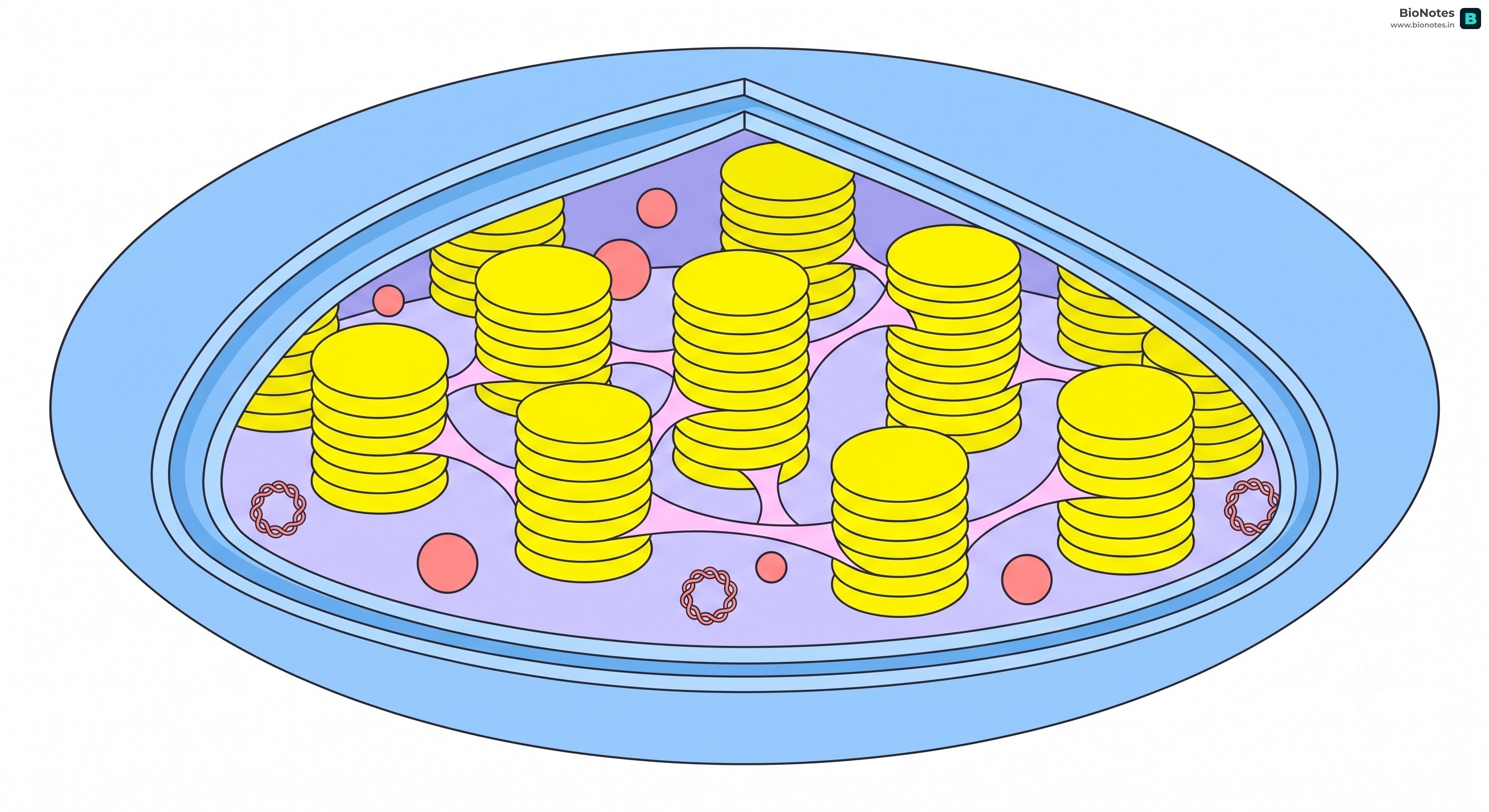
- Occurs in the Chloroplasts of mesophyll cells in leaves.
- Grana (Membrane system): Responsible for trapping light energy and synthesis of ATP and NADPH (Light Reaction).
- Stroma (Fluid matrix): Enzymatic reactions incorporate CO₂ into the plant leading to sugar synthesis (Dark Reaction).
Pigments involved in Photosynthesis
- Chlorophyll a: Bright or blue-green; the chief pigment associated with photosynthesis.
- Chlorophyll b: Yellow-green.
- Xanthophylls: Yellow.
- Carotenoids: Yellow to yellow-orange.
- Accessory Pigments: Chl b, xanthophylls, and carotenoids absorb light and transfer energy to Chl a. They protect Chl a from photo-oxidation and broaden the range of light wavelengths utilised.
Light Reaction (Photochemical Phase)
- Includes light absorption, water splitting, oxygen release, and formation of ATP and NADPH.
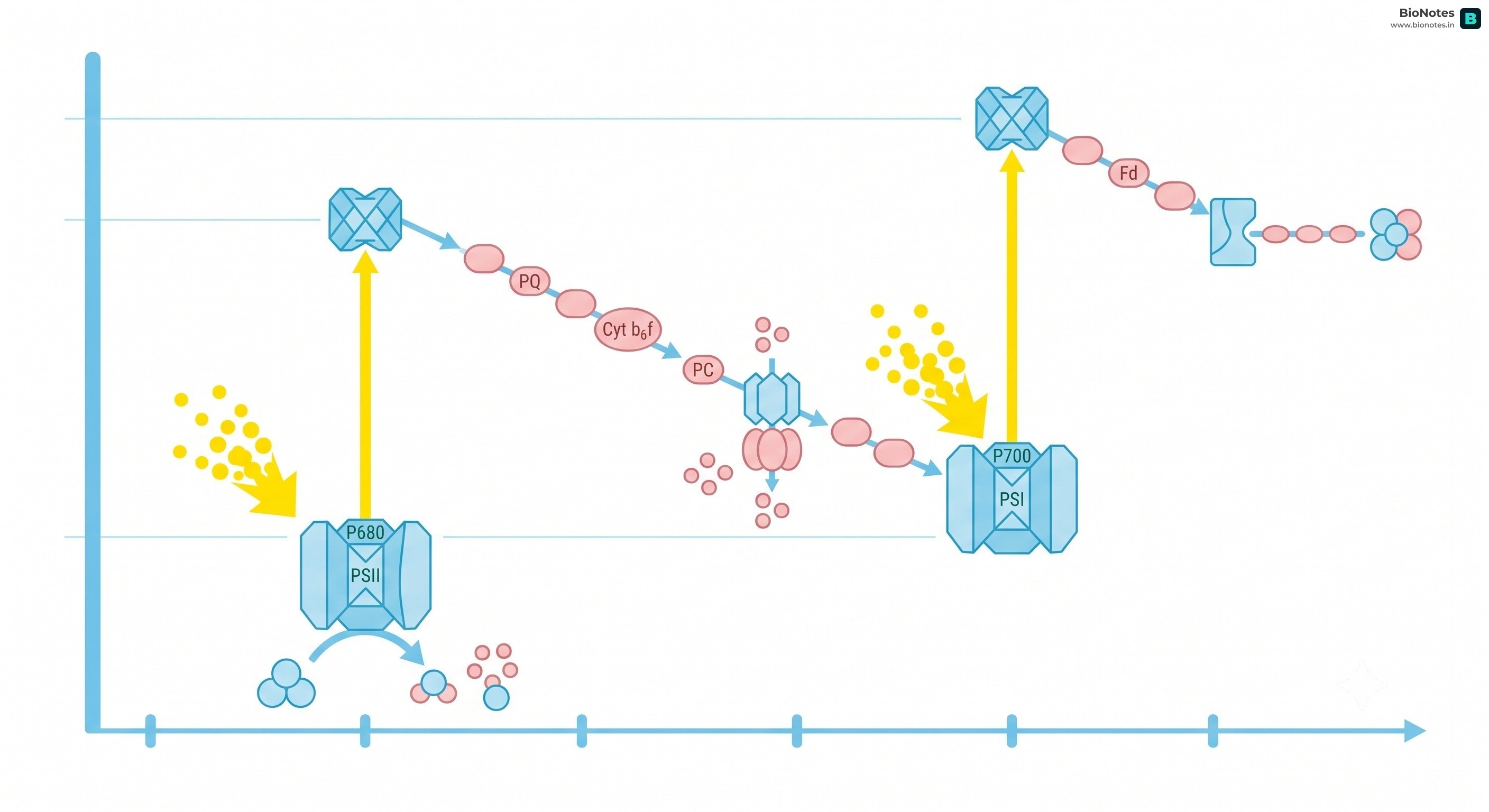
- Photosystems: PS I (Reaction centre P700) and PS II (Reaction centre P680).
- Z-Scheme (Non-cyclic Photophosphorylation):
- Electrons excited in PS II are picked up by an acceptor and passed through the ETS (Cytochromes) to PS I.
- Splitting of water ($2H_2O \rightarrow 4H^+ + O_2 + 4e^-$) provides electrons to PS II.
- PS I electrons are excited and passed to NADP⁺, reducing it to NADPH.
- Cyclic Photophosphorylation: Occurs when only PS I is functional (in stroma lamellae). Results only in ATP synthesis.
Chemiosmotic Hypothesis
- Explains ATP synthesis linked to a proton gradient across the thylakoid membrane.
- Protons accumulate in the lumen due to water splitting and the H-carrier in ETS.
- The gradient is broken down as protons move through the CF₀-CF₁ ATPase channel to the stroma, providing energy to synthesize ATP.
The Calvin Cycle (C3 Pathway)
Occurs in all photosynthetic plants in three stages:
- Carboxylation: Fixation of CO₂ into 3-phosphoglyceric acid (PGA) by the enzyme RuBisCO using RuBP (5C).
- Reduction: Series of reactions using 2 ATP and 2 NADPH per CO₂ to form glucose.
- Regeneration: RuBP is regenerated using 1 ATP.
- Total for 1 Glucose (6 turns): 18 ATP and 12 NADPH.
The C4 Pathway (Hatch and Slack Pathway)
- Found in tropical plants (e.g., Maize, Sorghum).
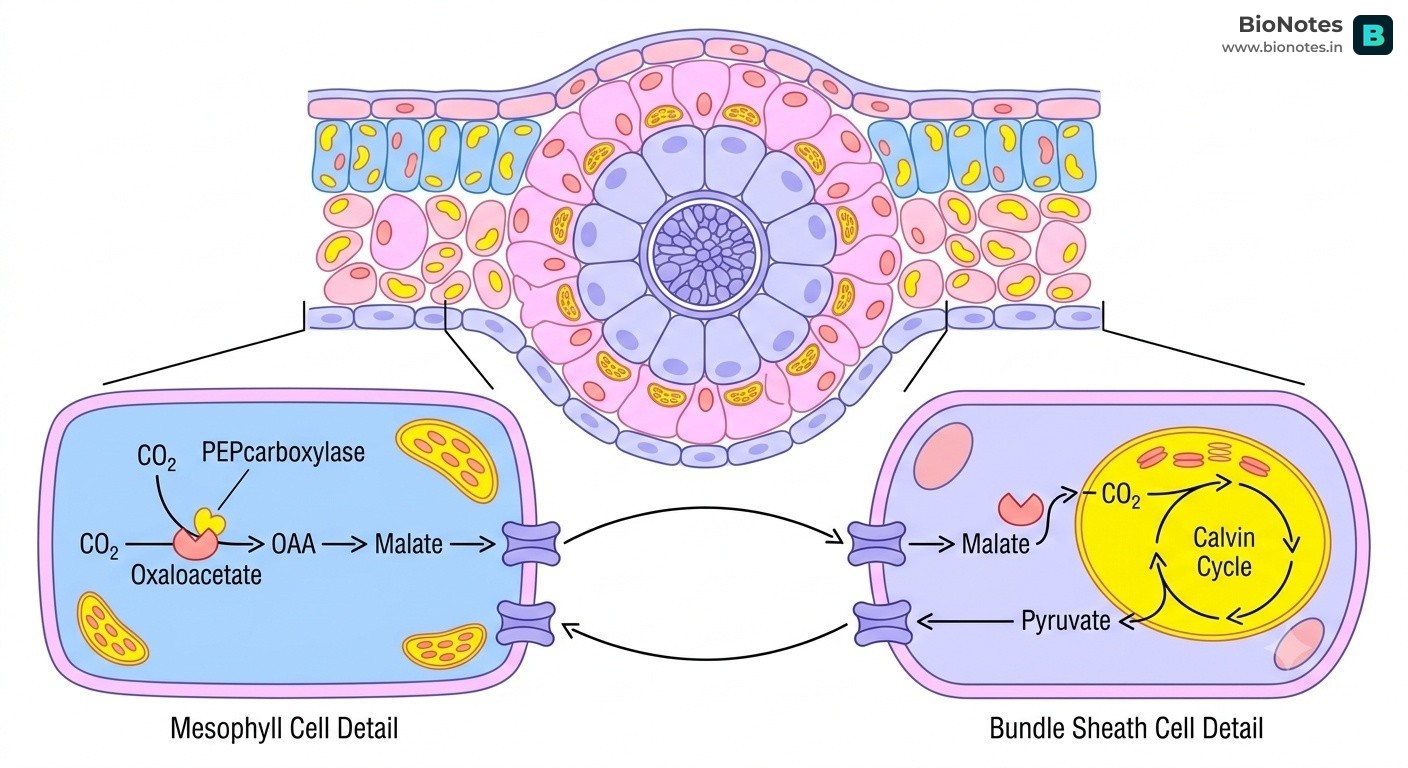
- Kranz Anatomy: Large bundle sheath cells around vascular bundles with many chloroplasts.
- Mechanism: CO₂ fixed as oxaloacetic acid (OAA, 4C) in mesophyll by PEPcase. OAA is converted to malic acid, transported to bundle sheath, and broken down to release CO₂ for the Calvin Cycle.
- Advantage: Lack of photorespiration; high productivity and tolerance to high temperatures.
Photorespiration
- A wasteful process in C3 plants where RuBisCO binds with O₂ instead of CO₂.
- Results in the release of CO₂ with the use of ATP; no synthesis of sugar or ATP/NADPH.
Factors affecting Photosynthesis
- Blackman’s Law of Limiting Factors: The rate is determined by the factor nearest its minimal value.
- Light: Saturation point is 10% of full sunlight. High intensity can cause chlorophyll breakdown.
- CO₂ Concentration: Major limiting factor. C4 plants saturate at 360 µL/L; C3 plants at 450 µL/L.
- Temperature: Enzymatic dark reactions are more sensitive. C4 plants have higher optimum.
- Water: Stress causes stomata closure and leaf wilting, indirectly reducing photosynthesis.
Location:
/CBSE/NCERT/Notes/Class_11_Biology/Chapter_11_Photosynthesis_in_Higher_Plants.mdx