BioNotes
CBSE/NCERT/Notes/Class_11_Biology

Class 11 Biology - Cell Cycle and Cell Division

NCERT Biology Notes for Class 11 Biology - Cell Cycle and Cell Division - Class_11_Biology
Class 11 Biology - Cell Cycle and Cell Division

Notes

Key Concepts

Introduction to Cell Cycle

  • Definition: The sequence of events by which a cell duplicates its genome, synthesises other constituents of the cell, and eventually divides into two daughter cells.
  • Coordination: Cell division, DNA replication, and cell growth must be coordinated for correct division.
  • Duration: Varies by organism. Human cells divide roughly every 24 hours; Yeast in 90 minutes.

Phases of Cell Cycle

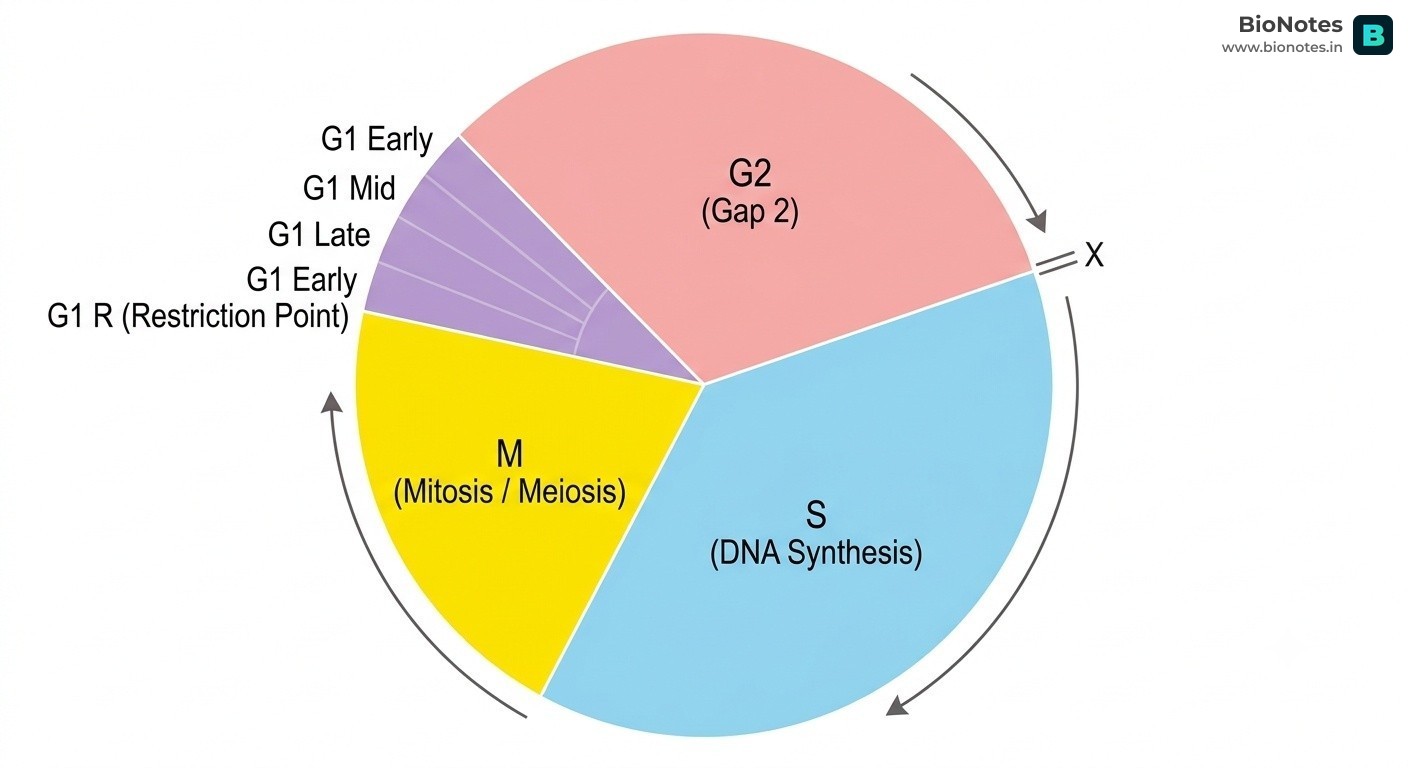
The cell cycle is divided into two basic phases:

  1. Interphase (Resting Phase): Occupies > 95% of the cycle. Preparation for division occurs here.
    • G₁ Phase (Gap 1): Cell is metabolically active and grows continuously but does not replicate DNA.
    • S Phase (Synthesis): DNA replication occurs. DNA amount doubles (2C to 4C), but chromosome number remains same (2n). Centrioles duplicate in animal cells.
    • G₂ Phase (Gap 2): Protein synthesis for mitosis occurs while growth continues.
    • G₀ Phase (Quiescent Stage): Inactive stage where cells remain metabolically active but do not proliferate (e.g., heart cells).
  2. M Phase (Mitosis Phase): The actual period of division. Starts with Karyokinesis (nuclear division) and ends with Cytokinesis (cytoplasmic division).

Mitosis (Equational Division)

Resulting daughter cells have the same number of chromosomes as the parent.
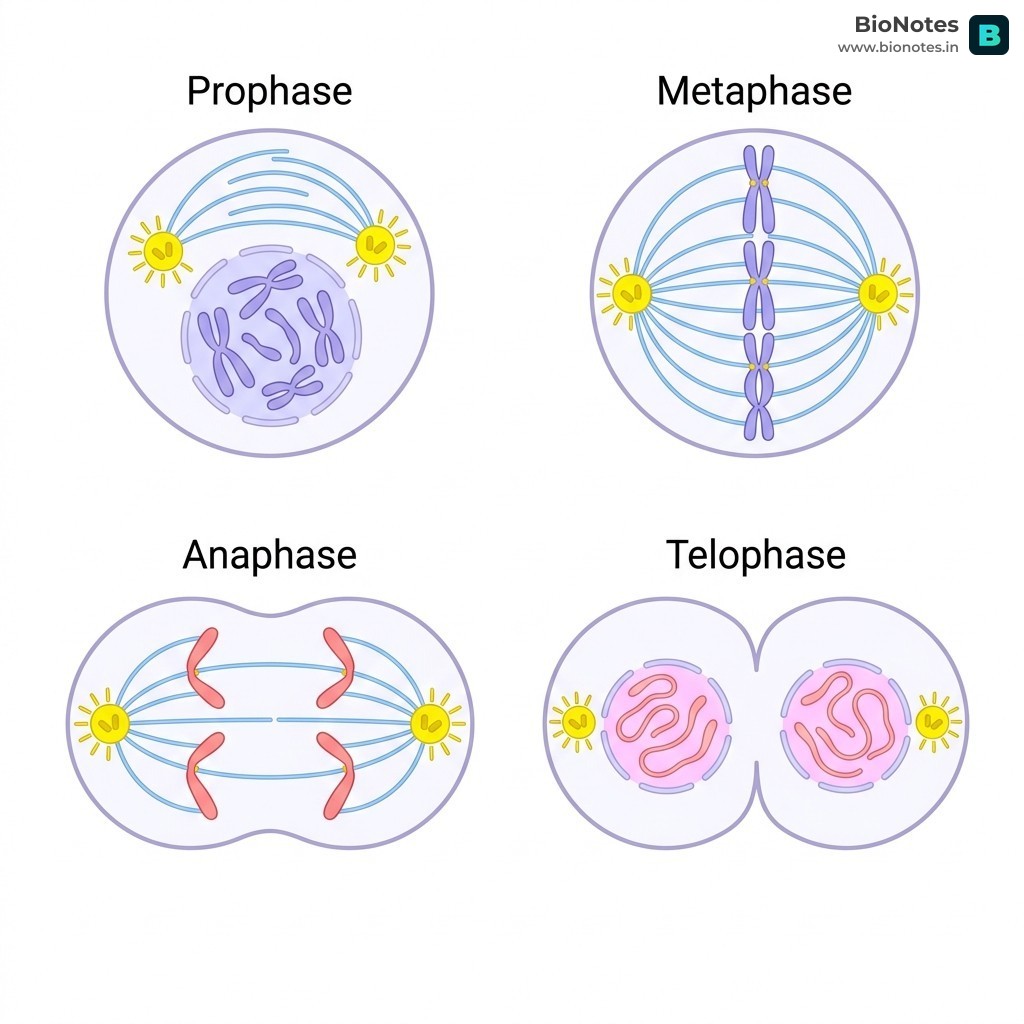
  • Prophase: Chromatin condensation into chromosomes. Centrosomes move to opposite poles and radiate asters. Golgi, ER, and nuclear envelope disappear.
  • Metaphase: Chromosomes align at the metaphase plate (equator). Spindle fibres attach to kinetochores.
  • Anaphase: Centromeres split simultaneously. Sister chromatids (now daughter chromosomes) move to opposite poles.
  • Telophase: Chromosomes decondense at poles. Nuclear envelope reforms. Nucleolus, Golgi, and ER reappear.
  • Cytokinesis:
    • Animal Cells: Cleavage furrow formation (centripetal).
    • Plant Cells: Cell plate formation (centrifugal) from the center.

Significance of Mitosis

  • Growth of multicellular organisms.
  • Cell repair and replacement (e.g., epidermis, gut lining, blood cells).
  • Restoration of nucleo-cytoplasmic ratio.
  • Continuous growth in plants via meristematic tissues.

Meiosis (Reduction Division)

Reduces chromosome number by half (2n to n). Occurs during gametogenesis.

  • Meiosis I:
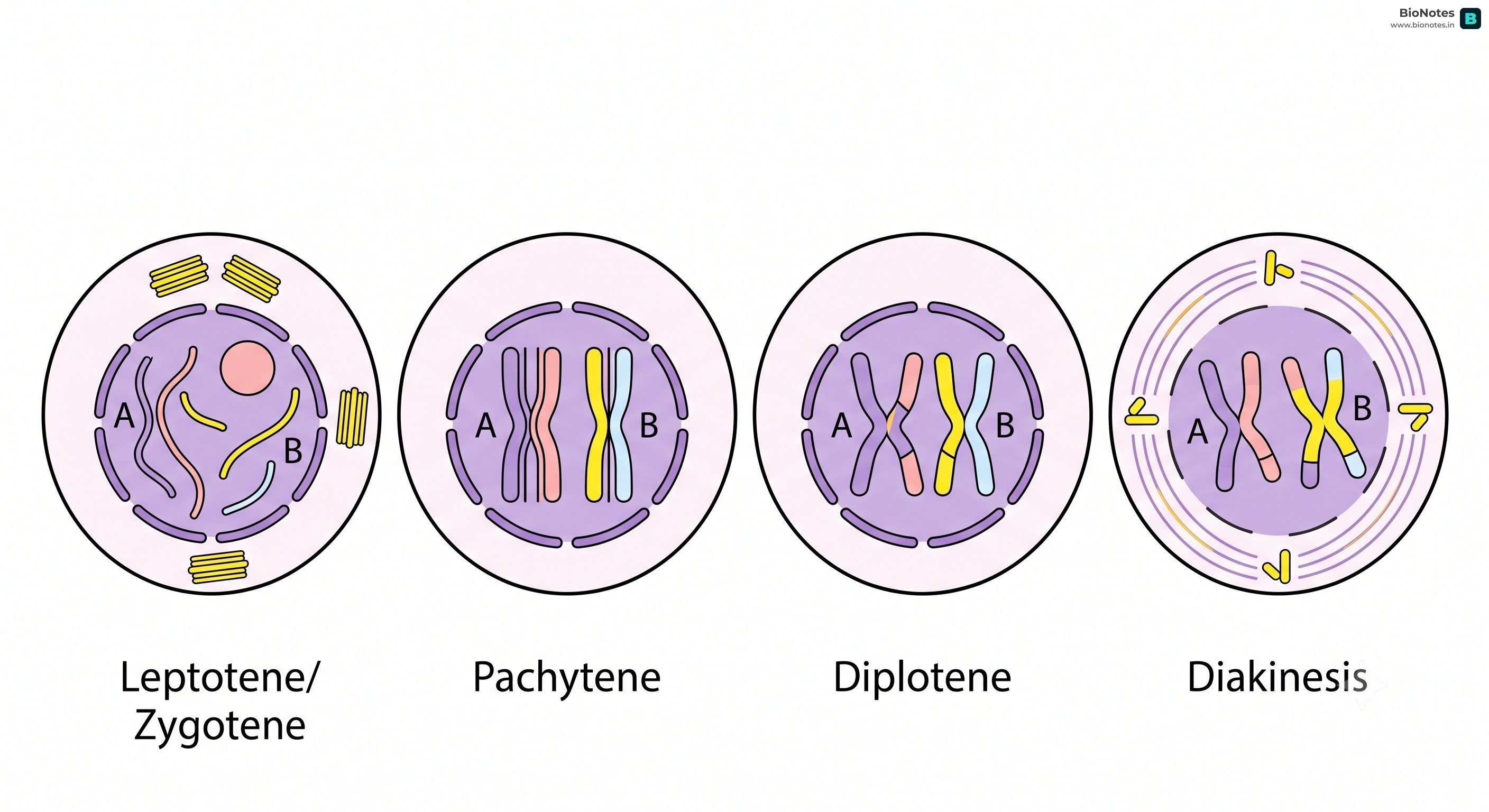
    • Prophase I (Long & Complex):
      • Leptotene: Chromosomes become visible.
      • Zygotene: Pairing (Synapsis) of homologous chromosomes into bivalents/tetrads. Synaptonemal complex forms.
      • Pachytene: Crossing over between non-sister chromatids of homologous chromosomes at recombination nodules (mediated by recombinase).
      • Diplotene: Chiasmata (X-shaped structures) visible as the complex dissolves.
      • Diakinesis: Terminalisation of chiasmata. Transition to metaphase.
    • Metaphase I: Bivalents align at the equator.
    • Anaphase I: Homologous chromosomes separate; sister chromatids remain together.
    • Telophase I: Two haploid nuclei form.
  • Meiosis II: Similar to mitosis; results in four haploid cells.

Significance of Meiosis

  • Conservation of specific chromosome number across generations.
  • Increases genetic variability due to crossing over, which is essential for evolution.
Location:/CBSE/NCERT/Notes/Class_11_Biology/Chapter_10_Cell_Cycle_and_Cell_Division.mdx

Created by Titas Mallick

Biology Teacher • M.Sc. Botany • B.Ed. • CTET Qualified • 10+ years teaching experience