Class 9
Created by Titas Mallick
Biology Teacher • M.Sc. Botany • B.Ed. • CTET (CBSE) • CISCE Examiner
 BioNotes
Created by Titas Mallick
Biology Teacher • M.Sc. Botany • B.Ed. • CTET (CBSE) • CISCE Examiner
Online
Common Misconceptions
Watch Out! The cell is the basic unit of life, but it's easy to misunderstand its scale:
The cell theory is a fundamental principle in biology that provides a framework for understanding the structure and function of all living organisms. It is built upon centuries of observations and discoveries, primarily made possible by the invention and refinement of the microscope. The classical cell theory, formulated by Matthias Schleiden, Theodor Schwann, and Rudolf Virchow, can be summarized in three main points:
All living organisms are composed of one or more cells. This means that from the smallest bacterium to the largest blue whale, the basic building block of life is the cell. Some organisms, like bacteria and amoebas, are unicellular (composed of a single cell), while others, like plants and animals, are multicellular (composed of many cells).
The cell is the basic unit of structure and function in organisms. This implies that the cell is not just a structural component but also the fundamental unit where all life processes occur. Metabolism, growth, and reproduction all happen at the cellular level. Just like a brick is the basic unit of a house, the cell is the basic unit of a living being.
Cells arise from pre-existing cells. This principle, famously stated by Rudolf Virchow as "Omnis cellula e cellula" (all cells from cells), refutes the idea of spontaneous generation. It establishes that new cells are formed through the division of existing cells, ensuring the continuity of life.
Modern additions to the cell theory include:
Protoplasm: Often described as the "living substance" of the cell, protoplasm is the entire content within the cell membrane. It is a complex, translucent substance that is composed of a mixture of small molecules such as ions, amino acids, monosaccharides and water, and macromolecules such as nucleic acids, proteins, lipids and polysaccharides. It is the site of all vital metabolic reactions. The protoplasm is broadly divided into the cytoplasm and the nucleoplasm (the substance within the nucleus).
Cytoplasm: This is the part of the protoplasm that lies outside the nucleus and within the cell membrane. It is a jelly-like substance that fills the cell and surrounds the organelles. The cytoplasm is composed of the cytosol (the fluid portion) and the various cell organelles. The cytosol itself is a complex mixture of water, salts, organic molecules, and enzymes that are crucial for cellular metabolism. The cytoplasm is where many of the cell's activities occur, including metabolic pathways like glycolysis and cell division.
The living world is fundamentally divided into two types of cells: prokaryotic and eukaryotic. This division is based on the internal complexity of the cell, particularly the presence or absence of a true nucleus and other membrane-bound organelles.
| Feature | Prokaryote | Eukaryote |
|---|---|---|
| Nucleus | Absent. The genetic material (a single, circular DNA molecule) is located in a region called the nucleoid, which is not enclosed by a membrane. | Present. A true nucleus, enclosed by a double membrane called the nuclear envelope, contains the cell's genetic material (multiple, linear DNA molecules organized into chromosomes). |
| Membrane-bound Organelles | Absent. There are no mitochondria, endoplasmic reticulum, Golgi bodies, lysosomes, or other organelles enclosed by a membrane. | Present. A complex system of internal membranes forms various organelles, each with a specific function (e.g., mitochondria for energy, ER for synthesis). |
| Cell Wall | Usually present. Made of peptidoglycan (in bacteria). It provides structural support and protection. | Present in plants (cellulose) and fungi (chitin). Absent in animal cells. |
| Ribosomes | 70S type. Smaller and less dense. They are scattered freely in the cytoplasm. | 80S type. Larger and denser. They can be found free in the cytoplasm or attached to the endoplasmic reticulum. |
| Size | Typically small (0.1-5.0 micrometers). | Typically larger (10-100 micrometers). |
| Complexity | Simpler in structure. | More complex with a high degree of internal organization. |
| Example | Bacteria, Archaea. | Plants, animals, fungi, protists. |
 www.bionotes.in
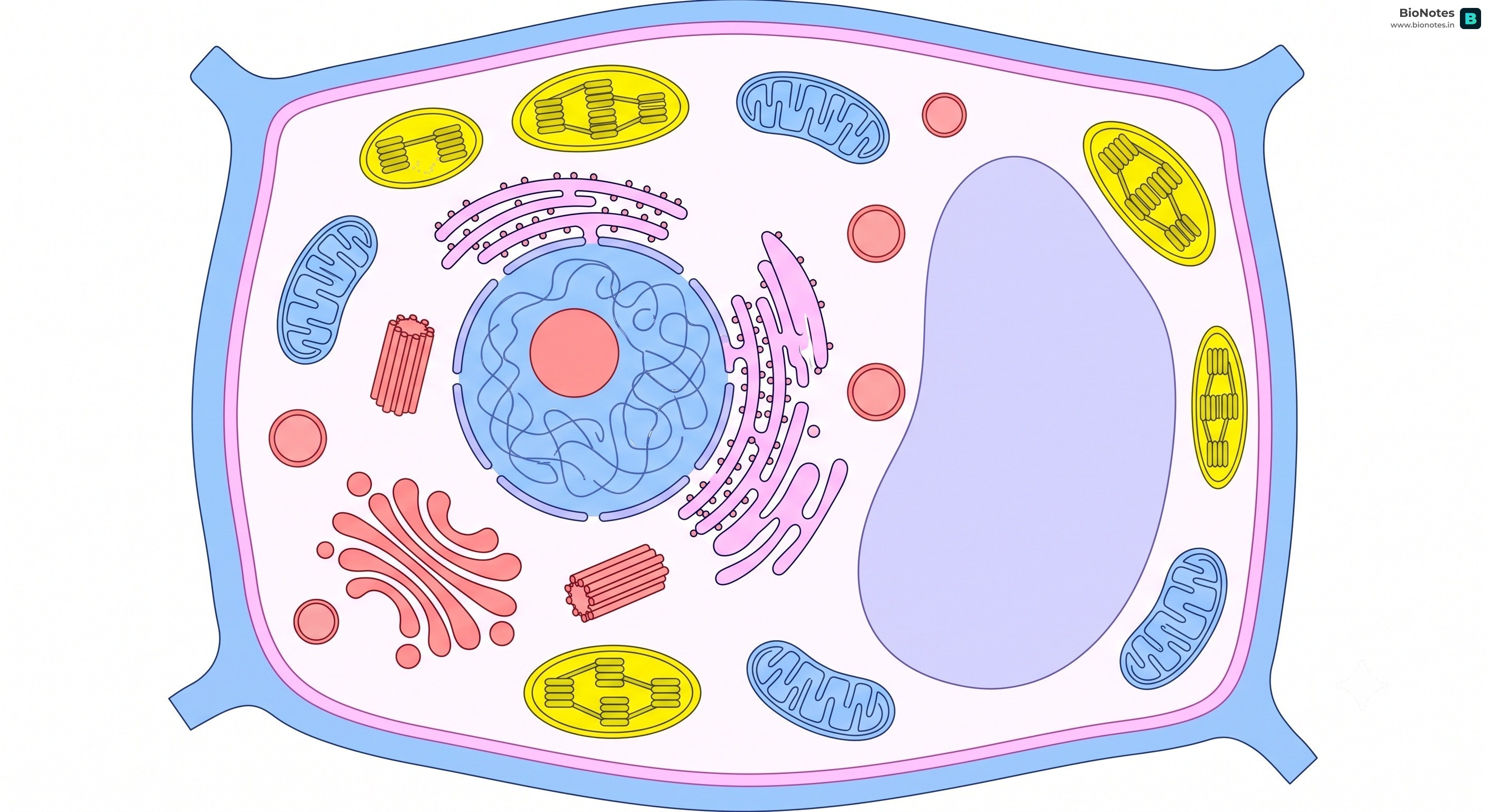
While both plant and animal cells are eukaryotic, they have distinct differences that reflect their different modes of life. Plants are generally stationary and produce their own food, while animals are motile and ingest their food. These differences are clearly visible in their cellular structures.
| Feature | Plant Cell | Animal Cell |
|---|---|---|
| Cell Wall | Present. A rigid outer layer made primarily of cellulose. It provides structural support, protection, and gives the plant cell a fixed shape. | Absent. The cell is enclosed only by a flexible cell membrane. This allows for a variety of shapes and movement. |
| Plastids | Present. These are a group of organelles responsible for photosynthesis and storage. The most important are chloroplasts, which contain chlorophyll and are the site of photosynthesis. Other plastids include chromoplasts (contain pigments) and leucoplasts (store starch). | Absent. Animal cells cannot perform photosynthesis. |
| Vacuoles | A large, central vacuole. This can occupy up to 90% of the cell volume. It stores water, nutrients, and waste products. The pressure of the vacuole against the cell wall (turgor pressure) provides support to the plant. | Small, temporary vacuoles. If present, they are much smaller and are involved in temporary storage or transport. |
| Centrosome | Absent in higher plants. Cell division occurs without the involvement of centrioles. | Present. An organelle located near the nucleus that contains a pair of centrioles. It plays a crucial role in cell division by organizing the microtubules of the spindle apparatus. |
Imagine a bustling city. It has a city hall, power plants, factories, roads, and a waste disposal system. A eukaryotic cell is much like this city, with various organelles performing specific roles to keep the cell alive and functioning.
ATP: The Energy Currency ATP (Adenosine Triphosphate) is the molecule that provides the energy required for almost all cellular activities. Mitochondria are the primary sites where this currency is "minted."
NGSS-MS-LS1-1AQA-GCSE-4.1.1KS3-Biology