Class 9
Created by Titas Mallick
Biology Teacher • M.Sc. Botany • B.Ed. • CTET (CBSE) • CISCE Examiner
 BioNotes
Created by Titas Mallick
Biology Teacher • M.Sc. Botany • B.Ed. • CTET (CBSE) • CISCE Examiner
Online
Common Misconceptions
Watch Out! Tissues form the building blocks of organs. Remember:
In multicellular organisms, cells with similar structures and functions are organized into groups called tissues. The study of tissues is called histology. Tissues are the next level of organization after cells, and they work together to form organs, which in turn form organ systems. This organization allows for a division of labor, where different tissues are specialized to perform specific functions, making the organism more efficient.
Plant tissues are broadly classified into two main types based on their ability to divide: meristematic tissues and permanent tissues.
 www.bionotes.in
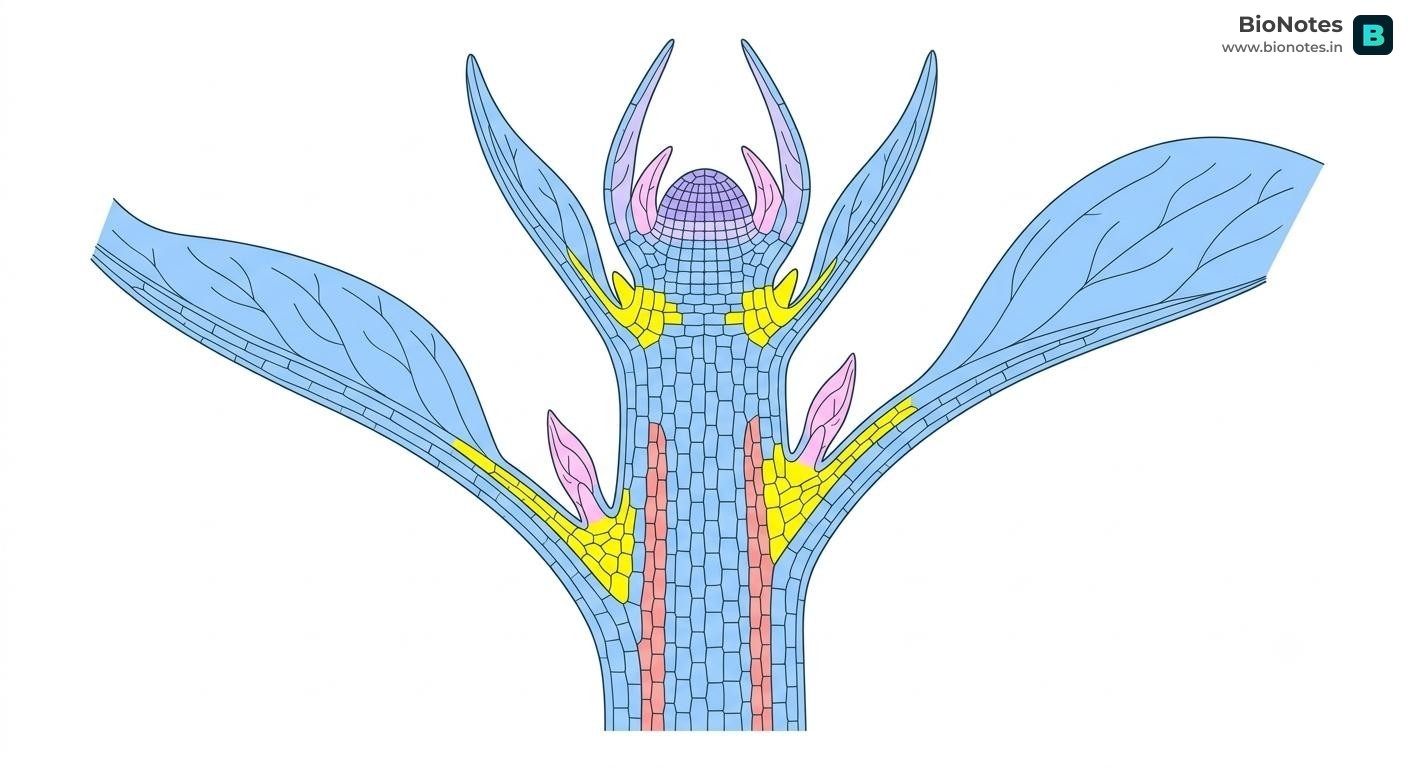
Meristematic tissues are composed of actively dividing cells that are responsible for the growth of the plant. These cells are typically small, have thin walls, dense cytoplasm, and a prominent nucleus.
Types of Meristematic Tissues:
| Type | Location | Function |
|---|---|---|
| Apical Meristem | Tips of roots and shoots. | Increases the length of the plant (primary growth). |
| Lateral Meristem | On the sides of stems and roots (e.g., cambium). | Increases the girth or diameter of the plant (secondary growth). |
| Intercalary Meristem | At the base of leaves or internodes. | Responsible for the growth of leaves and internodes. |
Permanent tissues are derived from meristematic tissues but have lost their ability to divide. They have differentiated to perform specific functions. They are classified into simple and complex permanent tissues.
 www.bionotes.in
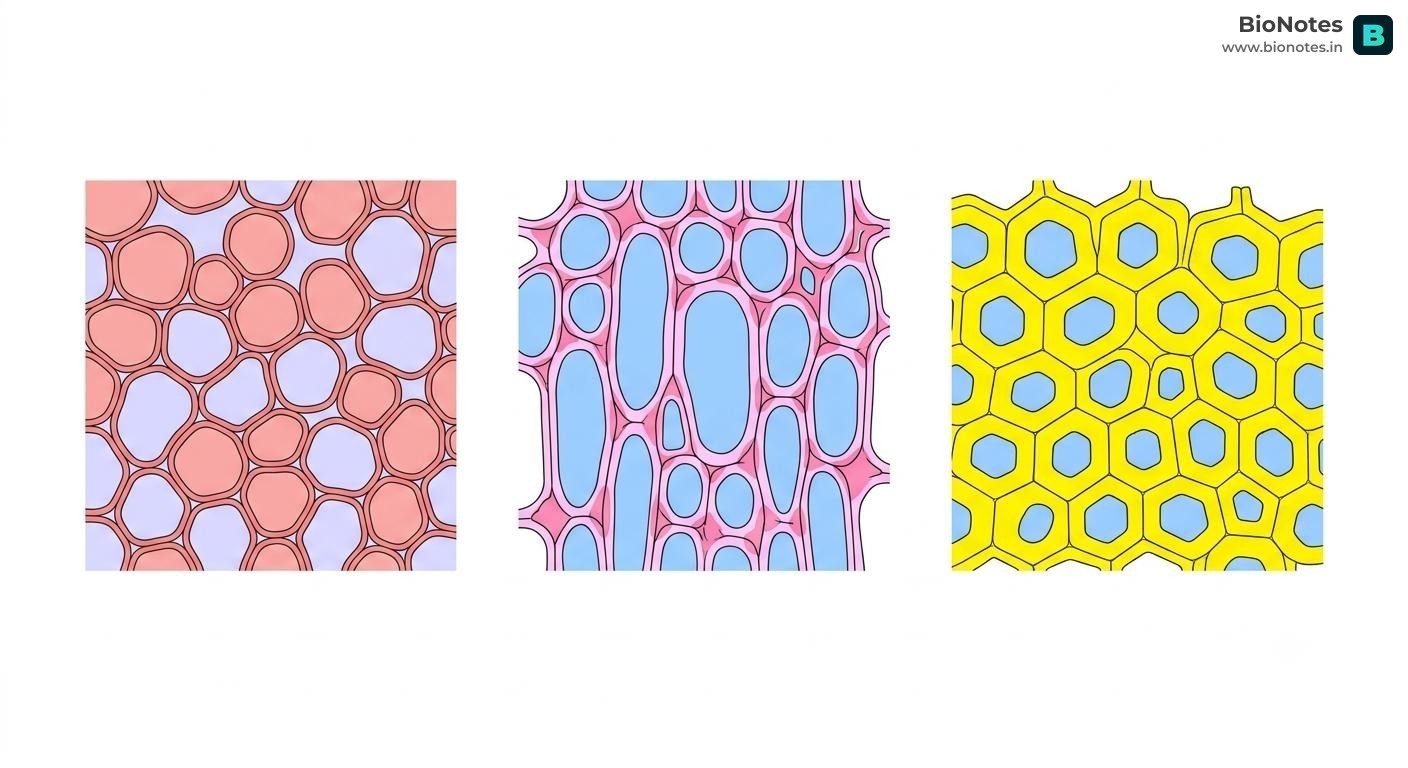
These tissues are composed of a single type of cell.
| Type | Structure | Location | Function | Role in Physiological Processes |
|---|---|---|---|---|
| Parenchyma | Thin-walled, isodiametric cells with intercellular spaces. | Found throughout the plant body (e.g., cortex, pith, mesophyll). | Storage of food, photosynthesis (chlorenchyma), buoyancy (aerenchyma). | Photosynthesis, respiration, food storage. |
| Collenchyma | Elongated cells with unevenly thickened corners (pectin and cellulose). | In the leaf stalks and below the epidermis of stems. | Provides mechanical support and flexibility to young stems and leaves. | Provides support to growing parts of the plant without restricting growth. |
| Sclerenchyma | Thick-walled, lignified cells (dead at maturity). Two types: fibers (long) and sclereids (short). | In stems, roots, veins of leaves, and hard coverings of seeds and nuts. | Provides mechanical strength and rigidity to the plant. | Provides structural support and protection. |
 www.bionotes.in
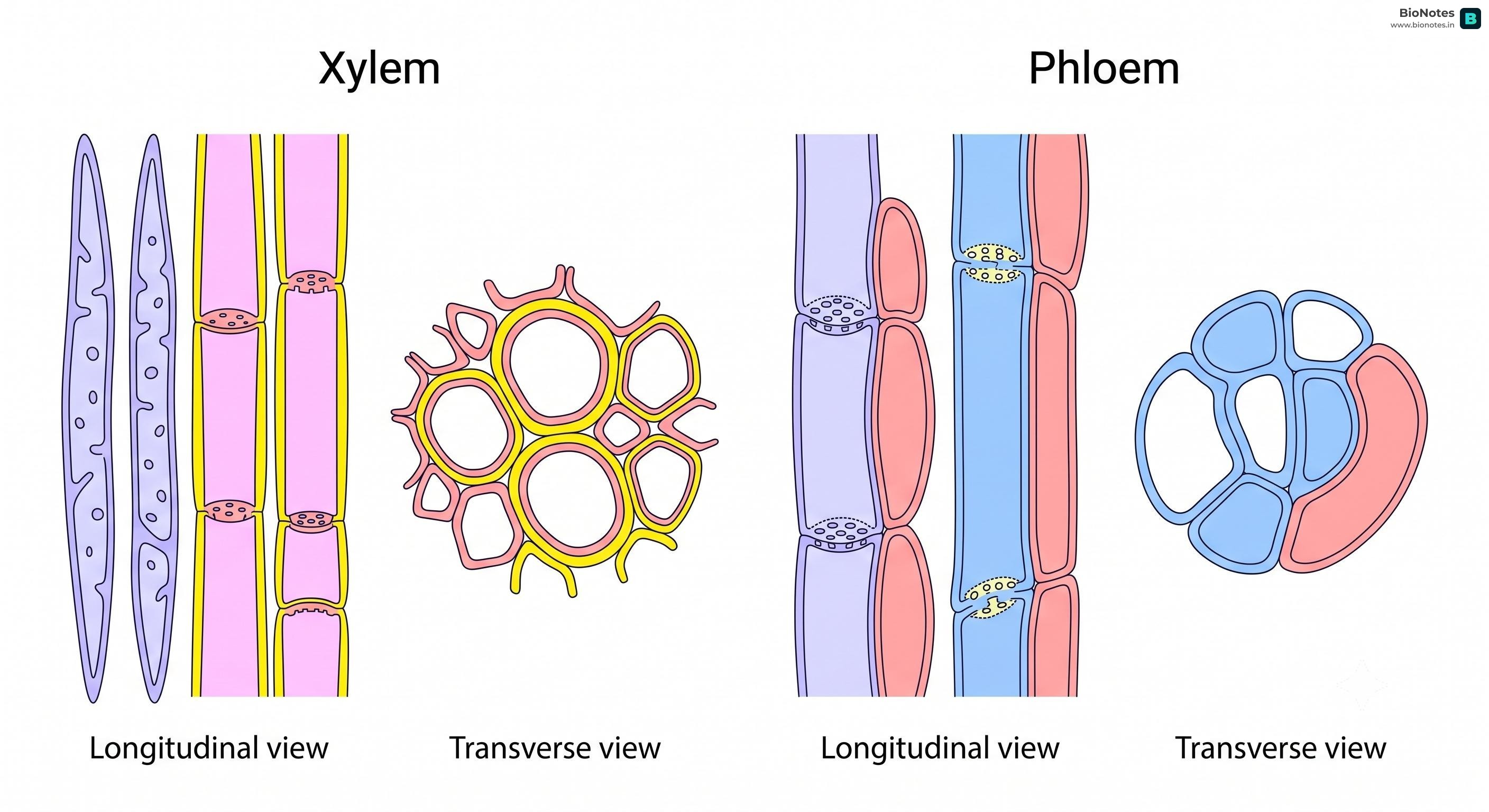
These tissues are composed of more than one type of cell, working together as a unit. They are also known as vascular tissues.
The One-Way and Two-Way Streets
| Type | Component Cells | Location | Function | Role in Physiological Processes |
|---|---|---|---|---|
| Xylem | Tracheids, vessels, xylem parenchyma, and xylem fibers. | In the vascular bundles of roots, stems, and leaves. | Conducts water and minerals from the roots to the rest of the plant. Provides mechanical support. | Transpiration and Water Transport: Forms a continuous channel for the upward movement of water. |
| Phloem | Sieve tubes, companion cells, phloem parenchyma, and phloem fibers. | In the vascular bundles of roots, stems, and leaves. | Transports food (sugars) from the leaves to other parts of the plant. | Translocation: The transport of soluble organic food materials from the leaves to other parts of the plant. |
 www.bionotes.in
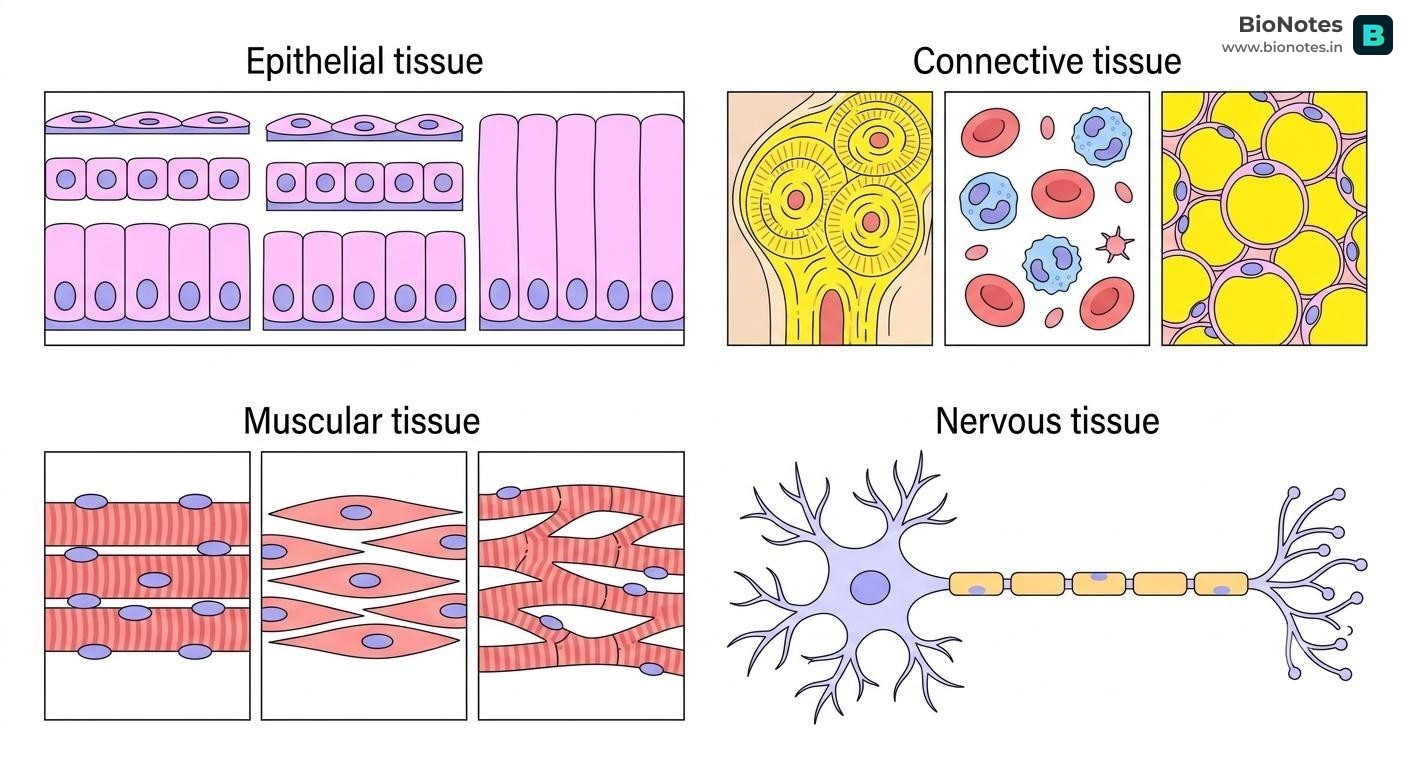
Animal tissues are classified into four main types based on their structure and function: epithelial, connective, muscular, and nervous tissues.
Epithelial tissue forms a continuous layer that covers the body surfaces, lines body cavities, and forms glands. The cells are tightly packed with little intercellular substance.
Types of Epithelial Tissues:
| Type | Structure | Location | Function |
|---|---|---|---|
| Squamous | Thin, flat cells. | Lining of blood vessels (endothelium), air sacs of lungs. | Filtration and diffusion. |
| Cuboidal | Cube-shaped cells. | Kidney tubules, ducts of glands. | Secretion and absorption. |
| Columnar | Tall, pillar-like cells. | Lining of the stomach and intestine. | Secretion and absorption. |
| Ciliated | Columnar or cuboidal cells with cilia. | Lining of the respiratory tract and fallopian tubes. | Moves mucus and other substances. |
| Glandular | Modified epithelial cells. | Glands (e.g., salivary, sweat). | Secretion of enzymes, hormones, etc. |
Connective tissue is the most abundant and widely distributed tissue in the body. It connects, supports, and binds other tissues and organs. It is characterized by having cells scattered in a large amount of extracellular matrix.
Types of Connective Tissues:
| Type | Description | Examples | Function |
|---|---|---|---|
| Areolar | Loose network of collagen and elastin fibers. | Beneath the skin, around nerves and blood vessels. | Fills space, supports organs, and fights infection. |
| Adipose | Fat cells (adipocytes) in a matrix. | Under the skin, around organs. | Stores fat for energy, insulation, and cushioning. |
| Fibrous | Densely packed collagen fibers. | Tendons (muscle to bone), ligaments (bone to bone). | Provides strong connection and support. |
| Cartilage | Chondrocytes in a rubbery matrix. | Ends of bones, nose, ears, trachea. | Provides flexible support and reduces friction. |
| Bone | Osteocytes in a rigid, calcified matrix. | Skeleton. | Provides support, protection, and allows movement. |
| Blood | Red blood cells, white blood cells, and platelets in a fluid matrix (plasma). | Within blood vessels. | Transports oxygen, nutrients, hormones, and waste products. |
Muscular tissue is composed of elongated cells called muscle fibers that are capable of contraction. This property is responsible for all types of movement in the body.
Types of Muscular Tissues:
| Type | Structure | Control | Location | Function |
|---|---|---|---|---|
| Striated (Skeletal) | Long, cylindrical, unbranched fibers with striations. | Voluntary | Attached to bones. | Voluntary movements. |
| Unstriated (Smooth) | Spindle-shaped, non-striated fibers. | Involuntary | Walls of internal organs (e.g., stomach, intestine). | Involuntary movements. |
| Cardiac | Branched, striated fibers with intercalated discs. | Involuntary | Wall of the heart. | Pumping of blood. |
Nervous tissue is the main component of the nervous system (brain, spinal cord, and nerves). It is responsible for coordinating and controlling all bodily activities.
A neuron is the structural and functional unit of the nervous system. It consists of the following main parts:
Cell Body (Cyton or Soma):
Dendrites:
Axon (Nerve Fiber):
NGSS-MS-LS1-3AQA-GCSE-4.1.1.2KS3-Biology