Class 9
Created by Titas Mallick
Biology Teacher • M.Sc. Botany • B.Ed. • CTET (CBSE) • CISCE Examiner
 BioNotes
Created by Titas Mallick
Biology Teacher • M.Sc. Botany • B.Ed. • CTET (CBSE) • CISCE Examiner
Online
Common Misconceptions
Watch Out! The transfer of pollen is critical for plant survival:
Pollination is a crucial step in the sexual reproduction of flowering plants. It is the process of transferring pollen grains from the male part of a flower (the anther) to the female part (the stigma). The ultimate goal of pollination is fertilization, which leads to the production of seeds and fruits, ensuring the propagation of the species.
 www.bionotes.in
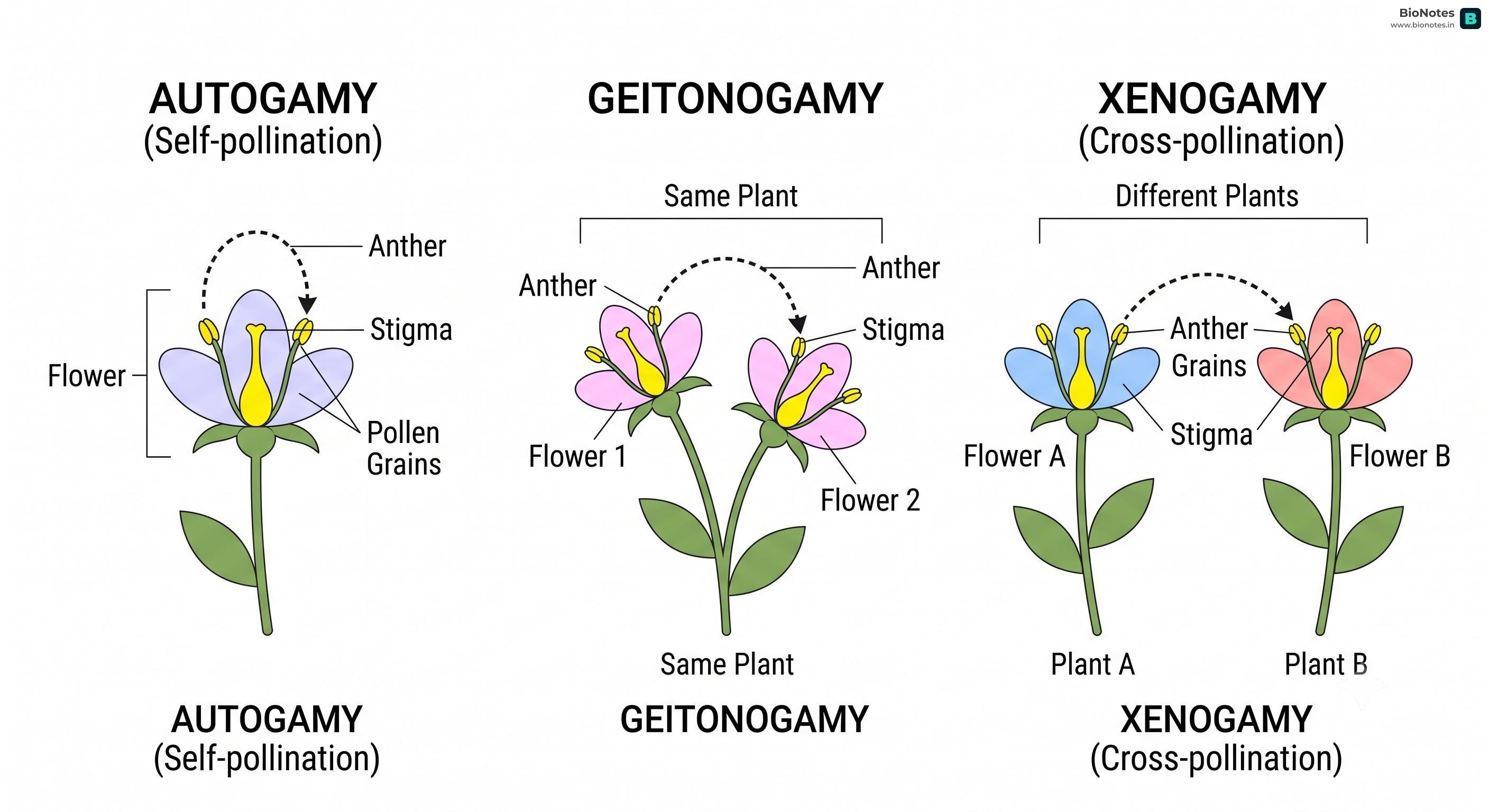
There are two fundamental types of pollination, based on whether the pollen is transferred to a stigma of the same plant or a different plant.
Explanation: Self-pollination is the transfer of pollen from the anther to the stigma of the same flower or to another flower on the same plant. This type of pollination is common in bisexual flowers where the anther and stigma mature at the same time.
Examples: Pea, Wheat, Rice, Tomato.
| Advantages | Disadvantages |
|---|---|
| Certainty: It is almost certain to occur in bisexual flowers where the stamens and carpels mature simultaneously. | No New Varieties: It does not lead to the formation of new varieties or species as there is no mixing of genes from different plants. |
| Less Wastage: The plant does not need to produce a large amount of pollen as the transfer is localized. | Reduced Vigor and Vitality: Continuous self-pollination over generations can lead to a weaker and less vigorous offspring. |
| Preservation of Parental Characters: It maintains the purity of the race, ensuring that the offspring have the same characteristics as the parent plant. | Increased Susceptibility to Diseases: The lack of genetic variation makes the entire population vulnerable to the same diseases. |
Explanation: Cross-pollination is the transfer of pollen from the anther of a flower on one plant to the stigma of a flower on another plant of the same species. This process introduces genetic variation into the population.
Examples: Apple, Rose, Hibiscus, Maize.
| Advantages | Disadvantages |
|---|---|
| New Varieties: It introduces new gene combinations, leading to genetic variation and the formation of new, improved varieties. | Uncertainty: The process is not always certain, as it depends on external agents (like wind, water, or animals). |
| Increased Vigor and Vitality: The offspring produced are often healthier, more vigorous, and have a better capacity for adaptation to changing environments. | Wastage of Pollen: Plants have to produce a large amount of pollen to ensure that some of it reaches the target stigma, leading to significant wastage. |
| Better Adaptation: Genetic diversity increases the chances of the species surviving in changing environmental conditions. | Potential for Undesirable Characters: The mixing of genes can sometimes result in the combination of undesirable traits from both parent plants. |
 www.bionotes.in
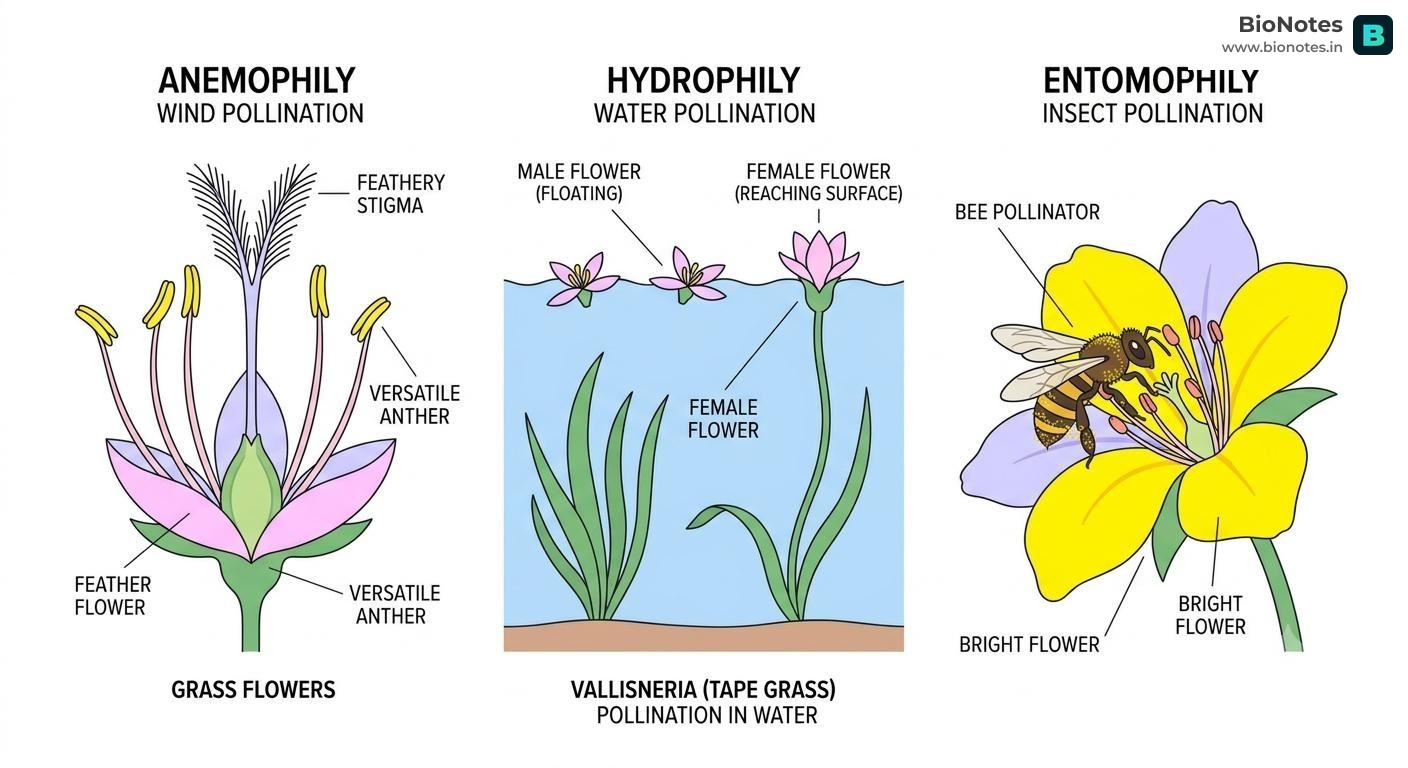
Cross-pollination requires external agents to transfer pollen from one plant to another. These agents can be abiotic (non-living) or biotic (living).
This is the most common type of biotic pollination. Insects like bees, butterflies, moths, and beetles visit flowers for nectar, and in the process, pollen grains get stuck to their bodies and are transferred to other flowers.
Characteristic Features of Insect-Pollinated Flowers:
Wind carries the pollen grains from one plant to another. This is common in grasses and many trees.
Characteristic Features of Wind-Pollinated Flowers:
This type of pollination is rare and occurs in some aquatic plants. The pollen is transferred through water currents.
Characteristic Features of Water-Pollinated Flowers:
Examples: Vallisneria, Hydrilla.
Pollination carried out by birds is called ornithophily. Sunbirds and hummingbirds are common bird pollinators.
Characteristic Features of Bird-Pollinated Flowers:
Pollination by bats is called chiropterophily. Bats are nocturnal, so these flowers have unique adaptations to attract them at night.
Characteristic Features of Bat-Pollinated Flowers:
This is a man-made process where humans manually transfer pollen grains from the anther of one flower to the receptive stigma of another. It is widely used in agriculture and plant breeding to produce high-yielding, disease-resistant crop varieties.
Steps Involved:
Since cross-pollination leads to healthier and more adaptable offspring, nature has evolved several mechanisms or "outbreeding devices" to encourage it and prevent self-pollination, even in bisexual flowers.
Unisexuality (or Dicliny):
Dichogamy:
Protandry vs. Protogyny Memorize the difference: Protandry (Androecium first) and Protogyny (Gynoecium first). Both are "outbreeding devices" that ensure cross-pollination by ensuring the male and female parts are not active simultaneously.
Self-Sterility (or Self-Incompatibility):
Herkogamy:
NGSS-MS-LS1-4AQA-GCSE-4.4.1KS3-Biology