Up to ICSE 2027: Mandatory (Part of the official Class IX board examination syllabus).
From ICSE 2028 onwards: Optional / Reference Only (Omitted from the official Class IX exam syllabus; starting from 2028, the syllabus focuses exclusively on the Diversity in Animal Kingdom).
The five kingdom classification is a system of classifying living organisms into five kingdoms: Monera, Protista, Fungi, Plantae, and Animalia. This classification was proposed by R.H. Whittaker in 1969 and is based on the following criteria:
Basis of Classification
Whittaker's system was revolutionary because it looked beyond just physical appearance, focusing on cellular structure (Prokaryote vs Eukaryote) and how organisms obtain energy (Nutrition).
Complexity of cell structure:Prokaryote or Eukaryote.
Complexity of body organization: Unicellular or Multicellular.
Mode of nutrition:Autotrophic or Heterotrophic.
Phylogenetic relationships:Evolutionary relationships between organisms.
Watch Out! Categorizing life relies on cellular structure:
Misconception 1:All microscopic single-celled organisms belong to the same kingdom.Correction: False! A single-celled bacterium (no nucleus) belongs to Monera, but a single-celled amoeba (has a nucleus) belongs to Protista.
Every discovered organism is given a unique scientific name to ensure it is recognized globally by the same name, avoiding local language confusion. This system of naming is called Binomial Nomenclature and was introduced by Carolus Linnaeus.
According to this system, a scientific name consists of two parts:
Genus (Generic name): Represents the group of closely related species. It always starts with a capital letter (e.g., Homo).
Species (Specific epithet): Represents the specific organism within that genus. It always starts with a lowercase letter (e.g., sapiens).
When writing or printing scientific names, the following rules must be strictly followed:
Italicization (Printed): When typed or printed, the scientific name must be written in italics (e.g., Homo sapiens, Panthera leo).
Underlining (Handwritten): When handwritten, the Genus name and the Species name must be underlined separately (e.g., Homosapiens).
Language: The names are derived from Latin or Greek (or are latinized) because Latin is a dead language and its words do not change meaning over time.
Authority: Sometimes, the name of the describer (author) is added at the end in abbreviated form (e.g., Homo sapiens L., where "L." stands for Linnaeus).
This kingdom includes unicellular prokaryoteorganisms. They are the simplest and most ancient group of organisms.
Main Characteristics:
ProkaryoteCells: They lack a true nucleus and other membrane-bound organelles like mitochondria, chloroplasts, and endoplasmic reticulum. The genetic material is a single, circular DNA molecule, located in a region called the nucleoid.
Cell Wall: Most monerans have a rigid cell wall made of peptidoglycan (murein), which provides structural support and protection.
Nutrition: They exhibit diverse modes of nutrition:
Autotrophic: They can produce their own food.
Photosynthesis: They use light energy to synthesize food (e.g., Cyanobacteria).
Chemosynthetic: They obtain energy from the oxidation of inorganic chemical compounds (e.g., Nitrifying bacteria).
Heterotrophic: They obtain food from external sources.
Saprophytic: They feed on dead and decaying organic matter (e.g., Decomposing bacteria).
Parasitic: They live in or on other organisms (hosts) and obtain nourishment from them (e.g., Vibrio cholerae).
Reproduction: They primarily reproduce asexually through binary fission.
Examples:
Bacteria: Microscopic, single-celled organisms found everywhere. They can be classified based on their shape:
Cyanobacteria (Blue-Green Algae):Photosynthesis bacteria that contain chlorophyll. They are known for their ability to fix atmospheric nitrogen (e.g., Nostoc, Anabaena).
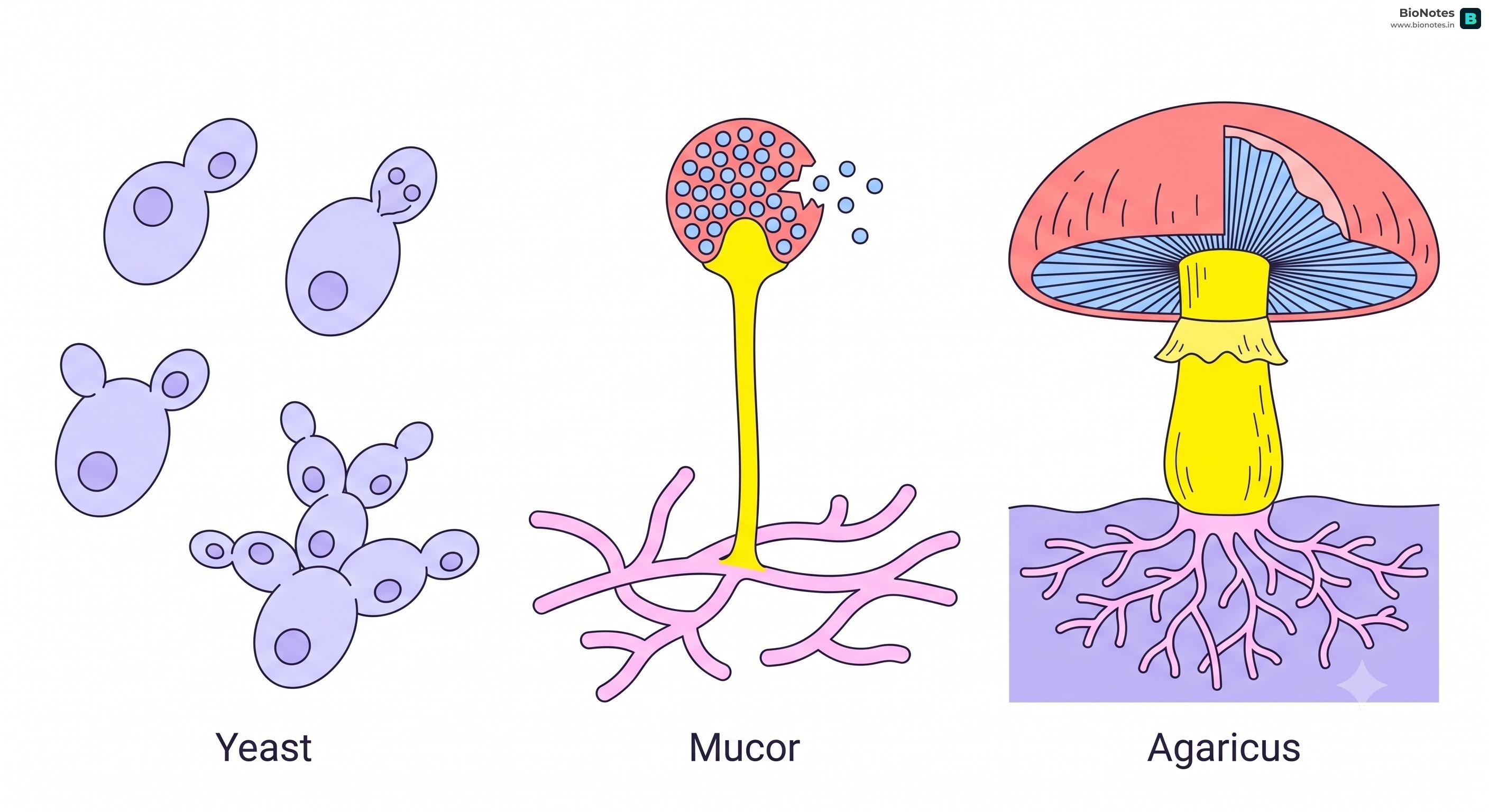
This kingdom includes eukaryote, heterotrophic organisms. They were previously classified as plants, but they lack chlorophyll and have a different cell wall composition.
Main Characteristics:
EukaryoteCells: They have a true nucleus and membrane-bound organelles.
Body Structure: Most fungi are multicellular and their body is composed of a network of thread-like structures called hyphae. This network is known as the mycelium. Some fungi, like yeast, are unicellular.
Cell Wall: Their cell walls are made of a complex polysaccharide called chitin.
Nutrition: They are heterotrophic and obtain nutrients by absorption:
Saprophytic: They obtain nutrients from dead organic matter (e.g., Mushrooms, Molds).
Parasitic: They live on or in other living organisms and cause diseases (e.g., Puccinia - rust fungus).
Symbiotic: They live in a mutually beneficial relationship with other organisms. For example, lichens are a symbiotic association between a fungus and an alga.
Reproduction: They reproduce both asexually (spore formation, budding) and sexually.
Interactive Diagram•study Mode
||
www.bionotes.in
Examples:
Mushrooms: The fleshy, spore-bearing fruiting body of a fungus, typically produced above ground on soil or on its food source.
Yeasts: Unicellular fungi that are used in the baking and brewing industries.
Plant Body: They have a more differentiated body than algae, with simple stem-like and leaf-like structures, but they lack true roots. They are attached to the substratum by root-like structures called rhizoids.
Habitat: They are often called the "amphibians of the plant kingdom" because they live in moist, shady places and require water for sexual reproduction.
Vascular System: They lack a specialized vascular system (xylem and phloem) for the transport of water and food.
These are the most advanced group of plants. Their defining characteristic is the presence of seeds for reproduction.
They are further divided into two groups:
Gymnosperms: They bear "naked" seeds, meaning the seeds are not enclosed within a fruit. (e.g., Pinus, Cycas).
Angiosperms (Flowering Plants): They bear seeds that are enclosed within a fruit. They are the largest and most diverse group of plants. (e.g., Mango, Rose, Wheat).
 BioNotes