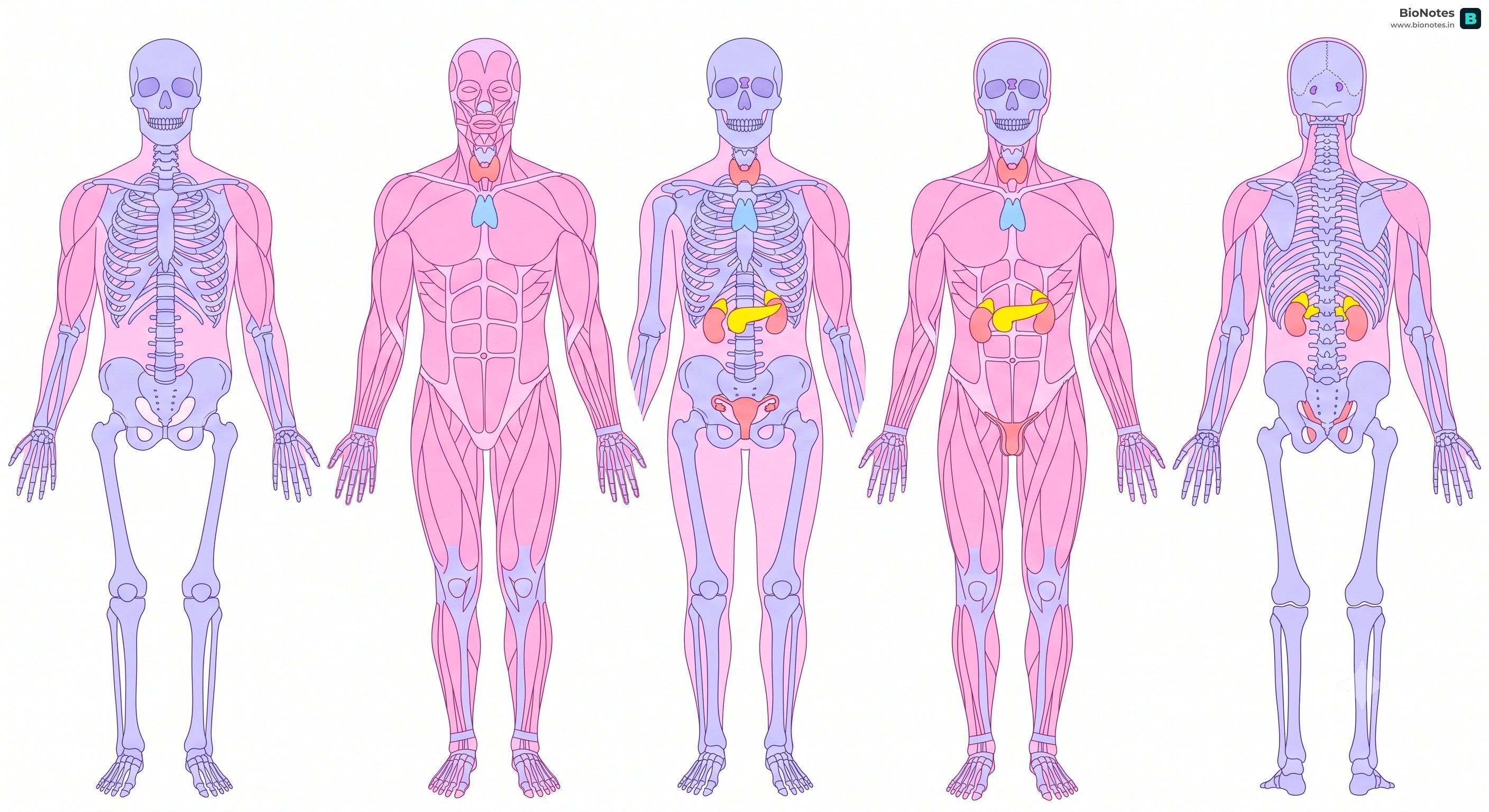
The human skeleton serves multiple vital functions that are essential for survival and daily activities.
Structural Support: Provides rigid framework that maintains body shape and postureBody Architecture: Acts as scaffolding for attachment of muscles, organs, and tissuesWeight Distribution: Distributes body weight evenly to prevent collapseExamples: Vertebral column supports upper body weight, leg bones support entire body weight
Cranium: Protects brain from physical damageRib Cage: Shields heart, lungs, and major blood vesselsVertebral Column: Protects spinal cordPelvic Girdle: Protects reproductive organs, bladder, and lower digestive organsImportance: Prevents damage from external impacts and mechanical stress
Muscle Attachment: Provides anchor points for skeletal musclesLever System: Bones act as levers, joints as fulcrums, muscles provide forceLocomotion: Enables walking, running, jumping, and all forms of movementFine Motor Skills: Allows precise movements like writing, typing, grasping
Red Bone Marrow: Produces red blood cells, white blood cells, and plateletsLocation: Found in flat bones (sternum, ribs, hip bones) and ends of long bonesContinuous Process: Replaces old blood cells throughout lifeImportance: Maintains oxygen transport, immune function, and blood clotting
Calcium Storage: 99% of body's calcium stored in bonesPhosphorus Storage: Major reservoir of phosphate ionsMineral Release: Releases minerals into bloodstream when neededpH Balance: Helps maintain acid-base balance in bloodBone Remodeling: Constant breakdown and rebuilding maintains mineral homeostasis
Yellow Bone Marrow: Stores fat (adipose tissue) in medullary cavitiesEnergy Reserve: Provides energy during times of nutritional stressLocation: Primarily in long bones of arms and legs in adults
Interactive Diagram • study Mode
Study Quiz | Save Image | Save Diagram
www.bionotes.in 1. Skull (Cranium and Facial Bones)
Cranium: 8 bones protecting the brain
Frontal bone, parietal bones (2), temporal bones (2), occipital bone, sphenoid bone, ethmoid bone
Facial Bones: 14 bones forming face structure
Maxilla (2), mandible, nasal bones (2), zygomatic bones (2), lacrimal bones (2), palatine bones (2), vomer, inferior nasal conchae (2)
Functions: Brain protection, sensory organ housing, digestive system beginning
2. Vertebral Column (Spine)
Cervical Vertebrae: 7 bones in neck region (C1-C7)
C1 (Atlas): Supports skull, allows nodding
C2 (Axis): Allows head rotation
Thoracic Vertebrae: 12 bones in chest region (T1-T12)
Attach to ribs, larger and stronger
Lumbar Vertebrae: 5 bones in lower back (L1-L5)
Largest vertebrae, bear most body weight
Sacrum: 5 fused vertebrae forming back of pelvisCoccyx: 4 fused vertebrae forming tailboneFunctions: Spinal cord protection, body support, movement flexibility
3. Rib Cage (Thoracic Cage)
Ribs: 12 pairs of curved bones
True ribs (1-7): Directly attached to sternum
False ribs (8-12): Indirectly attached or floating
Sternum: Breastbone with three parts
Manubrium (upper), body (middle), xiphoid process (lower)
Functions: Heart and lung protection, breathing assistance
The appendicular skeleton includes bones of the appendages (arms and legs) and their attachments to the axial skeleton.
1. Upper Extremities
Shoulder Girdle (Pectoral Girdle):
Clavicle (collarbone) - 2 bones
Scapula (shoulder blade) - 2 bones
Arms:
Humerus (upper arm) - 2 bones
Radius and Ulna (forearm) - 4 bones
Hand bones - 54 bones total
Carpals (wrist): 16 bones (8 per hand)
Metacarpals (palm): 10 bones (5 per hand)
Phalanges (fingers): 28 bones (14 per hand)
2. Lower Extremities
Pelvic Girdle (Hip Bones):
Hip bones (coxal bones) - 2 bones
Each hip bone formed by fusion of ilium, ischium, and pubis
Legs:
Femur (thigh bone) - 2 bones (longest bone in body)
Patella (kneecap) - 2 bones
Tibia and Fibula (lower leg) - 4 bones
Foot bones - 52 bones total
Tarsals (ankle): 14 bones (7 per foot)
Metatarsals (arch): 10 bones (5 per foot)
Phalanges (toes): 28 bones (14 per foot)
Joints are points where two or more bones meet. They are classified based on the degree of movement they allow.
Joints that allow no movement between bones.
Characteristics:
Bones are tightly fitted together
Connected by fibrous connective tissue
Provide maximum stability and protection
No joint cavity present
Types and Locations:
Sutures:
Location: Between skull bones (cranial sutures)Examples:
Coronal suture (between frontal and parietal bones)
Sagittal suture (between parietal bones)
Lambdoid suture (between parietal and occipital bones)
Function: Protect brain, allow skull growth during childhood
Gomphoses:
Location: Between teeth and jaw bonesExample: Tooth roots in dental sockets (alveoli)Function: Secure teeth firmly in jaw for effective chewing
Functions:
Maximum protection of vital organs
Structural stability
Force distribution across bones
Joints that allow limited movement between bones.
Characteristics:
Connected by cartilage or fibrous tissue
Allow slight flexibility while maintaining stability
Absorb shock and distribute forces
Limited joint cavity or no cavity
Types and Locations:
Cartilaginous Joints:
Location: Between vertebrae (intervertebral discs)Structure: Fibrocartilage discs between vertebral bodiesMovement: Slight bending and twisting of spineFunction: Shock absorption, spinal flexibility
Symphyses:
Location: Pubic symphysis (between hip bones)Structure: Fibrocartilage pad between bonesMovement: Slight separation during childbirthFunction: Stability with limited flexibility
Syndesmoses:
Location: Between tibia and fibula (lower leg)Structure: Dense fibrous connective tissueMovement: Slight spreading during ankle movementFunction: Maintains bone alignment while allowing flexibility
Functions:
Shock absorption
Limited flexibility for specific functions
Structural stability with some movement
Joints that allow considerable movement in one or more directions.
Synovial Fluid
Synovial fluid acts as a lubricant to reduce friction between bones. A reduction in this fluid or damage to the articular cartilage can lead to joint pain and conditions like arthritis.
General Characteristics:
Joint Cavity: Fluid-filled space between bonesSynovial Membrane: Lines joint cavity, secretes synovial fluidSynovial Fluid: Lubricates joint, reduces frictionArticular Cartilage: Smooth cartilage covering bone endsJoint Capsule: Fibrous capsule surrounding jointLigaments: Connect bones, provide stability
Types of Synovial Joints:
Structure and Movement:
Allows movement in one plane only (flexion and extension)
Resembles door hinge mechanism
Strong ligaments on sides prevent lateral movement
Locations and Examples:
Elbow Joint: Between humerus and ulna
Flexion: Bending arm (biceps contraction)
Extension: Straightening arm (triceps contraction)
Knee Joint: Between femur and tibia
Flexion: Bending leg backward
Extension: Straightening leg
Ankle Joint: Between tibia/fibula and talus
Dorsiflexion: Lifting foot upward
Plantarflexion: Pointing foot downward
Finger Joints: Between phalanges
Enables gripping and fine motor control
Functions:
Powerful lever actions
Precise directional movement
Essential for locomotion and manipulation
Structure and Movement:
Rounded head of one bone fits into cup-shaped cavity of another
Allows movement in all planes and rotation
Most mobile type of joint
Locations and Examples:
Shoulder Joint: Between humerus and scapula
Flexion/Extension: Moving arm forward/backward
Abduction/Adduction: Moving arm away/toward body
Rotation: Circular arm movements
Circumduction: Circular motion combining all movements
Hip Joint: Between femur and hip bone
Similar movements but more restricted than shoulder
Weight-bearing function limits range of motion
Functions:
Maximum range of motion
Multi-directional movement capability
Essential for complex movements like throwing, swimming
Structure and Movement:
Flat or slightly curved bone surfaces
Bones slide past each other
Limited movement in multiple directions
Locations and Examples:
Wrist Joints: Between carpal bones
Allows complex hand movements
Enables wrist bending and turning
Ankle Joints: Between tarsal bones
Provides foot flexibility
Aids in walking on uneven surfaces
Vertebral Joints: Between vertebral processes
Allows slight spinal twisting and bending
Contributes to overall spinal flexibility
Sternoclavicular Joint: Between sternum and clavicle
Allows shoulder girdle movement
Functions:
Fine adjustment of position
Distribution of forces across multiple bones
Enhanced flexibility in complex structures
Structure and Movement:
One bone rotates around another
Cylindrical or ring-like structure
Allows rotation only
Locations and Examples:
Atlantoaxial Joint: Between C1 (atlas) and C2 (axis) vertebrae
Allows head rotation (saying "no")
Atlas rotates around odontoid process of axis
Radioulnar Joint: Between radius and ulna in forearm
Pronation: Turning palm downward
Supination: Turning palm upward
Essential for hand positioning
Functions:
Rotational movements
Important for orientation and positioning
Enables complex manipulative tasks
Joint Type Movement Degree Structure Examples Primary Function Immovable None Fibrous tissue Skull sutures, tooth sockets Protection, stability Slightly Movable Limited Cartilage/fibrous Vertebrae, pubic symphysis Shock absorption, limited flexibility Hinge One plane Synovial Elbow, knee, ankle Flexion/extension Ball & Socket Multi-plane Synovial Shoulder, hip All movements + rotation Gliding Sliding Synovial Wrist, ankle bones Fine position adjustment Pivot Rotational Synovial Neck (C1-C2), forearm Rotation around axis
Flexion: Decreasing joint angle (bending)Extension: Increasing joint angle (straightening)Abduction: Moving away from body midlineAdduction: Moving toward body midlineRotation: Turning around bone's axisCircumduction: Circular movement combining flexion, extension, abduction, adductionPronation: Turning palm downwardSupination: Turning palm upward
Q1. Name two functions of the human skeleton.
A1. Support and protection of internal organs.
Q2. What is the total number of bones in an adult human skeleton?
A2. 206 bones.
Q3. Give one example of an immovable joint.
A3. Skull sutures.
Q4. Name the joint between the atlas and axis vertebrae.
A4. Pivot joint.
Q5. Which type of joint is present at the elbow?
A5. Hinge joint.
Q6. What is the function of synovial fluid?
A6. To lubricate joints and reduce friction.
Q7. Name the longest bone in the human body.
A7. Femur (thigh bone).
Q8. How many cervical vertebrae are present in humans?
A8. 7 cervical vertebrae.
Q9. Give one example of a ball and socket joint.
A9. Shoulder joint or hip joint.
Q10. What type of joint allows rotation around an axis?
A10. Pivot joint.
Q11. Name the process of blood cell formation in bones.
A11. Hematopoiesis.
Q12. Which skeleton includes the skull and vertebral column?
A12. Axial skeleton.
Q13. Give one example of a gliding joint.
A13. Wrist joints (between carpal bones).
Q14. How many ribs are present in the human rib cage?
A14. 12 pairs (24 ribs total).
Q15. What movement does a hinge joint allow?
A15. Flexion and extension.
Q1. Differentiate between axial and appendicular skeleton.
A1.
Axial skeleton: Forms central axis, includes skull, vertebral column, and rib cageAppendicular skeleton: Includes bones of arms, legs, and their attachments to axial skeleton
Q2. List four functions of the human skeleton.
A2.
Support and framework for the body
Protection of internal organs
Movement and locomotion
Blood cell production (hematopoiesis)
Q3. Name two examples each of immovable and freely movable joints.
A3.
Immovable joints: Skull sutures, tooth socketsFreely movable joints: Shoulder joint, knee joint
Q4. State two characteristics of synovial joints.
A4.
Presence of joint cavity filled with synovial fluid
Bones covered with smooth articular cartilage
Q5. Differentiate between hinge joint and ball and socket joint.
A5.
Hinge joint: Allows movement in one plane only (flexion/extension), e.g., elbowBall and socket joint: Allows movement in all planes including rotation, e.g., shoulder
Q6. Name the three types of vertebrae with their numbers.
A6.
Cervical vertebrae: 7
Thoracic vertebrae: 12
Lumbar vertebrae: 5
Q7. List two functions of red bone marrow.
A7.
Production of red blood cells
Production of white blood cells and platelets
Q8. State two examples of pivot joints with their locations.
A8.
Atlantoaxial joint (between atlas and axis vertebrae)
Radioulnar joint (between radius and ulna in forearm)
Q9. Name four bones of the appendicular skeleton.
A9.
Humerus (upper arm)
Femur (thigh)
Radius (forearm)
Tibia (lower leg)
Q10. Differentiate between flexion and extension movements.
A10.
Flexion: Decreasing the angle between bones (bending movement)Extension: Increasing the angle between bones (straightening movement)
Q11. List two components each of axial and appendicular skeleton.
A11.
Axial skeleton: Skull, vertebral columnAppendicular skeleton: Arms and hands, legs and feet
Q12. State two characteristics of slightly movable joints.
A12.
Allow limited movement between bones
Connected by cartilage or fibrous tissue
Q13. Name two movements possible at ball and socket joints.
A13.
Rotation around the bone's axis
Circumduction (circular movement)
Q14. List two functions of the vertebral column.
A14.
Protection of the spinal cord
Support of the upper body weight
Q15. State two locations where gliding joints are found.
A15.
Between carpal bones in the wrist
Between tarsal bones in the ankle
Q1. Explain the structure and functions of axial skeleton.
A1.
Structure: Includes skull (cranium and facial bones), vertebral column (cervical, thoracic, lumbar vertebrae, sacrum, coccyx), and rib cage (12 pairs of ribs and sternum)
Functions:
Forms central axis and framework of body
Protects vital organs (brain, spinal cord, heart, lungs)
Provides attachment sites for muscles involved in posture and breathing
Q2. Describe three types of joints based on degree of movement.
A2.
Immovable joints: No movement, bones connected by fibrous tissue, e.g., skull suturesSlightly movable joints: Limited movement, connected by cartilage, e.g., intervertebral jointsFreely movable joints: Considerable movement, synovial joints with joint cavity, e.g., shoulder, knee
Q3. Explain the structure and function of a hinge joint with examples.
A3.
Structure: Cylindrical end of one bone fits into corresponding depression of another, strong lateral ligaments prevent sideways movement
Function: Allows flexion and extension in one plane only, like a door hinge
Examples: Elbow joint (humerus-ulna), knee joint (femur-tibia), ankle joint
Q4. Describe five important functions of the human skeleton.
A4.
Support: Provides structural framework maintaining body shape and postureProtection: Shields internal organs (skull protects brain, ribs protect heart/lungs)Movement: Serves as attachment points for muscles enabling locomotionBlood cell production: Red bone marrow produces blood cells through hematopoiesisMineral storage: Stores calcium and phosphorus, releases them when needed
Q5. Compare ball and socket joint with pivot joint.
A5.
Ball and Socket Joint:
Structure: Round head fits into cup-shaped cavity
Movement: All directions plus rotation
Examples: Shoulder, hip joints
Pivot Joint:
Structure: One bone rotates around another
Movement: Rotation only
Examples: Atlas-axis joint, radioulnar joint
Q6. Explain the components and functions of appendicular skeleton.
A6.
Components: Upper extremities (shoulder girdle, arms, hands), lower extremities (pelvic girdle, legs, feet)
Functions:
Enables locomotion and movement through attachment of limb muscles
Provides manipulation capability through arm and hand bones
Supports body weight and enables upright posture through leg bones
Q7. Describe the structure and characteristics of synovial joints.
A7.
Structure:
Joint cavity filled with synovial fluid
Articular cartilage covers bone ends
Synovial membrane lines joint cavity
Joint capsule surrounds entire joint
Characteristics: Allow free movement, lubricated for smooth motion, most mobile joint type
Q8. Explain three types of freely movable joints with their movements.
A8.
Hinge joint: Flexion and extension in one plane (elbow, knee)Ball and socket joint: Movement in all planes including rotation (shoulder, hip)Gliding joint: Sliding movements in multiple directions (wrist, ankle bones)
Q9. Describe the vertebral column structure and its functions.
A9.
Structure:
33 vertebrae: 7 cervical, 12 thoracic, 5 lumbar, 5 sacral (fused), 4 coccygeal (fused)
Natural curves for shock absorption
Intervertebral discs between vertebrae
Functions: Spinal cord protection, body support, movement flexibility, shock absorption
Q10. Explain how bones contribute to mineral homeostasis.
A10.
Calcium storage: Bones store 99% of body's calcium in calcium phosphate crystals
Mineral release: When blood calcium drops, bones release calcium; when excess, bones store it
Regulation: Controlled by hormones (parathyroid hormone, calcitonin) maintaining proper blood mineral levels
Q11. Describe the differences between red and yellow bone marrow.
A11.
Red Bone Marrow:
Function: Produces blood cells (hematopoiesis)
Location: Flat bones, ends of long bones
Active throughout life
Yellow Bone Marrow:
Function: Stores fat as energy reserve
Location: Medullary cavities of long bones
Can convert to red marrow when needed
Q12. Explain the joint classification based on structural features.
A12.
Fibrous joints: Connected by dense fibrous tissue, immovable (skull sutures)Cartilaginous joints: Connected by cartilage, slightly movable (vertebral joints)Synovial joints: Have joint cavity with synovial fluid, freely movable (knee, shoulder)
Q13. Describe the protective functions of different parts of axial skeleton.
A13.
Skull: Cranium protects brain from trauma and impactRib cage: Ribs and sternum shield heart, lungs, and major blood vesselsVertebral column: Vertebrae protect spinal cord and nerve roots from damage
Q14. Explain the movements possible at different synovial joints.
A14.
Flexion/Extension: Decreasing/increasing joint angles (hinge joints)Abduction/Adduction: Moving away/toward midline (ball and socket)Rotation: Turning around bone axis (pivot joints)Gliding: Sliding movements (plane joints)Circumduction: Circular combination movement
Q15. Describe how the skeleton enables movement and locomotion.
A15.
Lever system: Bones act as levers, joints as fulcrums, muscles provide force
Muscle attachment: Bones provide anchor points for skeletal muscle attachment
Movement coordination: Different joint types allow specific movements - hinge for walking, ball-socket for arm swinging, enabling complex locomotor patterns like running, jumpingg, jumping
 BioNotes