Class 9
Created by Titas Mallick
Biology Teacher • M.Sc. Botany • B.Ed. • CTET (CBSE) • CISCE Examiner
 BioNotes
Created by Titas Mallick
Biology Teacher • M.Sc. Botany • B.Ed. • CTET (CBSE) • CISCE Examiner
Online
Common Misconceptions
Watch Out! Flowers are not just for decoration:
A flower is the reproductive unit of an angiosperm (flowering plant). It is a modified shoot with condensed internodes, where the leaves are modified into floral structures. The primary purpose of a flower is to produce seeds through sexual reproduction, ensuring the continuation of the species.
Did You Know? The largest flower in the world is the Rafflesia arnoldii, which can grow up to 3 feet in diameter and weigh over 10 kilograms! It is also known as the "corpse flower" because of its strong smell of decaying meat, which attracts flies for pollination.
A bisexual flower (or hermaphrodite flower) is one that contains both male (androecium) and female (gynoecium) reproductive parts. A typical bisexual flower is arranged in four concentric circles or whorls, attached to the receptacle (the swollen tip of the flower stalk or pedicel).
The four whorls are:
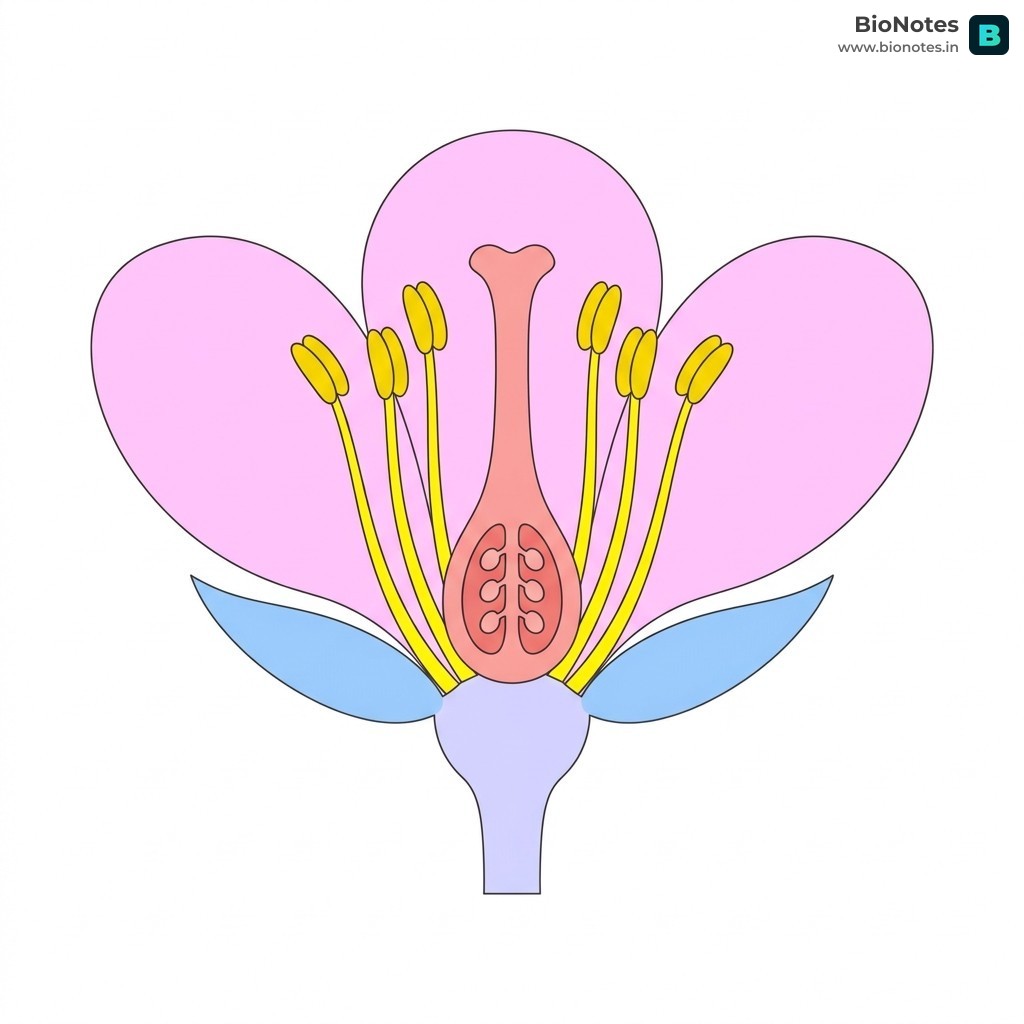 www.bionotes.in
The four whorls of a flower can be categorized into two groups: non-essential (or accessory) whorls and essential (or reproductive) whorls.
These whorls do not directly participate in reproduction but play a supportive role, mainly in protecting the reproductive parts and attracting pollinators.
| Whorl | Individual Unit | Description & Structure | Function(s) |
|---|---|---|---|
| Calyx | Sepal | The outermost whorl, typically green and leaf-like. The sepals enclose and protect the flower in its bud stage. | Protection: Guards the inner whorls during the bud stage. Photosynthesis: Can perform photosynthesis if green. |
| Corolla | Petal | Located inside the calyx. Petals are often large, brightly colored, and scented to attract insects and other pollinators. | Attraction: The primary function is to attract pollinators for cross-pollination. |
Perianth: In some flowers, like the lily and tulip, the calyx and corolla are not distinct from each other. This undifferentiated whorl is called the perianth, and its individual units are called tepals.
These are the male and female reproductive parts of the flower, directly involved in the process of reproduction (production of gametes and seeds).
| Whorl | Part | Description & Structure | Function(s) |
|---|---|---|---|
| Androecium | Stamen | The male reproductive part of the flower. Each stamen consists of two parts: 1. Anther: A bilobed sac at the tip of the stamen. 2. Filament: The stalk that holds the anther. | Anther: Produces and stores pollen grains, which contain the male gametes. Filament: Supports the anther and positions it to effectively disperse pollen. |
| Gynoecium (Pistil) | Carpel | The female reproductive part, located in the center of the flower. It consists of three parts: 1. Stigma: The receptive tip of the carpel, which is often sticky. 2. Style: A tube-like structure that connects the stigma to the ovary. 3. Ovary: The swollen basal part that contains the ovules. | Stigma: Serves as the landing platform for pollen grains. Style: Provides a pathway for the pollen tube to grow from the stigma to the ovules. Ovary: Protects the ovules. After fertilization, the ovary develops into the fruit, and the ovules develop into seeds. |
Key Concept: The Transformation It is crucial to remember the fate of the flower parts after fertilization:
Inflorescence is the term used to describe the arrangement of a cluster of flowers on a floral axis (peduncle). The type of inflorescence is important for plant identification.
Main Types of Inflorescence:
Acropetal vs. Basipetal
Placentation refers to the arrangement of ovules within the ovary. The ovules are attached to a cushion-like tissue called the placenta inside the ovary.
Types of Placentation:
| Type | Description | Example(s) |
|---|---|---|
| Marginal | The placenta forms a ridge along the ventral suture of the ovary, and the ovules are borne on this ridge, forming two rows. | Pea, Bean |
| Axile | The placenta is axial (in the center), and the ovules are attached to it in a multilocular (multi-chambered) ovary. | Tomato, Lemon, Hibiscus |
| Parietal | The ovules develop on the inner wall of the ovary or on the peripheral part. The ovary is one-chambered but may appear two-chambered due to the formation of a false septum. | Mustard, Cucumber, Papaya |
| Basal | The placenta develops at the base of the ovary, and a single ovule is attached to it. | Sunflower, Marigold, Rice |
| Free Central | The ovules are borne on a central axis, and the septa (partitions) are absent. The ovary is unilocular. | Dianthus, Primrose |
NGSS-MS-LS1-4AQA-GCSE-4.4.1KS3-Biology