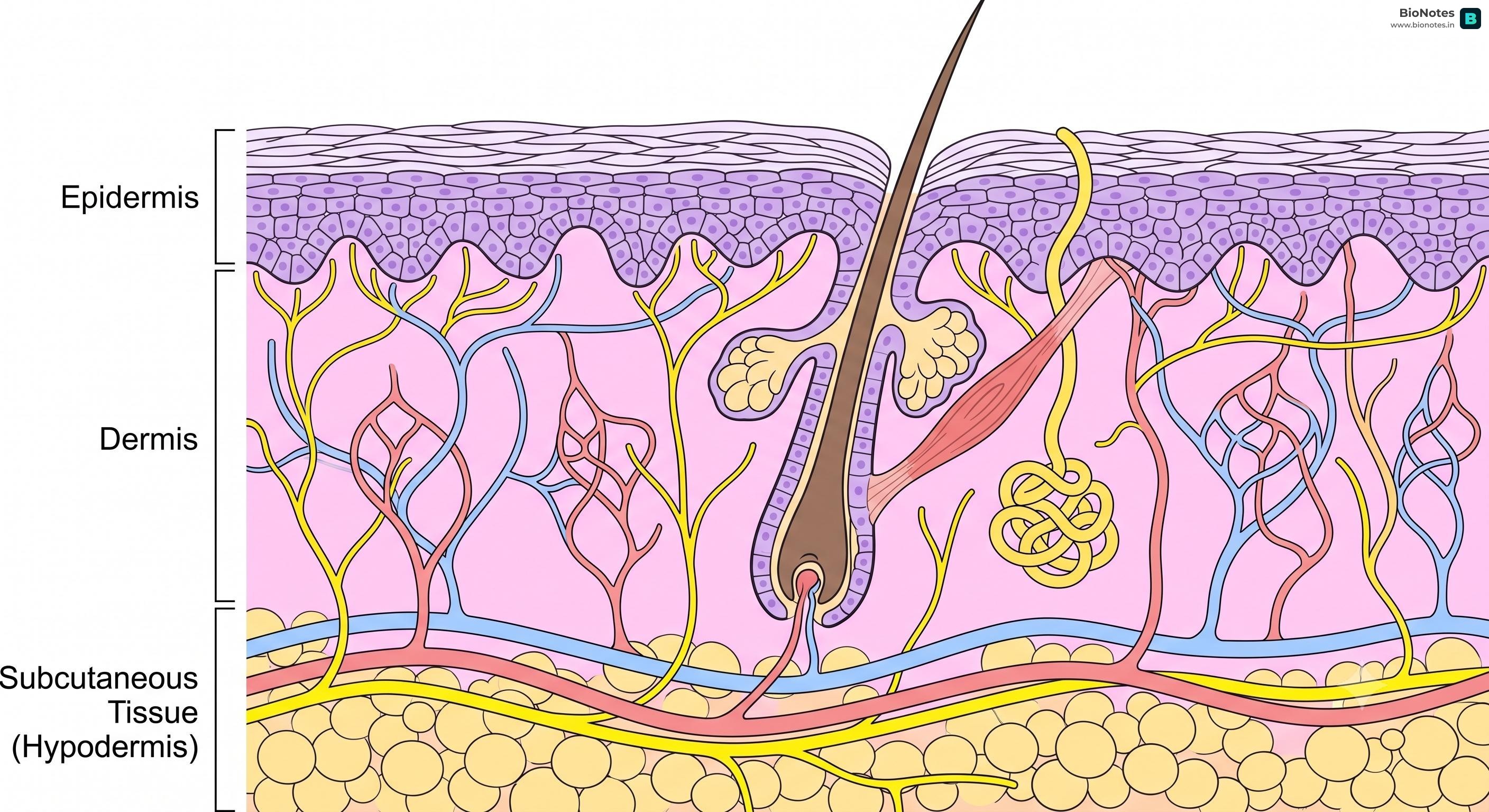
The skin is the largest organ of the human body, covering the entire external surface. It serves as the primary barrier between the internal body environment and the external world. An average adult has approximately 2 square meters of skin surface area, weighing about 4-5 kg (16% of total body weight).
Temperature gradient: Allows heat transfer from core to environment
Vasodilation vs. Vasoconstriction
Vasodilation increases blood flow to the skin to lose heat, while vasoconstriction reduces blood flow to conserve core body temperature during cold exposure.
Q1. Describe the structure and functions of epidermis.A1.Structure: Outermost skin layer with five sublayers - stratum corneum (dead keratinized cells), stratum lucidum (in thick skin), stratum granulosum (keratin production), stratum spinosum (strength), stratum basale (cell division)
Functions:
Primary barrier against physical, chemical, and microbial damage
Prevents water loss through keratinized surface
UV protection through melanin production in basal layer
Q2. Explain the mechanism of temperature regulation through vasodilation.A2.Mechanism: When body temperature rises, hypothalamus detects change and reduces sympathetic vasoconstrictor tone, causing arterioles in skin to dilate
Process: Arteriovenous anastomoses open, blood flow to skin increases up to 8L/min, skin temperature rises
Result: Enhanced heat loss through conduction, convection, and radiation; skin appears flushed and warm
Q3. Describe the structure and functions of sebaceous glands.A3.Structure: Alveolar glands with multiple secretory sacs connected to hair follicles, absent on palms and soles, concentrated on face and scalp
Functions:
Produce sebum for skin and hair lubrication
Provide antimicrobial protection through fatty acids
Q4. Explain the types and functions of sweat glands.A4.Eccrine glands: Simple coiled tubular glands throughout body producing watery sweat (99% water, 1% salts) for temperature regulation and waste excretion
Apocrine glands: Larger glands in axillae and groin producing thick, protein-rich secretion for scent production, active after puberty
Functions: Temperature control, waste elimination, pheromone production
Q5. Describe the structure and growth of hair.A5.Structure: Hair shaft (medulla, cortex, cuticle) above surface; hair root with follicle, bulb, and dermal papilla below surface
Growth cycle: Anagen phase (active growth 2-7 years), catagen phase (transition 2-3 weeks), telogen phase (resting 2-4 months)
Functions: Protection from UV and trauma, thermal insulation, sensory detection, social/sexual characteristics
Q6. Explain the role of dermis in skin function.A6.Structure: Middle layer with papillary dermis (loose connective tissue) and reticular dermis (dense connective tissue with collagen/elastin)
Functions:
Provides structural support and elasticity through collagen and elastin fibers
Houses blood vessels for nutrient supply and temperature regulation
Contains sensory receptors for touch, pressure, temperature, and pain
Q7. Describe the mechanism of heat conservation through vasoconstriction.A7.Mechanism: When body temperature drops, hypothalamus increases sympathetic norepinephrine release, causing arteriole smooth muscle contraction
Process: Arteriovenous anastomoses close, blood flow reduces to 1% of maximum, blood diverted to vital organs
Result: Heat conservation, skin appears pale and cold, may trigger shivering thermogenesis
Q8. Explain the structure and functions of nails.A8.Structure: Nail plate (hard keratin), nail matrix (growth site), nail bed (supporting tissue), cuticle (protective fold), lunula (visible matrix)
Functions:
Protect fingertips from mechanical trauma
Enhance manipulation of small objects and tactile sensitivity
Provide scratching capability for defense and grooming
Q9. Describe the development and function of mammary glands.A9.Development: Rudimentary in childhood, develop at puberty under estrogen/progesterone influence, further develop during pregnancy for lactation
Function: Produce milk under prolactin control, eject milk through oxytocin action, provide complete infant nutrition and immune protection
Structure: 15-20 lobules with ductal system converging at nipple
Q10. Explain how skin maintains body temperature homeostasis.A10.Heat loss mechanisms: Vasodilation increases blood flow to skin, eccrine sweating provides evaporative cooling, behavioral responses like removing clothing
Heat conservation: Vasoconstriction reduces skin blood flow, arrector pili contraction creates insulating air layer, behavioral responses like adding clothing
Integration: Hypothalamus coordinates responses based on core and skin temperature sensors
Q11. Describe the protective functions of different skin layers.A11.Epidermis: Keratinized stratum corneum blocks pathogens and chemicals, melanin protects from UV radiation
Dermis: Collagen fibers provide mechanical strength, immune cells (macrophages) fight infections
Hypodermis: Fat layer cushions against mechanical trauma, provides thermal insulation
Q12. Explain the composition and functions of sebum.A12.Composition: Triglycerides (57%), wax esters (26%), fatty acids (12%), cholesterol compounds (5%)
Functions:
Lubricates and waterproofs skin and hair
Antimicrobial protection through fatty acids that inhibit bacterial growth
Minor UV protection and pheromone transport
Q13. Describe the sensory functions of skin.A13.Receptors: Free nerve endings (pain, temperature), Meissner's corpuscles (light touch), Pacinian corpuscles (deep pressure), Ruffini endings (stretch)
Distribution: High density in fingertips, lips, and face; lower density on back and limbs
Function: Provides information about external environment, enables fine motor control, protects from injury through pain sensation
Q14. Explain the role of blood vessels in skin function.A14.Structure: Extensive network from deep arteries to superficial capillary loops in dermal papillae
Functions:
Nutrient delivery and waste removal for skin cells
Temperature regulation through vasodilation/vasoconstriction
Immune surveillance through circulating white blood cells
Q15. Describe the factors affecting skin aging and maintenance.A15.Aging factors: UV exposure breaks down collagen/elastin, reduced sebum production, decreased cell turnover, hormonal changes
Effects: Wrinkles, reduced elasticity, dryness, age spots, slower wound healing
Maintenance: Sun protection, moisturization, proper nutrition, adequate hydration support healthy skin function support healthy skin function
 BioNotes