Class 9
Created by Titas Mallick
Biology Teacher • M.Sc. Botany • B.Ed. • CTET (CBSE) • CISCE Examiner
 BioNotes
Created by Titas Mallick
Biology Teacher • M.Sc. Botany • B.Ed. • CTET (CBSE) • CISCE Examiner
Online
Common Misconceptions
Watch Out! Fertilization in plants is a hidden process. Watch out:
Fertilisation in flowering plants is the culmination of the reproductive process that begins with pollination. It is the fusion of the male gamete (from the pollen grain) with the female gamete (the egg cell, inside the ovule) to form a zygote. This zygote will then develop into an embryo, which is contained within the seed. In angiosperms (flowering plants), this process is unique and involves two fusion events, collectively known as double fertilization.
The period between the landing of a pollen grain on the stigma and the actual fusion of gametes is a dynamic and crucial phase. Here are the sequential events that lead to the formation of the zygote:
Germination of the Pollen Grain:
Growth of the Pollen Tube through the Style:
Chemotropism Chemotropism is a growth movement in response to a chemical stimulus. In plants, the growth of the pollen tube towards the ovule (due to sugars and calcium) is a classic example of positive chemotropism.
Entry of the Pollen Tube into the Ovule and Embryo Sac:
Release of Male Gametes and Formation of the Zygote:
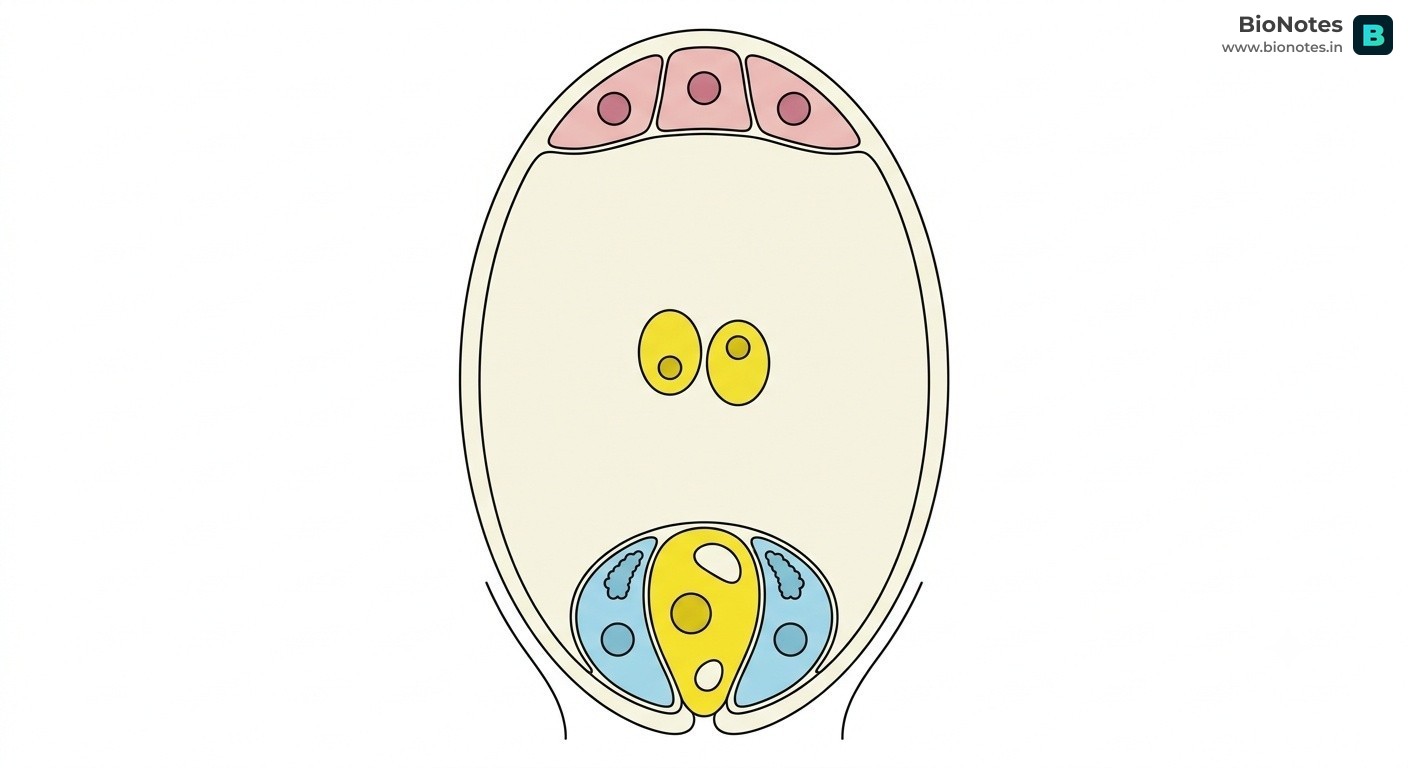 www.bionotes.in
Flowering plants exhibit a unique process where two fusion events occur within the embryo sac. This is called double fertilization.
Triple Fusion: The second male gamete (the one that did not fuse with the egg) migrates towards the two polar nuclei located in the center of the embryo sac. It fuses with them to form a triploid (3n) nucleus called the Primary Endosperm Nucleus (PEN). This fusion, involving three nuclei (one male gamete and two polar nuclei), is known as triple fusion.
Double Fertilization: This is the term for the two fertilization events that occur simultaneously in the embryo sac:
Significance of Double Fertilization:
| Event | Fusion Of | Product | Ploidy | Fate of Product |
|---|---|---|---|---|
| Syngamy | Male Gamete + Egg Cell | Zygote | Diploid (2n) | Develops into the Embryo |
| Triple Fusion | Male Gamete + 2 Polar Nuclei | Primary Endosperm Nucleus (PEN) | Triploid (3n) | Develops into the Endosperm |
After fertilization, the flower undergoes a series of changes. The petals, sepals, stamens, style, and stigma usually wither and fall off, while the ovary and ovules develop into the fruit and seeds, respectively.
NGSS-MS-LS1-4AQA-GCSE-4.4.1KS3-Biology